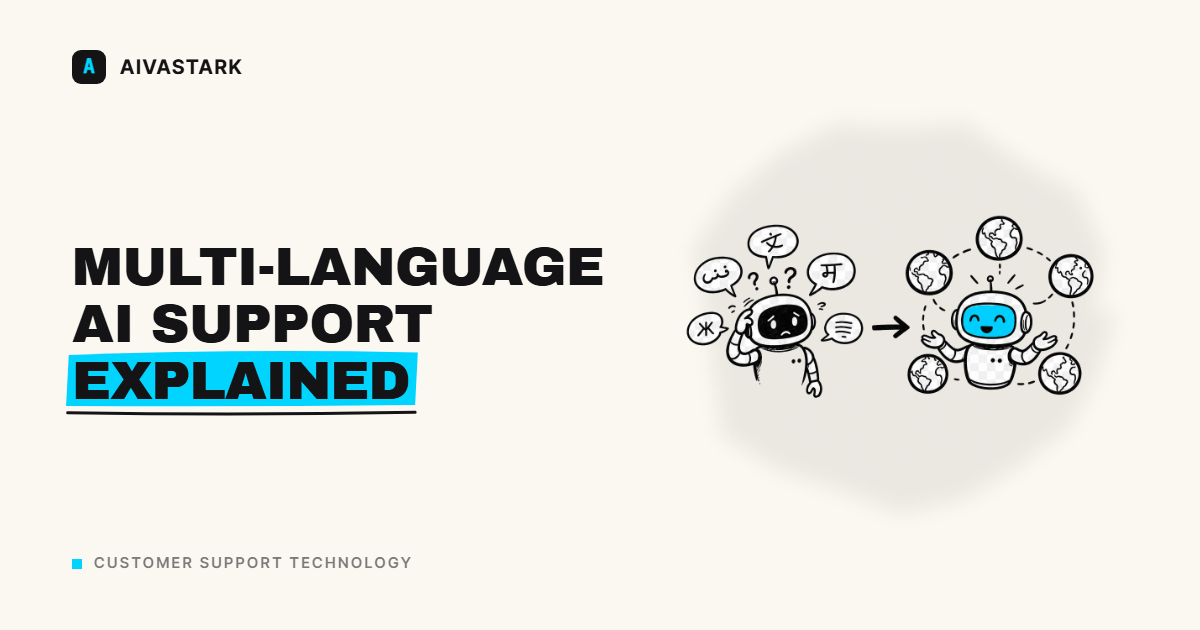
Multi-language AI support is the ability of an automated support system to understand, reason in, and respond to customers in their native language—without routing every message through a bolt-on translation layer. For global businesses, it is the difference between "we technically translate your ticket" and "we actually understand what you asked, in the language you asked it, and answer with the right context." As customer bases spread across regions, multi-language AI support has shifted from a nice-to-have to a baseline expectation.
This guide explains what multi-language AI support really is, how it works beneath the surface, the benefits and pitfalls you should plan for, and how to evaluate a platform before you deploy it across markets.
What Is Multi-language AI Support?
Multi-language AI support is a customer-service capability where an AI agent detects the customer's language automatically and handles the entire conversation—understanding intent, retrieving knowledge, and generating replies—in that language. It differs sharply from a basic translation plugin, which typically takes English content and pushes it through a machine-translation API on the way out.
A translation plugin treats language as a wrapper around a fixed English brain. Multi-language AI support treats each language as a first-class citizen: the model reasons about meaning directly rather than round-tripping through English, so nuance, negation, and context survive.
Automatic language detection from the first message
Good systems identify language from the customer's very first message—often within the first sentence—so there is no dropdown to pick or button to press. Detection works across scripts (Latin, Cyrillic, Arabic, CJK) and can distinguish closely related languages like Portuguese vs. Spanish or Simplified vs. Traditional Chinese. If a customer switches languages mid-conversation, a capable agent follows the switch instead of getting stuck.
Translation vs. localization vs. native-language understanding
These three terms are often blurred, but they are not the same:
- Translation converts text from one language to another, word-for-meaning. It can be literal and brittle.
- Localization adapts content to a locale—dates, currencies, units, formality, and cultural norms—not just the words.
- Native-language understanding means the AI comprehends intent directly in the source language, so it can answer accurately even when phrasing is idiomatic or ambiguous.
"The trap most teams fall into is assuming translation quality equals support quality. A perfectly translated answer to the wrong question is still a failed interaction. Understanding has to come first, translation second."
Native-language understanding is what separates modern multi-language AI support from the translation-plugin era. If you want a deeper primer on the underlying difference between a scripted bot and a reasoning agent, see AI Agent vs AI Chatbot: What's the Difference?.
How Multi-language AI Support Works Under the Hood
Understanding the mechanics helps you set realistic expectations and configure the system well.
Language detection and intent recognition across scripts and dialects
The pipeline usually starts with language identification, then intent recognition. Modern agents recognize intent across scripts and regional dialects—for example, understanding that "boleto não chegou" (Brazilian Portuguese) and a European Portuguese equivalent both mean "my payment slip didn't arrive." Dialect handling matters most in languages with strong regional variation, such as Arabic, Spanish, and German.
Large language models vs. dedicated machine translation pipelines
There are two broad architectures:
- Dedicated machine-translation pipelines: detect language → translate input to English → run an English model → translate output back. This is simpler but accumulates errors at each hop and often loses tone.
- Multilingual large language models: the model was trained on many languages and reasons directly in the customer's language, retrieving knowledge and generating answers natively.
The second approach generally preserves meaning and tone better because there is no lossy round-trip. Many production systems blend both—using an LLM for understanding and generation, and a translation step only for source content that exists in a single language. For a broader look at where general-purpose models fit versus purpose-built support agents, read ChatGPT vs AI Support Agents: What to Use.
Maintaining tone, context, and terminology consistency
A single answer must stay on-brand across languages. That means:
- Tone: formal vs. casual registers differ by language (e.g., the tu/vous distinction in French, du/Sie in German). The agent should apply the right register.
- Context: conversation history must persist across turns even when the customer mixes languages.
- Terminology: product names, feature labels, and legal terms should be consistent, enforced by a shared glossary rather than re-invented each time.
Fallback and human handoff when confidence is low
No system understands every dialect or edge case perfectly. A robust deployment measures confidence and, when it drops below a set threshold, either asks a clarifying question or escalates to a human. Ideally the handoff includes a translated transcript so a monolingual agent can still help. For teams weighing where automation ends and people begin, AI Chatbots vs Human Support: Which Is Better? is a useful companion read.
Key Benefits of Multi-language AI Support for Global Businesses
The business case is straightforward: reach more customers, in more languages, without linearly scaling headcount.
24/7 coverage in dozens of languages
A single AI agent can support conversations in dozens of languages at once, around the clock, without recruiting native-speaker agents for every market. Considering that roughly three-quarters of consumers prefer to buy products with information in their own language, language coverage directly affects conversion and retention—not just support metrics.
Faster resolution and higher CSAT
Customers resolve issues faster when they can describe problems in their own words and read answers in their own language. That tends to raise CSAT and reduce repeat contacts, because clarity improves on both sides of the conversation.
Lower costs and scalable market expansion
Instead of standing up a support team for each new locale before you have volume, you can launch in a language on day one and add human specialists only where complexity or volume justifies it. This lowers the cost of entering new markets and de-risks expansion. For a structured way to think about in-house teams versus vendor platforms, see Build vs Buy AI Customer Support Agents: A Guide.
Consistent brand voice across languages and channels
Because tone and terminology are governed centrally, your brand sounds like itself whether the customer writes on your website, WhatsApp, or email. Consistency across languages and channels is where multi-language support overlaps with omnichannel customer support—the same understanding should follow the customer wherever they reach out.
Common Challenges and How to Solve Them
Multi-language support introduces real linguistic and technical hurdles. Plan for them explicitly.
Idioms, slang, and regional dialects
Literal handling of idioms produces confusing or comical answers. Mitigate this by:
- Choosing an architecture that understands meaning natively rather than translating word-for-word.
- Feeding real customer transcripts from each region into testing so the agent sees actual slang.
- Adding clarifying questions when confidence is low instead of guessing.
Preserving industry and brand terminology
Regulated and technical industries cannot tolerate loose wording. A dental practice, a law firm, and a SaaS company each have terms that must be exact. A shared, per-language glossary locks in approved translations for product names, legal phrases, and clinical terms. Industry-specific deployments—like those outlined for dental practices, legal firms, and SaaS companies—benefit most from strict terminology control.
Right-to-left languages and non-Latin scripts
Arabic, Hebrew, and Persian read right-to-left, which affects both text rendering and UI layout. Non-Latin scripts (CJK, Cyrillic, Devanagari) require correct font support and character handling. Verify that your chat widget renders RTL text and mixed-direction strings (e.g., an Arabic sentence containing a Latin product name) correctly.
Avoiding literal mistranslations in sensitive contexts
In legal, medical, financial, or safety contexts, a small mistranslation can create liability. Best practice is to:
- Use glossaries and human review for high-stakes response templates.
- Set lower confidence thresholds (i.e., escalate sooner) for sensitive intents.
- Keep an auditable log of what the AI said, per language, for compliance review.
Best Practices for Deploying Multi-language AI Support
A strong deployment is less about the model and more about the surrounding process.
Build a multilingual knowledge base and shared glossary
Your AI is only as good as the content it draws on. Maintain a knowledge base that either exists in each priority language or is high-quality source content the model can reason over. Pair it with a shared glossary of approved terms per language. If you are just getting started, how to add an AI chatbot to your website walks through connecting content sources.
Set confidence thresholds and escalation rules
Decide, per language and per intent type, when the AI should:
- Answer directly.
- Ask a clarifying question.
- Hand off to a human with a translated transcript.
Sensitive or low-volume languages usually warrant more conservative thresholds until you have data proving quality.
Test with native speakers and monitor per-language metrics
Automated scores are not enough. Have native speakers review sample conversations for tone, accuracy, and cultural fit. Then monitor language-specific metrics—resolution rate, CSAT, escalation rate, and containment—so you can spot a language that underperforms and fix it. A language that resolves 85% of issues in English but only 55% in Turkish is a signal, not noise.
Localize beyond words
Adapt dates (DD/MM vs. MM/DD), currencies, number formats, measurement units, and cultural conventions like formality and greeting style. A message that is linguistically perfect but shows the wrong currency symbol still erodes trust.
Choosing the Right Multi-language AI Support Platform
When you evaluate vendors, look past the marketing list of "100+ languages" and test the dimensions that actually affect customers.
Supported languages, detection accuracy, and translation quality
Confirm which languages are genuinely supported for understanding and generation, not just UI translation. Ask about detection accuracy across scripts and how the system handles dialects and mid-conversation language switches. Run your own transcripts through a trial. Comparison guides like Best AI Customer Support Software in 2026 can help you shortlist.
White-label, integration, and channel coverage
Agencies and SaaS vendors reselling support often need the tool to carry their own brand. If that's you, understand what a white-label AI chatbot offers and confirm the platform supports your channels—web, WhatsApp, email, social—so language handling is consistent everywhere. Aivastark's features and WordPress plugin are examples of how deployment and branding options can be evaluated.
Data privacy, compliance, and regional data handling
Different regions impose different data rules. Confirm where conversation data is processed and stored, whether the vendor supports regional data residency, and how they handle deletion and retention. This matters most for regulated verticals and any market covered by strict privacy regulation.
Analytics for per-language performance
You cannot improve what you cannot see. Choose a platform that reports metrics broken out by language so you can identify weak spots and prioritize glossary updates, knowledge-base translations, or threshold changes. Continuous, data-driven improvement is what keeps multi-language quality from drifting over time.
Final Thoughts
Multi-language AI support has moved well beyond bolt-on translation. The best systems detect language instantly, understand intent natively, preserve your brand's tone and terminology, and know when to hand off to a human. For global businesses, that means faster resolutions, higher satisfaction in customers' preferred languages, and scalable expansion into new markets without linear hiring.
The winning approach combines the right architecture with disciplined process: a multilingual knowledge base, a shared glossary, sensible confidence thresholds, native-speaker testing, and per-language analytics. Get those fundamentals in place, and language stops being a barrier to global support—it becomes a competitive advantage.
To see how a white-label agent can anchor a multi-language, multi-channel support strategy, explore Aivastark and its pricing, or start with the FAQ for common deployment questions.