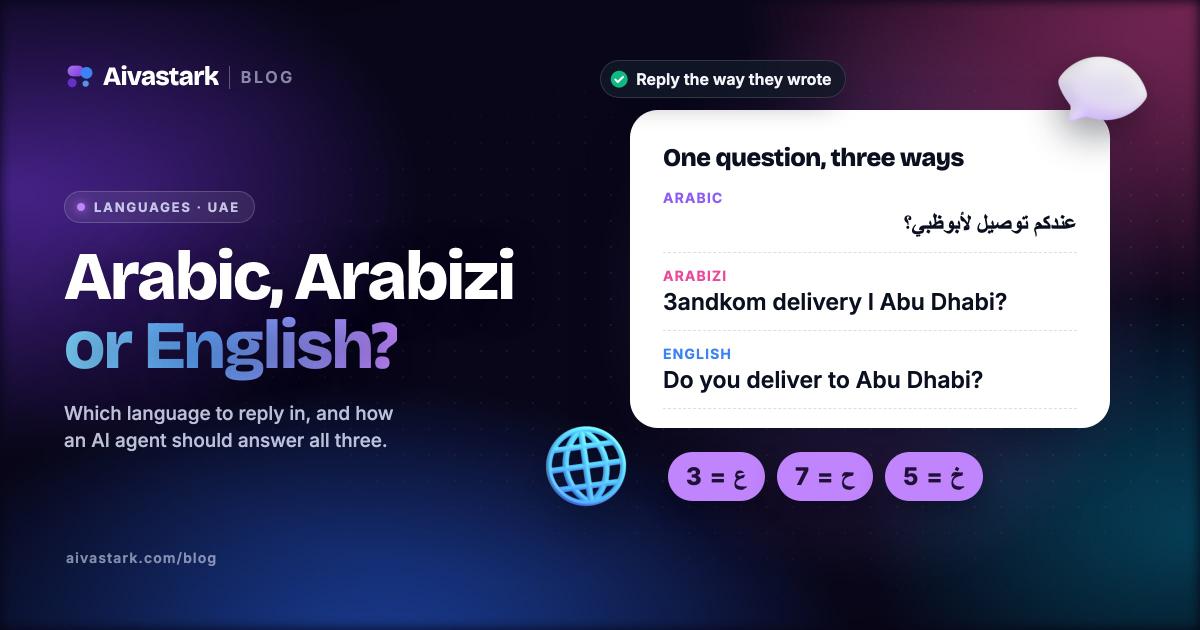
Arabizi is Arabic typed in Latin letters, with numbers for the sounds English has no letter for: "3andkom" for عندكم ("do you have"), "7elw" for حلو ("nice"). In the UAE, customers write to businesses in Arabizi, in Arabic script and in English, and often mix them in one message: "hi, 3andkom delivery l Abu Dhabi?"
For a business, that raises four practical questions: which language to reply in, whether replies should match a dialect, how a chatbot finds the answer when your website is in English, and what happens when the customer wants a person. This guide answers each, with what Aivastark actually does and where its limits are. Behaviour was checked against the product on 29 October 2026.
What is Arabizi?
Arabizi, also called Franco-Arabic or the Arabic chat alphabet, grew out of phones and keyboards that had no Arabic letters. Writers use Latin letters for the sounds English shares with Arabic, and numerals that look like the Arabic letters for the rest:
| Numeral | Arabic letter | Example |
|---|---|---|
| 2 | ء (hamza) | so2al (سؤال, question) |
| 3 | ع (ʿayn) | 3andkom (عندكم, do you have) |
| 5 | خ (khāʾ) | 5alas (خلاص, done) |
| 6 | ط (ṭāʾ) | 6alab (طلب, order) |
| 7 | ح (ḥāʾ) | 7elw (حلو, nice) |
| 9 | ص (ṣād) | 9a7 (صح, right) |
Usage varies by region and by person (Wikipedia lists the regional variants), and spelling isn't standard: the same word can arrive as "3andkom", "3ndkm" or "andkom".
Which language should the reply be in?
Reply in the script the customer used. Someone who typed Arabizi on an English keyboard often reads it faster than Arabic script, and someone who wrote in Arabic script expects Arabic back.
| The customer writes | Aivastark replies |
|---|---|
| Arabic script | Arabic |
| Arabizi | The same romanized style |
| English | English |
This is how Aivastark's reply-language rule works, and it is prompt-driven rather than a hard switch, so test it with a few of your own customers' real messages before you rely on it. You can also limit the agent to the languages you support: reply languages take up to eight, the first one is the default, and "Arabic and English only" is a valid setup on every plan.
Will the replies match the Emirati dialect?
No, and you shouldn't promise customers they will. Aivastark's Arabic replies lean toward Modern Standard Arabic, the standard written form taught and read across the Arab world (Wikipedia), which every Arabic reader understands and which reads as polite and clear in a business chat. Nothing in the product makes a reply match Gulf, Emirati, Egyptian or Levantine dialect. If a dialect is part of your brand's voice, keep those chats with your team.
How does the chatbot find answers when your website is in English?
Most UAE businesses keep their website, policies and product catalogue in English. That is fine for Arabic-script questions: Aivastark translates the question into your knowledge base's language before it searches, finds the English passage, and answers in Arabic.
Arabizi works differently: it is searched as typed. Because Arabizi spelling varies so much, the safest fix is a few lines in your FAQs:
- Add your five most common questions in Arabizi as well as English, for example "kam el delivery l Dubai?" next to "How much is delivery to Dubai?".
- Write product and brand names in the Latin spelling your customers use.
- Keep the answers themselves in one language; the agent replies in the customer's style.
What about voice notes?
Many customers in the UAE send voice notes instead of typing. On WhatsApp, Instagram, Messenger and Telegram (from the Starter plan), Aivastark transcribes Arabic voice notes and answers them in text. It doesn't send voice replies. If most of your customers speak Arabic, pin voice messages to Arabic in the agent's settings, so notes are transcribed as Arabic.
What happens when the customer asks for a person in Arabic?
With human handoff switched on (from the Solo plan), Arabic requests for a person hand the chat to your inbox with the whole thread:
- "أريد التحدث مع موظف" (I want to speak to an employee)
- "حولني لموظف" (transfer me to an employee)
- "شخص حقيقي" (a real person)
Words such as "محامي" (lawyer), "احتيال" (fraud) and "شكوى رسمية" (formal complaint) escalate the chat. The agent also hands over when a customer sounds upset or still isn't helped after repeated tries.
On your team's side, an incoming Arabic message in the Aivastark inbox has a one-tap Read in English, which changes only what the teammate sees, never the stored message. A teammate can also write a reply in English and have the draft translated into Arabic before sending. In the website chat, each paragraph of a message takes its direction from its own text, so an Arabic reply lines up right to left and English stays left to right.
A setup checklist
- Set the reply languages, Arabic and English, with your customers' usual language first.
- Keep your knowledge base in English if that's what you have; add Arabizi versions of your top questions.
- Pin voice messages to Arabic if most of your customers speak it.
- Switch on human handoff, and decide who answers Arabic chats on your team.
- Test with three real messages, one in Arabic script, one in Arabizi and one mixed, and read the replies with a native speaker.
Where to go next
For the full product picture in Arabic and English, see Arabic AI chatbot support and the UAE hub, or read it in Arabic on /ar/uae. For the channels most UAE customers use, see the WhatsApp AI agent for UAE businesses and the AI chatbot for UAE websites.
More questions
Should a chatbot reply in Arabic if the customer writes in Arabizi?
Mirror the customer. Someone who types Arabizi on a phone keyboard often reads it more easily than Arabic script, so reply in the same romanized style. Aivastark answers Arabic script in Arabic, Arabizi in Arabizi and English in English; it is prompt-driven, so test it with your own customers' messages.
Can an AI chatbot reply in the Emirati dialect?
Don't count on it. Aivastark's Arabic replies lean toward Modern Standard Arabic, which every Arabic reader understands, and no setting makes them match a dialect. If dialect matters for your brand, have your team handle those chats.
Do I need to translate my website into Arabic for an Arabic chatbot?
No. Aivastark translates an Arabic-script question into your knowledge base's language before it searches, so an English-only site can answer it, and the reply comes back in Arabic. Arabizi is searched as typed, so add Arabizi phrasing for your most common questions.
Can the chatbot understand Arabic voice notes?
Yes, on WhatsApp, Instagram, Messenger and Telegram from the Starter plan. Arabic voice notes are transcribed and answered in text; there are no voice replies. Voice messages can be pinned to Arabic in the agent's settings.
Sources