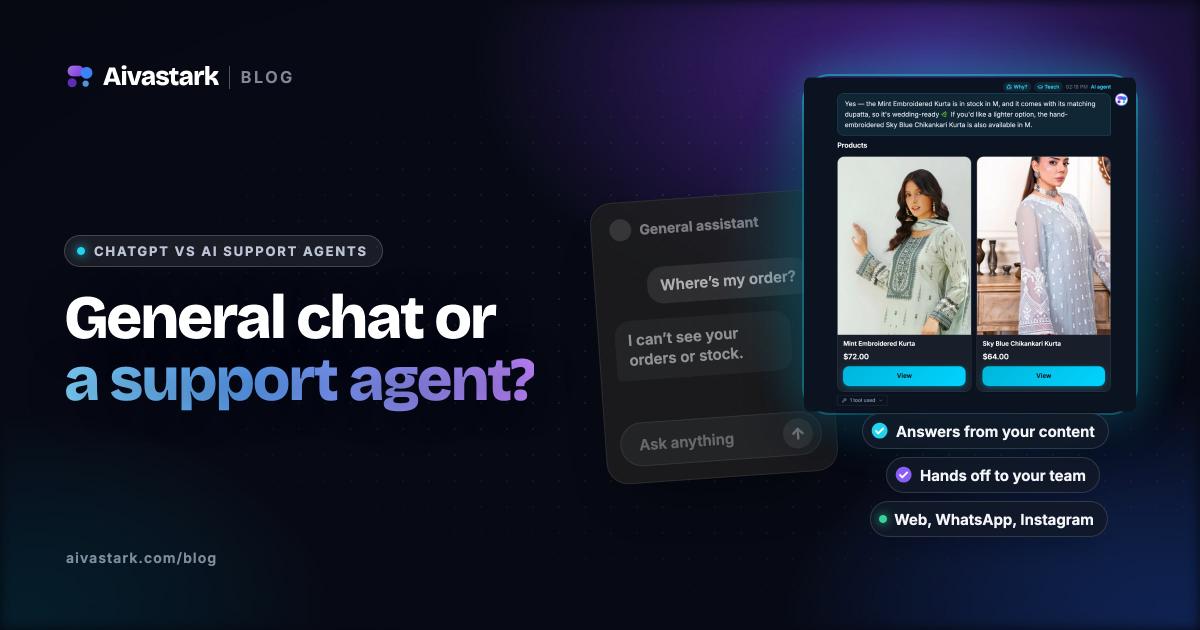
The ChatGPT vs AI support agents question is one of the most common we hear from businesses trying to modernize their customer service without overspending or over-engineering. On the surface, both use large language models to generate human-like responses. But under the hood, they solve fundamentally different problems. ChatGPT is a general-purpose conversation interface. A purpose-built AI support agent is an operational system designed to resolve customer queries, escalate when needed, and integrate with the tools your team already uses. Confusing the two leads to broken workflows, hallucinated answers, and data privacy headaches.
This guide breaks down exactly what each tool does, where each falls short, and how to pick the right one based on your ticket volume, channels, and compliance needs.
ChatGPT vs AI Support Agents: The Core Difference
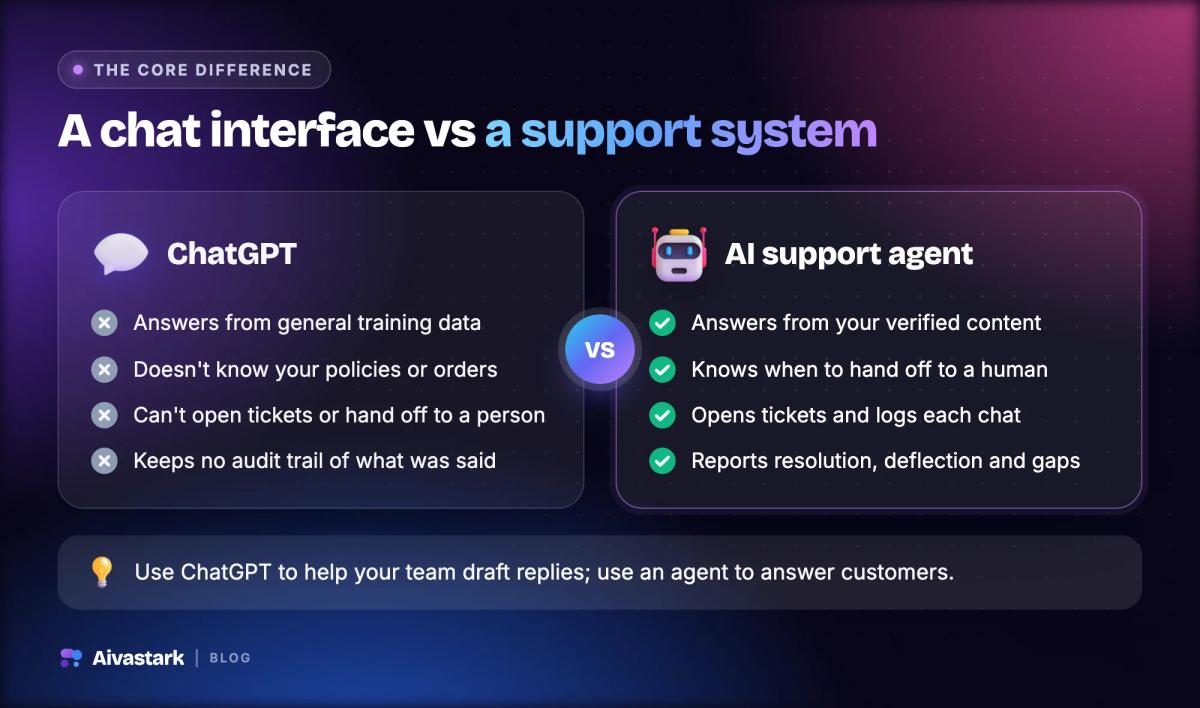
The single most important distinction is this: ChatGPT is a chat interface for a general-purpose LLM, while an AI support agent is a complete support system.
When you open ChatGPT, you're talking to a model trained on public data up to a cutoff date. It has no inherent knowledge of your refund policy, your live order statuses, or the customer sitting in front of it. It doesn't create tickets, route conversations to a human, or log an audit trail. It answers whatever you type, confidently, whether or not the answer is correct for your business.
An AI support agent, by contrast, is purpose-built to resolve customer queries using your own verified content. It's grounded in your help center, product docs, and policies. It knows when to hand off to a human, how to open a ticket, and where the conversation happened. As we explain in AI Agent vs AI Chatbot: What's the Difference?, an agent is defined less by the model and more by its ability to take action inside a defined workflow.
Why does this distinction matter?
- Accuracy: A raw model guesses. A grounded agent retrieves from approved sources.
- Security: Pasting customer data into a generic chat interface creates privacy exposure. A dedicated system enforces retention and access rules.
- Workflow ownership: Support isn't just answering questions—it's escalation, tracking, and reporting. ChatGPT owns none of that.
"The difference isn't the language model—it's the plumbing around it. Retrieval, escalation, logging, and integrations are what turn a chatbot into a support system you can actually run a business on."
What ChatGPT Does Well (and Where It Falls Short) for Support
ChatGPT is a genuinely useful tool, and dismissing it entirely would be a mistake. It just belongs in a different part of your workflow.
Where ChatGPT shines
For support teams, ChatGPT excels as an assistant to a human agent, not a replacement for one:
- Drafting replies: Paste a rough answer and ask it to make the tone warmer or more concise.
- Summarizing long threads: Condense a 20-message ticket into a two-line handoff note.
- Brainstorming macros and tone guidelines: Generate a library of canned responses or refine your brand voice.
These are drafting and ideation tasks where a human reviews every output before it reaches a customer.
Where ChatGPT falls short
The gaps become obvious the moment you try to use ChatGPT as a customer-facing support system:
- No native access to your data. Without a custom API build, ChatGPT can't read your live docs, order database, or CRM. It doesn't know if an order shipped or a subscription renewed.
- Hallucinated answers. Because it generates plausible text rather than retrieving verified facts, it can invent policies, prices, or steps that don't exist. In customer support, a confident wrong answer is worse than no answer.
- No audit trail. There's no record of what was said to which customer, which is a compliance non-starter in regulated industries.
- Data privacy concerns. Pasting customer names, emails, or account details into a general interface raises real questions about where that data goes.
- Missing operational features. No human handoff, no analytics, no channel integrations. You can't deploy ChatGPT as a WhatsApp responder or a website widget without building the entire infrastructure yourself.
What Purpose-Built AI Support Agents Deliver
A dedicated AI support agent is engineered specifically for the job ChatGPT wasn't built to do. The architecture is different from the ground up.
Grounded answers with retrieval (RAG)
Instead of relying on the model's training data, a support agent uses retrieval-augmented generation (RAG). It searches your help center, PDFs, and product data first, then generates an answer grounded in what it found. If the answer isn't in your knowledge base, it says so or escalates—rather than inventing something. This dramatically reduces hallucination and keeps answers consistent with your actual policies. For a deeper look at how this moves beyond simple scripted bots, see Agentic AI in Customer Support: Beyond Chatbots.
Built-in human handoff and ticketing
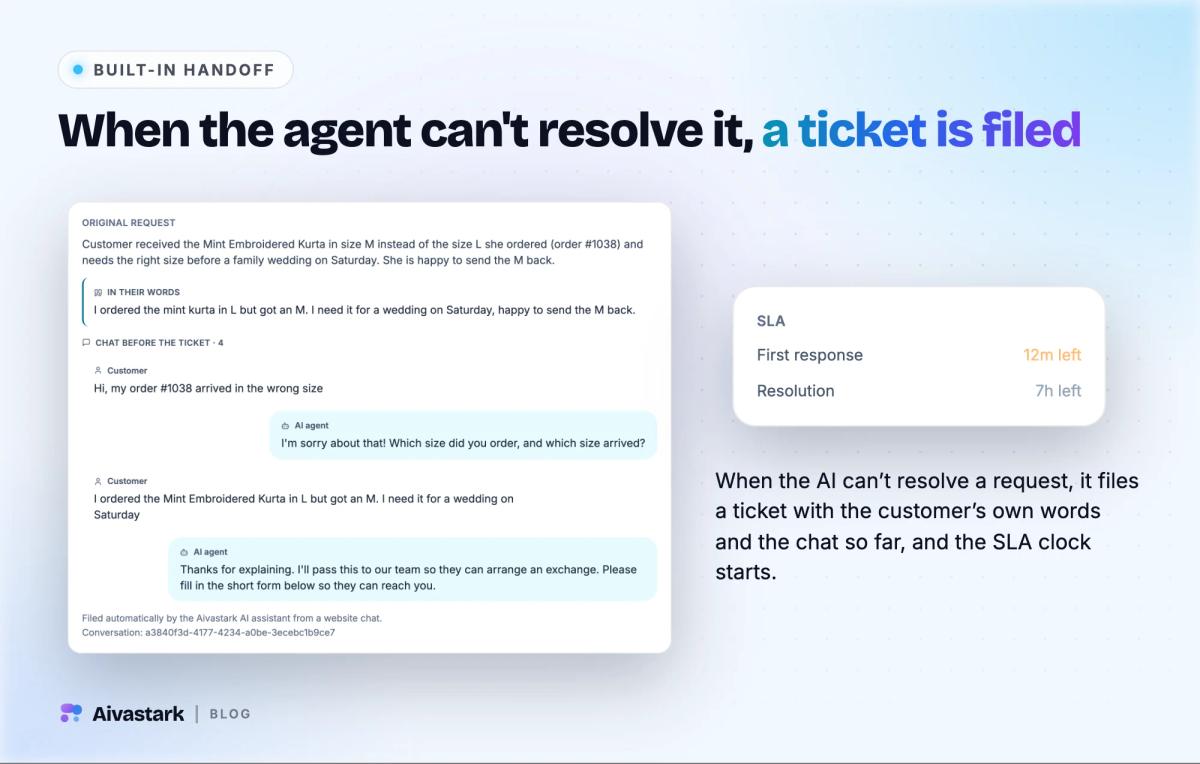
When a conversation exceeds the agent's confidence threshold or a customer asks for a person, a real agent routes the ticket to your team with full context. Escalation rules, ticket creation, and priority tagging are native features, not afterthoughts.
Multichannel deployment
Customers don't only ask questions on your website. A purpose-built agent deploys across a website widget, WhatsApp, email, and social media from a single knowledge base. Our AI-Powered Social Media Responses: Complete Guide covers how consistent, channel-aware automation works in practice.
Analytics that prove value
You can't improve what you can't measure. Support agents report on:
- Resolution rate — how many queries were fully answered without a human.
- Deflection rate — the share of tickets handled automatically.
- Unanswered questions — gaps in your knowledge base to fix next.
Side-by-Side Comparison: Accuracy, Integrations, Cost, and Control
Here's how the two approaches stack up across the four dimensions that matter most to a support operation.
Accuracy and grounding
| Factor | ChatGPT | AI Support Agent |
|---|---|---|
| Source of answers | Model training data | Your verified content (RAG) |
| Hallucination risk | High for business-specific questions | Low—answers cite your docs |
| Handling of unknowns | Guesses confidently | Escalates or says "I don't know" |
A raw model answers from general knowledge. A retrieval-based agent answers from your knowledge, which is the only version a customer should ever see.
Integrations
With ChatGPT, connecting to your helpdesk or store means manual copy-paste or a custom-coded API integration you build and maintain yourself. Purpose-built agents ship with prebuilt connectors for CRMs, helpdesks, and e-commerce platforms. If you run on WordPress, for example, the WordPress plugin installs the widget without touching code.
Cost model
The pricing structures differ in a way that affects how you scale:
- ChatGPT typically charges per seat (per human user), which makes sense for a tool your staff uses to draft replies.
- AI support agents often use per-resolution or usage-based pricing, so you pay based on the customer queries actually handled. As volume grows, this can be far more economical than adding human seats. Compare approaches on our Pricing page.
For teams weighing whether to build this stack themselves, Build vs Buy AI Customer Support Agents: A Guide walks through the real total cost of ownership.
Data control and compliance
ChatGPT's consumer and standard business tiers give you limited control over retention and access when data is pasted into prompts. A dedicated support platform lets you configure data retention windows, access permissions, and regional storage—essential for industries with strict privacy requirements like legal firms and healthcare-adjacent dental practices.
How to Choose Based on Your Business Stage and Volume
The right answer to the ChatGPT vs AI support agents debate depends heavily on where your business is today.
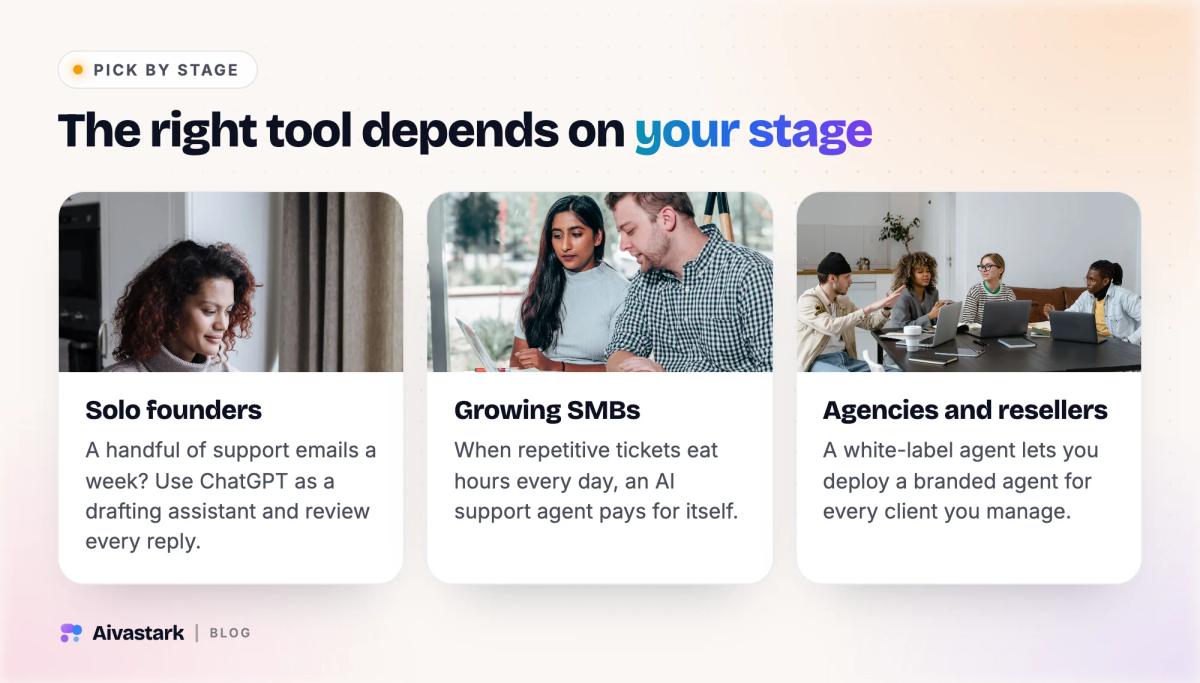
Solo founders and low volume
If you're handling a handful of support emails a week, you likely don't need a full agent. Use ChatGPT as a drafting assistant: it helps you write faster and stay on-brand while you review every message. The manual touch is manageable at this scale, and the overhead of setting up a full system isn't yet justified.
Growing SMBs
Once repetitive tickets start eating hours every day—password resets, shipping status, "how do I..." questions—an AI support agent pays for itself. A well-tuned agent can take most routine, repetitive tickets off your team's plate, freeing your team to focus on complex, high-value cases. Running 24/7 also means customers in every time zone get instant answers. This is the tipping point where automation moves from nice-to-have to necessary, a theme we cover in Why Every Business Needs an AI Agent in 2026.
Agencies and resellers
If you serve multiple clients, a white-label AI support agent lets you deploy branded agents for each brand you manage—no engineering team required. This is where the SaaS model shines: one platform, many client-facing deployments. Learn how the model works in What is a white-label AI chatbot?.
Decision checklist
Ask yourself:
- Ticket volume: Are repetitive questions consuming meaningful staff time? → Agent.
- Channels: Do you need coverage across web, WhatsApp, email, and social? → Agent.
- Integrations: Do you need live CRM, helpdesk, or store data in answers? → Agent.
- Privacy needs: Do you handle regulated or sensitive customer data? → Agent with configurable controls.
- Everything above is minimal and you just want faster drafting? → ChatGPT as an assistant.
Notably, the two aren't mutually exclusive. Many teams run an AI support agent for customer-facing automation and use ChatGPT internally for drafting and summaries.
Getting Started With an AI Support Agent
If your checklist points toward a purpose-built agent, a disciplined rollout makes the difference between quick ROI and a frustrating pilot. Here's a proven sequence.
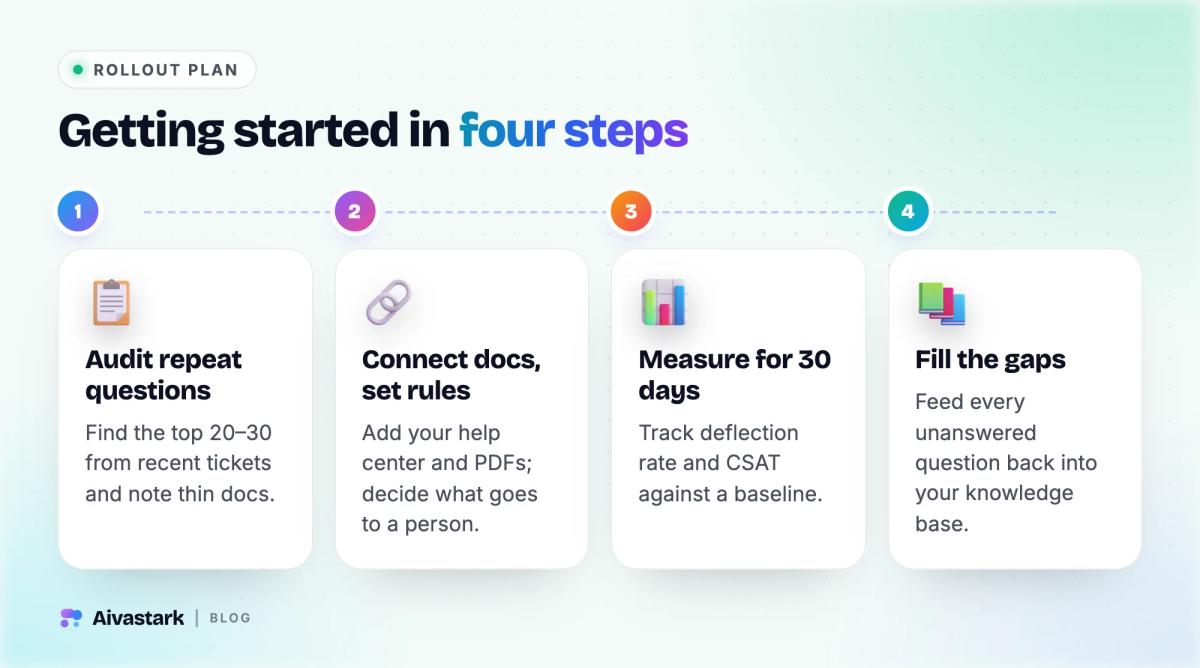
1. Audit your recurring questions
Pull your last few months of tickets and identify the top 20–30 questions that repeat. These are your highest-value automation targets. At the same time, note where your knowledge base is thin or outdated—gaps the agent can't answer around.
2. Connect your docs and set escalation thresholds
Point the agent at your help center, PDFs, and product data. Then configure escalation rules before going live: define the confidence level below which the agent hands off to a human, and specify which topics (billing disputes, cancellations, legal questions) should always route to a person. Setting these guardrails early prevents the agent from over-reaching. Our How to add an AI chatbot to your website guide covers the technical setup step by step.
3. Measure deflection and CSAT in the first 30 days
Establish a baseline and track two numbers closely:
- Deflection rate: the percentage of conversations resolved without a human.
- CSAT: are customers satisfied with the automated answers?
Thirty days is enough to see whether the agent is genuinely reducing workload without hurting satisfaction. This early data is how you prove ROI to stakeholders.
4. Iterate on unanswered questions
The most valuable report your agent produces is the list of questions it couldn't answer. Each one is a content gap. Feed those answers back into your knowledge base, and your automated coverage expands week over week. Support automation isn't a one-time install—it's a compounding system that gets smarter the more you maintain it.
The Bottom Line
The ChatGPT vs AI support agents decision comes down to purpose. ChatGPT is an excellent assistant for a human writing replies—fast, flexible, and great for drafting. But it lacks the grounding, integrations, escalation, and analytics that a real support operation requires. A purpose-built AI support agent is engineered to resolve customer queries accurately from your own content, hand off to humans when needed, deploy across every channel, and give you the compliance controls and reporting to run a serious support function.
For a solo founder with light volume, ChatGPT as an assistant is often enough. For any business scaling past a trickle of repetitive tickets, a dedicated agent delivers measurable deflection and 24/7 coverage that a general-purpose chat tool simply can't. If you're ready to see what a grounded, branded agent looks like for your business, explore Aivastark's features or browse solutions tailored to your industry.
Frequently asked questions
What is the core difference between ChatGPT and an AI support agent?
ChatGPT is a chat interface for a general-purpose LLM trained on public data, while an AI support agent is a complete support system grounded in your own verified content that can create tickets, escalate to humans, and log an audit trail.
Why does ChatGPT hallucinate answers in customer support?
Because ChatGPT generates plausible text rather than retrieving verified facts, it can invent policies, prices, or steps that don't exist. In customer support, a confident wrong answer is worse than no answer.
When should I use ChatGPT instead of an AI support agent?
Use ChatGPT as a drafting assistant if you handle low volume, don't need multichannel coverage or live integrations, and simply want faster, on-brand replies that a human reviews before sending.
How much of my support workload can an AI support agent automate?
A well-tuned agent can take most routine, repetitive tickets off your team's plate, freeing your team to focus on complex, high-value cases while running 24/7.
How do the pricing models differ?
ChatGPT typically charges per seat (per human user), while AI support agents often use per-resolution or usage-based pricing, so you pay based on the customer queries actually handled—often more economical as volume grows.
What metrics prove an AI support agent's value?
Track resolution rate (queries fully answered without a human), deflection rate (tickets handled automatically), and CSAT, plus unanswered questions that reveal gaps in your knowledge base.