The short answer
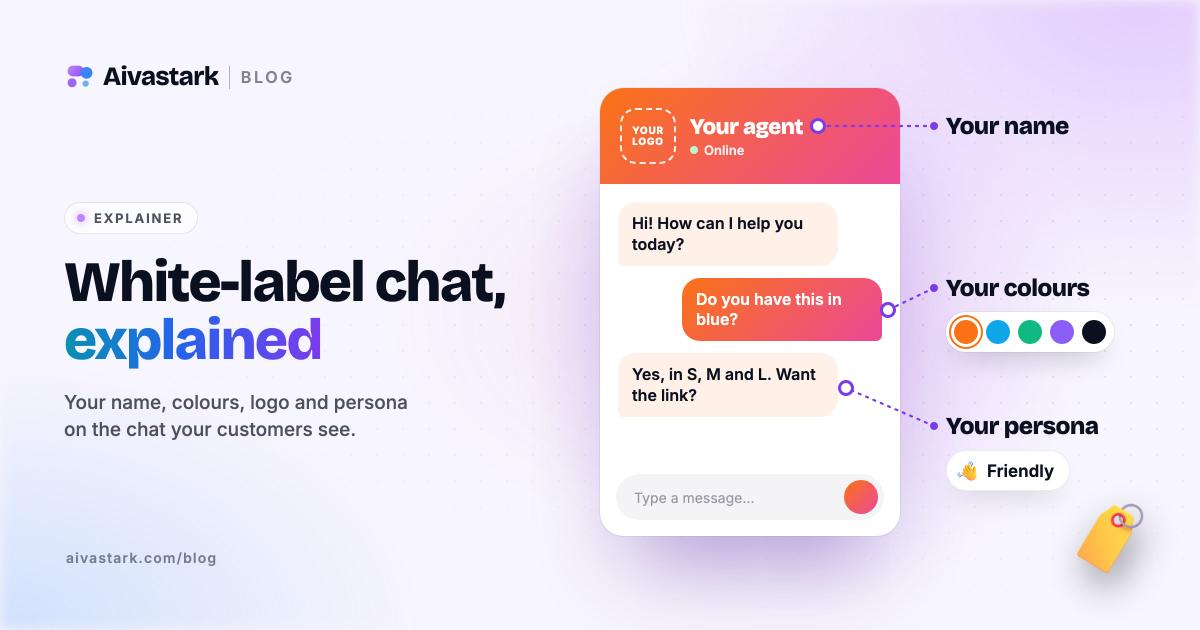
A white-label AI chatbot is a fully functional AI support widget that a business can brand as their own · with their logo, colors, persona name, and domain · and deploy to their customers without any sign of the underlying platform.
The word "white-label" comes from the practice of buying a generic product and slapping your own label on it. In the software world, it means you use a pre-built platform's engine while presenting it to the world as your own product.
A white-label AI chatbot works the same way: you upload your knowledge base, choose a persona name, apply your brand colors, and your customers see your AI support assistant · not a third-party tool.
How a white-label AI chatbot is different from a generic chatbot
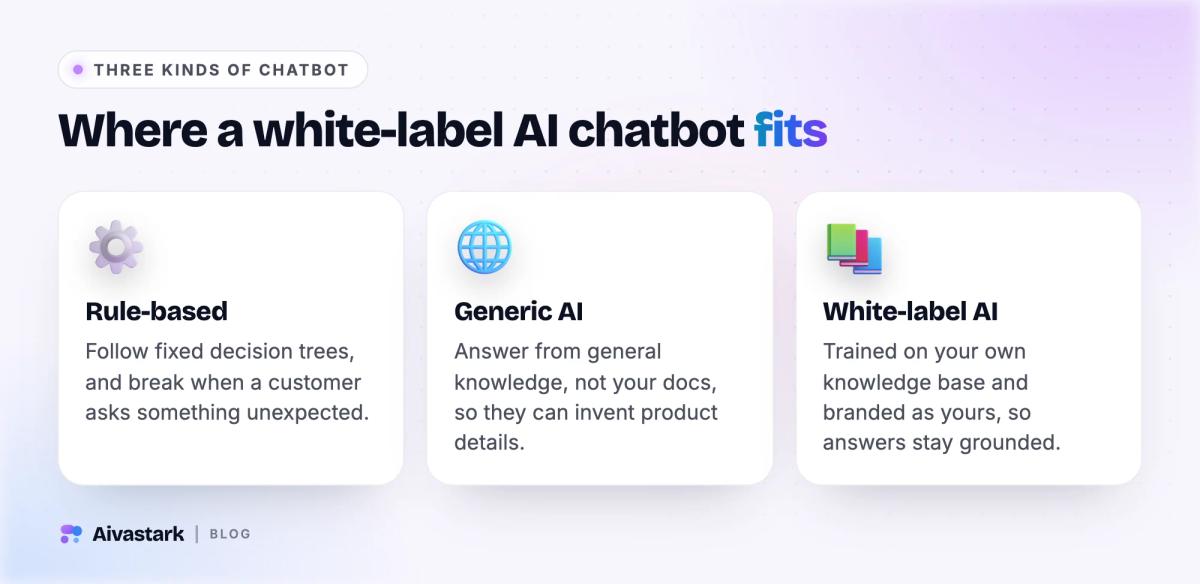
Most business chatbots fall into one of three categories:
- Rule-based chatbots · follow fixed decision trees. They break the moment a customer asks something unexpected.
- Generic AI chatbots (like embedding ChatGPT directly) · can answer almost anything, but they answer from general knowledge, not from your docs. They hallucinate product-specific details.
- White-label AI chatbots · trained exclusively on your own knowledge base (docs, PDFs, website pages, GitHub repos), so every answer is grounded in your content. Fully branded as yours.
The key differentiator is knowledge grounding. A white-label AI chatbot only answers from the information you give it. If the answer isn't in your docs, it doesn't hallucinate · it escalates to a human or opens a support ticket automatically.
What makes an AI chatbot truly "white-label"?
Not every "customizable" chatbot is genuinely white-label. Here's what real white-labeling means in practice:
- Brand name and persona · the chatbot has a name you choose (e.g., "Aria" or "Max"), not the vendor's branding.
- Colors and logo · the widget matches your design system exactly.
- Custom domain · the chat interface loads from your domain, not the vendor's.
- Branded email notifications · follow-up emails come from your address, in your voice.
- No "Powered by" badge · your customers have no idea which underlying platform runs the AI.
Anything short of this is partial branding · useful, but not true white-labeling.
Measured against that list, Aivastark gives you the first two on every plan, hides its "Powered by" badge on the Scale plan, and offers the rest only as custom white-label arrangements on Enterprise, on request; it does not serve the widget from your own domain.
Who uses white-label AI chatbots?
White-label AI chatbots are particularly popular in three types of businesses:
1. SaaS companies with a growing support load
As a SaaS product scales, support tickets scale with it. A white-label AI chatbot deflects 50–80% of repetitive questions · billing, setup steps, feature how-tos · so your support team focuses on edge cases and high-value customers.
2. Agencies building for clients
Digital agencies and development shops use white-label platforms to resell AI support under their own brand. They onboard a client, configure the knowledge base, set the brand, and hand over a fully branded AI support product · without building anything from scratch.
3. E-commerce and marketplace businesses
Online stores deal with a massive volume of "where is my order?" and "what's your return policy?" questions. A white-label AI chatbot trained on store policies and product documentation handles these 24/7 without human involvement.
4. Vertical-specific service businesses
Some industries layer the white-label foundation with domain-specific workflows · appointment booking, intake forms, order lookups. Common examples are dental practices (a 24/7 receptionist that answers patients and books into the practice calendar), law firms (an intake agent that qualifies inbound case leads and books consultations) and e-commerce stores (order tracking, returns and product questions on Shopify and WooCommerce).
How does a white-label AI chatbot work technically?
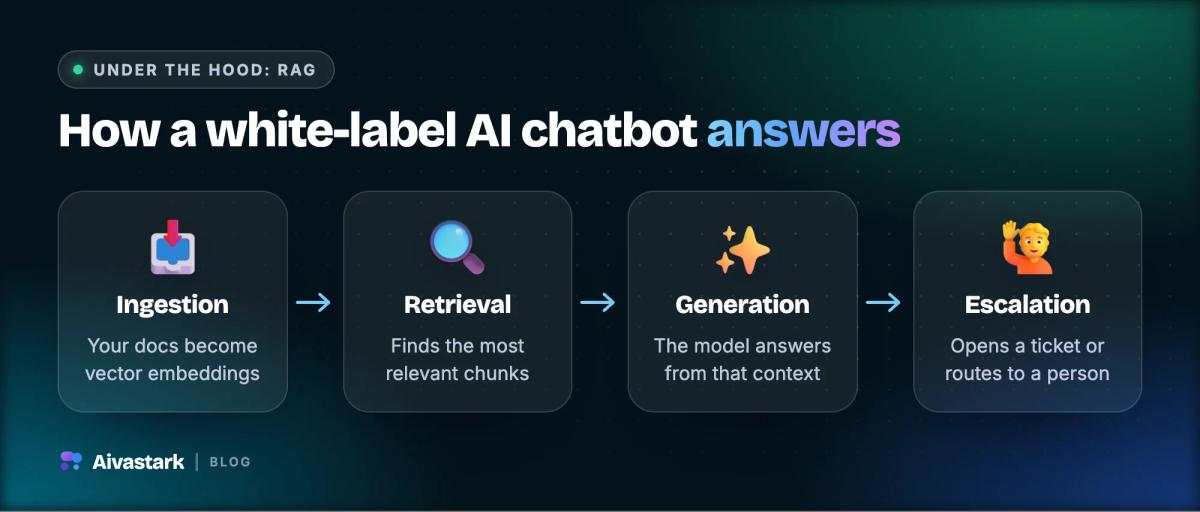
Under the hood, modern white-label AI chatbots use a technique called Retrieval-Augmented Generation (RAG):
- Ingestion · your documents (PDFs, URLs, Google Drive files, GitHub repos) are chunked and converted into vector embeddings, stored in a database.
- Retrieval · when a user asks a question, the chatbot searches for the most relevant chunks from your knowledge base using semantic similarity.
- Generation · a language model (like GPT-4) uses the retrieved context to generate a grounded, accurate answer · not a hallucinated one.
- Escalation · if confidence is low or the user is frustrated, the chatbot opens a ticket or routes to a live agent automatically.
This architecture means the AI only knows what you've told it · and everything it says can be traced back to a source document.
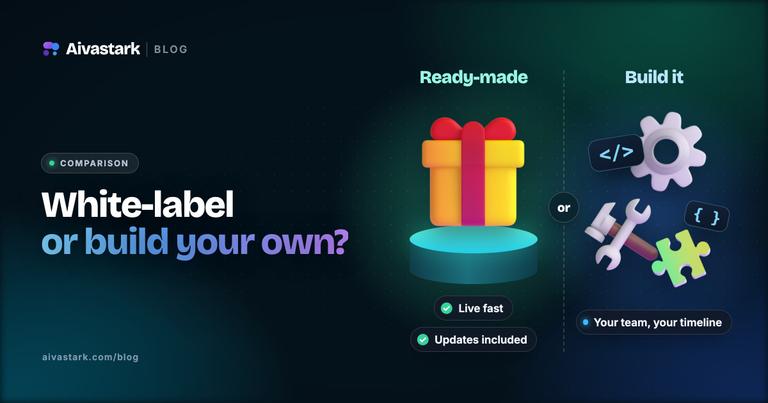
White-label AI chatbot vs. building your own
Building a RAG pipeline from scratch is entirely possible · but it typically takes a team of engineers 3–6 months and requires ongoing maintenance of the embedding pipeline, vector database, LLM API integration, and the chat widget itself.
A white-label AI chatbot platform like Aivastark collapses that work into a 10-minute setup: connect your data sources, configure the branding, and paste one script tag. The ingestion pipeline, retrieval, escalation logic, and analytics are already built.
For most teams, the build-vs-buy decision comes down to whether AI chat infrastructure is a core competency of your business · or a tool your business needs. If it's the latter, white-labeling is almost always faster and cheaper. We've broken down the full cost, time, and control comparison in white-label AI chatbot vs building your own.
Key questions to ask before choosing a white-label AI chatbot platform
- Does it support the data sources your knowledge base lives in (PDFs, Google Drive, website crawls)?
- Can you remove all vendor branding · including on the chat widget, emails, and any public URLs?
- Does the AI cite sources so you can verify it isn't hallucinating?
- What happens when the AI can't answer? Is there an automatic escalation path?
- Does it support multiple languages, and does it auto-detect the user's language?
- Can you deploy it to multiple sites or clients from a single account?
Summary
A white-label AI chatbot is an AI-powered support Agent that you train on your own data and fully brand as your own. It uses retrieval-augmented generation to give accurate, grounded answers · not hallucinations · and escalates automatically when it can't help. Businesses use them to deflect repetitive support tickets, give customers 24/7 coverage, and present a polished, on-brand experience without the cost of building from scratch.