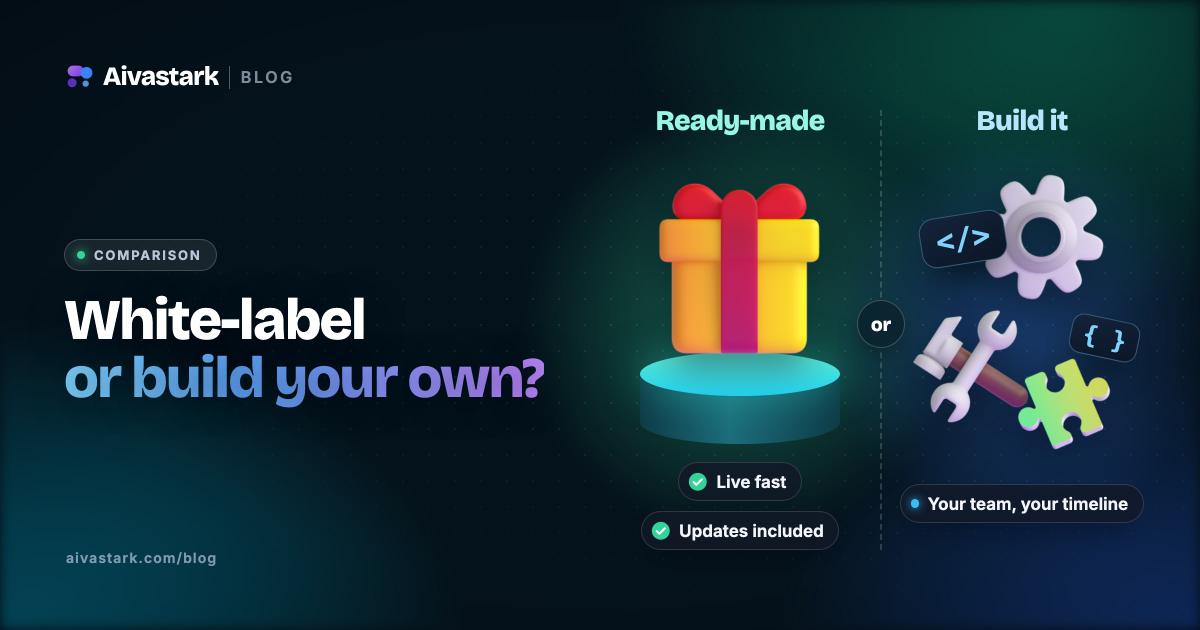
If you're evaluating whether to add an AI support chatbot to your product, you'll quickly face the build-vs-buy question: should you use a white-label platform like Aivastark, or build the whole thing from scratch?
The honest answer depends on your situation. This article breaks down the real costs, timelines, and tradeoffs so you can make the right call for your team.
What "building your own" actually means
Building a custom AI support chatbot from scratch means engineering and maintaining all of the following:
- Data ingestion pipeline · parsing PDFs, crawling websites, reading Google Drive, chunking content, and cleaning it
- Embedding pipeline · converting chunks to vector embeddings using OpenAI or another embedding model
- Vector database · hosting and querying a database like Pinecone, Weaviate, pgvector, or Qdrant
- RAG logic · the retrieval + generation pipeline that fetches the right context and calls the LLM
- Chat widget · a frontend component that handles streaming responses, session management, and works across devices
- Escalation logic · detecting low confidence and routing to a human or ticket system
- Analytics · logging conversations, measuring deflection rate, identifying knowledge gaps
- Infrastructure · hosting, authentication, rate limiting, and keeping it all running
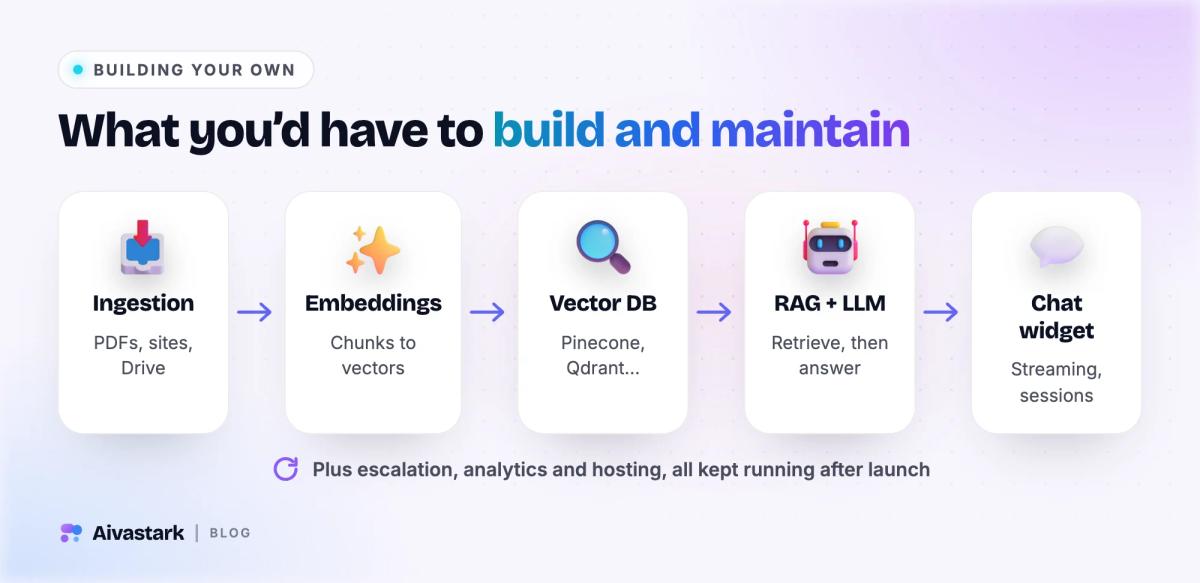
None of these are impossible. But together, they represent a significant amount of engineering · and ongoing maintenance work after launch.
The honest cost of building from scratch
Let's look at real numbers. These estimates are based on what engineering teams typically report:
| Component | Build time (eng-weeks) | Ongoing monthly cost |
|---|---|---|
| Ingestion pipeline | 3–5 weeks | $50–200 (infra + APIs) |
| Vector database | 1–2 weeks setup | $70–300 (hosted DB) |
| RAG + LLM integration | 2–4 weeks | $200–2,000 (LLM API) |
| Chat widget (frontend) | 2–3 weeks | - |
| Escalation + ticketing | 1–2 weeks | - |
| Analytics + monitoring | 1–2 weeks | $50–200 |
| Total | 10–18 engineer-weeks | $370–2,700+/mo |
At an average blended engineering cost of $150/hr, 10–18 engineer-weeks translates to $60,000–$108,000 in initial build cost, before a single line is written for your actual product.
That's before the ongoing cost of keeping it working as LLM APIs change, your docs evolve, and you add new features.
What a white-label platform like Aivastark costs
Aivastark's plans start with a permanent free plan (300 AI replies a month on one website), then $12/month (Solo), $39 (Starter, which adds WhatsApp, Instagram, Messenger and Telegram), $129 (Growth) and $319 (Scale). Enterprise pricing is custom.
Time to first live widget: under 10 minutes. No infrastructure to provision. No embedding pipeline to build. No chat widget to design.
Head-to-head comparison
| Factor | Build your own | White-label platform |
|---|---|---|
| Time to first deploy | 3–6 months | <10 minutes |
| Initial engineering cost | $60k–$100k+ | $0 |
| Monthly operating cost | $370–$2,700+ | $0–$319 |
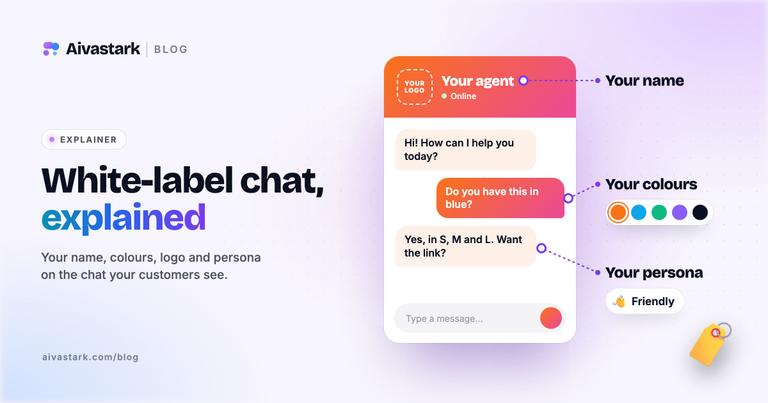
| Branding control | Full (you built it) | Your name, colours and logo; badge hidden on Scale |
| Data sources supported | Whatever you build | URLs, PDFs, Drive, GitHub |
| Multilingual support | Must implement | 80+ languages, built-in |
| Analytics / dashboard | Must implement | Built-in |
| Escalation logic | Must implement | Built-in |
| Maintenance burden | High (your team) | Low (vendor handles it) |
| Vendor dependency | None | Yes |
| Customization ceiling | Unlimited | Platform limits apply |
When building your own makes sense
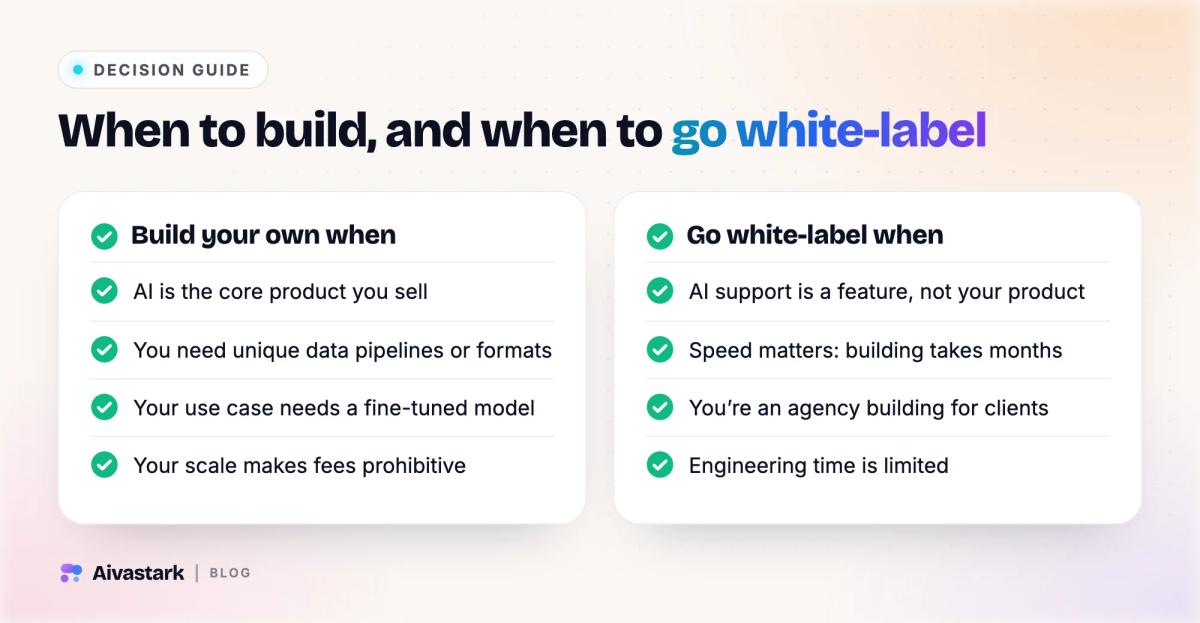
Building from scratch is the right call when:
- AI is your core product · if the chatbot is the thing you're selling, not a support tool attached to it, you need full control over the model, retrieval logic, and infrastructure.
- You have unique data pipeline requirements · proprietary file formats, real-time data feeds, or compliance requirements that no platform supports out of the box.
- You need custom model fine-tuning · white-label platforms use foundation models with RAG. If your use case requires a fine-tuned model, you'll need to build the infrastructure yourself.
- Your scale makes per-seat pricing prohibitive · at very large scale, building your own infrastructure can become cheaper than platform fees.
When a white-label platform is the obvious choice
A white-label platform is almost always the right choice when:
- AI support is a feature, not your product · if you're a SaaS company that wants to stop answering "how do I reset my password?" 50 times a day, you need a chatbot, not a chatbot startup.
- Speed matters · a competitor could ship AI support tomorrow. Building from scratch means you're 3–6 months behind.
- You're an agency building for clients · white-labeling lets you deliver a polished AI support product to clients without the overhead of maintaining infrastructure.
- Engineering resources are limited · every engineer-week spent on chatbot infrastructure is a week not spent on your product's core differentiation.
What about vendor lock-in?
The biggest legitimate concern with white-label platforms is vendor dependency. If Aivastark goes away or raises prices, what happens?
A few things reduce this risk:
- Your knowledge base content (the docs, PDFs, and URLs you ingested) lives with you · it's not locked in the platform.
- The business logic (system prompt, persona configuration, escalation rules) is configuration, not code · it's portable.
- At any point, you could migrate to another platform or build your own using the same knowledge base content.
The widget embed itself and the conversation history would need migration, but the heavy intellectual work · your knowledge base · stays with you.
The verdict
For the vast majority of businesses · SaaS companies, agencies, e-commerce operators · a white-label AI chatbot platform is the right choice. It's faster, dramatically cheaper to start, and the maintenance burden stays with the vendor.
Build your own if your AI is the product you're selling, if you have unique infrastructure requirements, or if you're at a scale where the economics tilt in favor of ownership.
For everyone else, the question isn't "should we build or buy?" · it's "why haven't we deployed yet?"
What you actually get out of the box
The build-cost table above understates the gap, because a white-label platform doesn't just save you the generic build · it ships with vertical-specific deployments already wired up:
- AI receptionist for dentists · answers patients' questions about treatments, hours, fees and insurance 24/7 and books appointments into Google Calendar or Cal.com.
- AI intake agent for law firms · collects intake details, books consultations and is instructed not to give legal advice.
- AI agent for e-commerce · live order lookups, return requests, address changes and add-to-cart on Shopify and WooCommerce.
Each of these is months of additional vertical-specific engineering on top of the core RAG stack. If your business is in any of them, the build-vs-buy math becomes lopsided enough that it isn't really a decision anymore.
For background, see what is a white-label AI chatbot and the step-by-step how to add an AI chatbot to your website in 10 minutes.