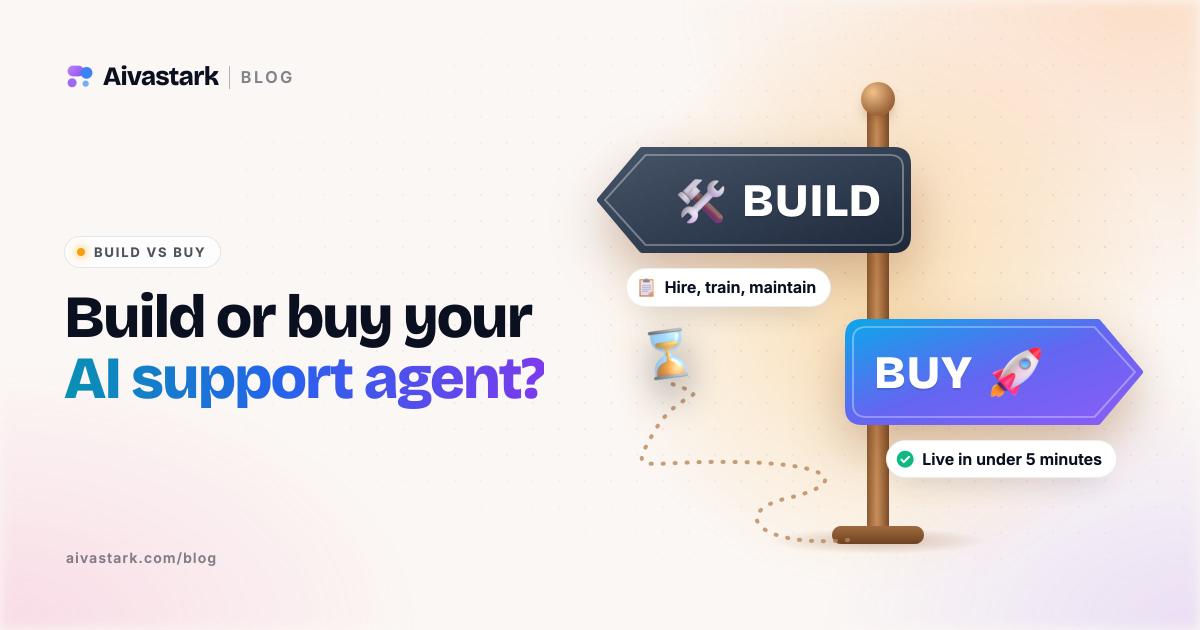
The build vs buy AI customer support agents decision is one of the highest-stakes calls a support leader will make this decade. Get it right and you deploy an intelligent agent that resolves tickets around the clock, scales with demand, and frees your human team for complex work. Get it wrong and you sink 6–12 months and a seven-figure engineering budget into a system that hallucinates, drifts, and never quite ships. This article gives you a practical framework to decide whether to build a custom AI support agent in-house or buy a white-label platform like Aivastark—and how to think about total cost of ownership before you commit.
The Build vs Buy Decision: Why It Matters for Support Teams
A modern AI customer support agent is not a scripted FAQ bot. It ingests your knowledge base, help docs, past tickets, and product data; it understands natural-language questions; it retrieves accurate answers; and increasingly it acts—processing refunds, updating orders, booking appointments, and escalating edge cases to humans. The gap between a static chatbot and an autonomous agent is significant, and it's worth understanding the distinction before you scope anything (our breakdown of AI Agent vs AI Chatbot covers this in depth).
The strategic trade-off comes down to three competing priorities: control, speed, and cost. Building gives you maximum control over the model, the data pipeline, and the roadmap—but it's the slowest and most expensive path. Buying a white-label platform delivers speed and predictable cost, with control concentrated on configuration and customization rather than infrastructure.
"The question is rarely can we build it. Most competent engineering teams can. The real question is whether AI support infrastructure is a core differentiator worth your best engineers' attention—or a solved problem you should rent."
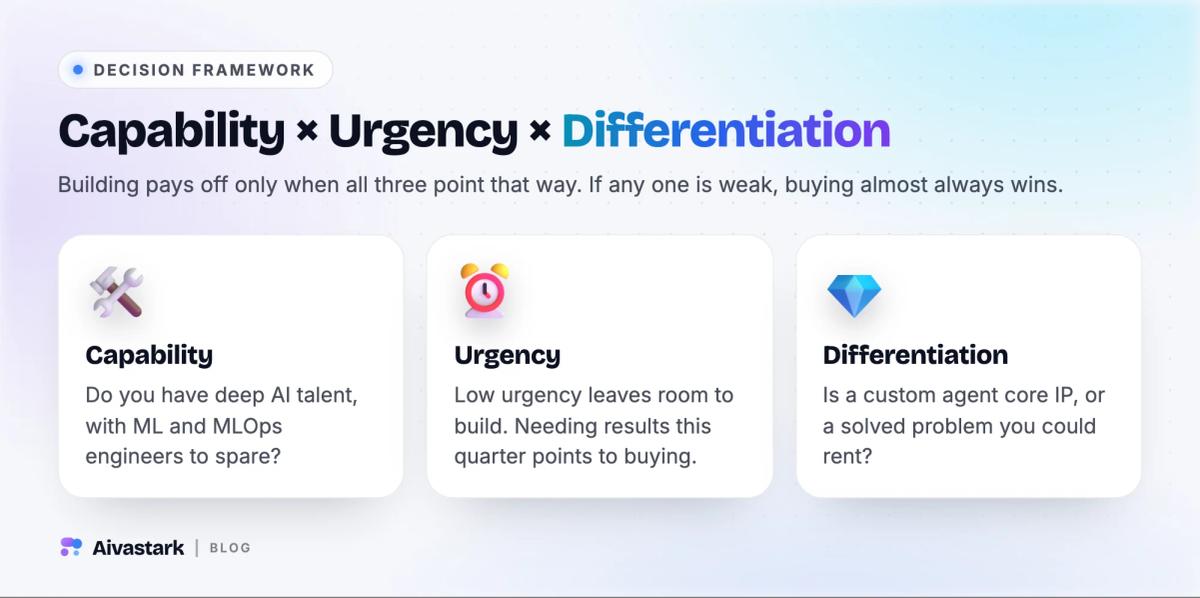
Throughout this article, use this simple decision framework: Capability × Urgency × Differentiation. If you have deep AI capability, low urgency, and genuine differentiation from a custom agent, building may pay off. If any of those three is weak, buying almost always wins.
What It Really Takes to Build an AI Support Agent In-House
Teams routinely underestimate the surface area of building a production-grade support agent. It is not a single model call wrapped in a chat UI.
The team you'll need to hire
A viable in-house build typically requires:
- ML engineers to design retrieval-augmented generation (RAG) pipelines, tune prompts, and manage embeddings.
- NLP specialists to handle intent classification, entity extraction, and multilingual support.
- DevOps / MLOps engineers to manage GPU hosting, vector databases, scaling, and observability.
- QA and prompt engineers to test for accuracy, edge cases, and regressions on every change.
In competitive markets, that's easily $600,000–$1,200,000 per year in fully loaded salaries before you've shipped a single conversation.
Ongoing costs that never stop
The build cost is not one-time. You'll pay continuously for:
- Model inference and hosting, which scales with ticket volume.
- Retraining and re-indexing every time your product, pricing, or policies change.
- Monitoring and evaluation to catch quality drift.
- Security patching and compliance audits.
Support content changes constantly. A knowledge base that isn't re-ingested weekly produces stale, inaccurate answers—and inaccurate answers erode trust faster than no answer at all.
Timeline realities
A realistic path from kickoff to a production agent handling real customer traffic is 6 to 12 months. That includes data preparation, pipeline engineering, evaluation harnesses, safety guardrails, integration work, and staged rollout. During those months, your existing support costs continue unchanged while the investment shows zero return.
Compliance and hallucination are your problem now
When you build, you own hallucination mitigation, PII handling, data residency, and regulatory compliance (GDPR, SOC 2, HIPAA where relevant). For a deeper look at these responsibilities, our comparison of white-label AI chatbot vs build your own walks through the operational burden most teams don't anticipate.
What You Get When You Buy a White-Label Platform Like Aivastark
Buying doesn't mean settling for a generic bot. A white-label platform gives you a production-ready agent that carries your brand, connected to your systems, without the infrastructure overhead.
Faster time-to-value
Instead of building a knowledge-ingestion pipeline from scratch, you point the platform at your docs, website, and help center and it indexes them automatically. Pre-built integrations connect to your existing stack. What takes an in-house team months takes days—see our practical guide on how to add an AI chatbot to your website for what that setup actually looks like.
White-label branding
The whole point of white-labeling is that the agent looks and feels like your product—your colors, your name, your voice—with no vendor logo in sight. If you're new to the concept, what is a white-label AI chatbot explains how agencies and SaaS companies resell it as their own.
Predictable pricing
A subscription replaces unpredictable dev overhead. You know your monthly cost regardless of how many engineering hours a custom system would have quietly consumed. You can review the pricing model directly rather than estimating a moving target.
Vendor-managed updates and compliance
Model improvements, security patches, uptime, and compliance certifications become the vendor's responsibility. When a better underlying model ships, you inherit the upgrade without a migration project. The full feature set reflects capabilities that would each be a standalone engineering initiative in-house.
Comparing Total Cost of Ownership (TCO) for Build vs Buy AI Customer Support Agents
TCO is where the decision usually becomes clear. Comparing a build's upfront cost to a SaaS sticker price is misleading—you have to model the full lifecycle.
| Build in-house | Buy a white-label platform | |
|---|---|---|
| Year-one cost | $250,000–$750,000+ in engineering, plus infrastructure | A recurring subscription, a few hundred to a few thousand per month |
| Time to first value | Months | Days |
| Who owns hallucinations and compliance | You | The vendor |
| Ongoing maintenance | Permanent engineering headcount | Included in the subscription |
| Costs teams forget | Downtime, opportunity cost, quality failures | Overage fees, integration limits, customisation ceilings |
Upfront build vs recurring SaaS
- Build: $250,000–$750,000+ in year-one engineering, plus infrastructure setup.
- Buy: A recurring subscription, often a few hundred to a few thousand dollars per month depending on volume and tier.
The costs teams forget
On the build side, hidden costs include maintenance labor, downtime incidents, opportunity cost of engineers not building revenue features, and the cost of quality failures (a hallucinated refund policy is expensive). On the buy side, watch for per-resolution overage fees, integration limits, and customization ceilings.
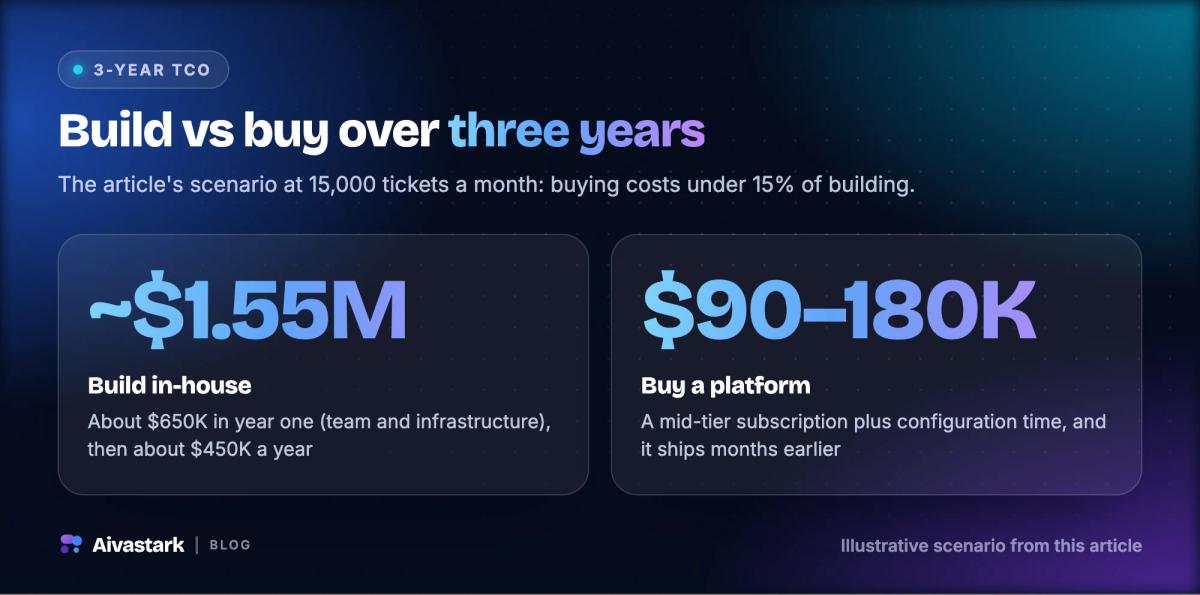
A 3-year TCO scenario
Consider a mid-sized support team handling 15,000 tickets/month:
- Build: ~$650,000 year one (team + infra), then ~$450,000/year in maintenance and hosting for years two and three. 3-year total: roughly $1.55M.
- Buy: A mid-tier subscription plus configuration time. Even at $30,000–$60,000/year all-in, the 3-year total lands around $90,000–$180,000.
Even generously, the buy path in this scenario costs less than 15% of the build path over three years—while shipping months earlier. For a broader market view of what's available, see our roundup of the best AI customer support software in 2026.
"The most expensive AI support project is the one your team maintains for three years and still can't fully trust in production. TCO isn't just dollars—it's the engineering focus you never get back."
When Building Makes Sense (and When It Doesn't)
The framework isn't ideological—there are legitimate cases for each path.
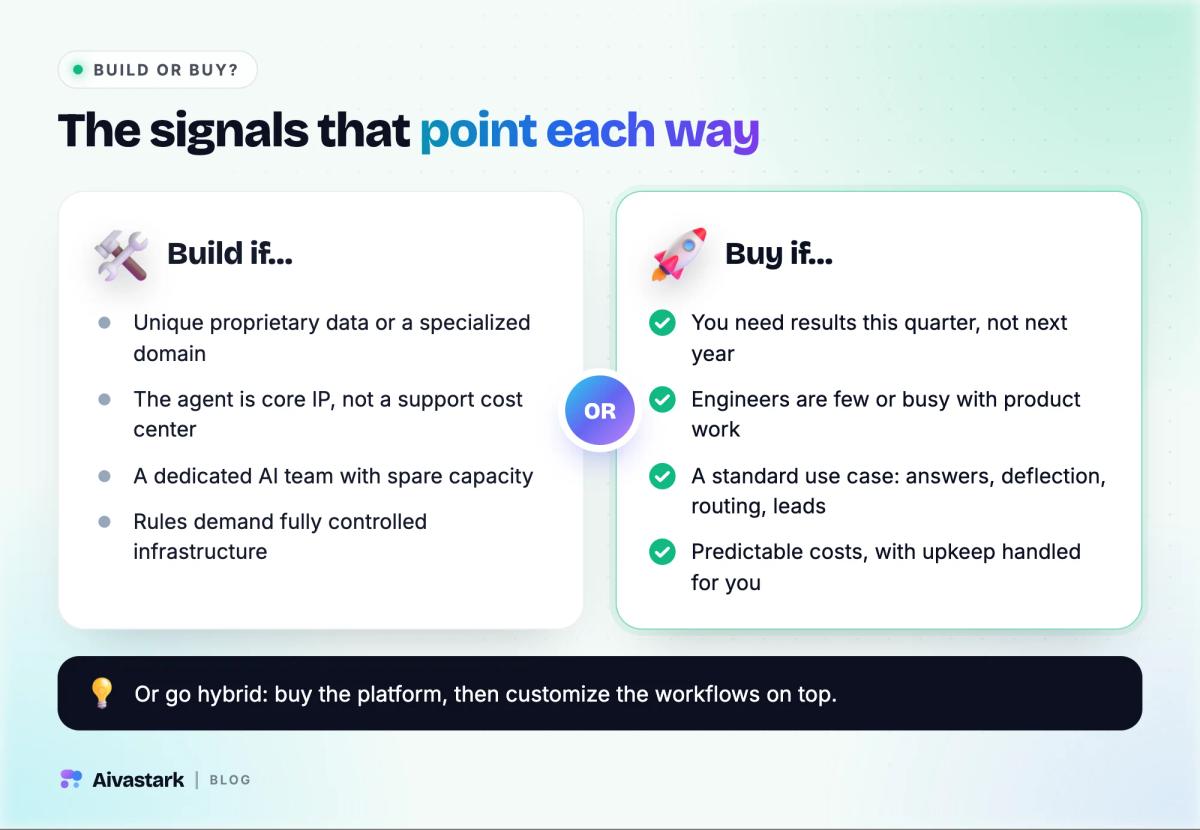
Signals you should build
- You have unique proprietary data or a specialized domain that no off-the-shelf model handles well.
- The AI agent is core IP and a genuine differentiator, not a support cost center.
- You already staff a dedicated, experienced AI team with excess capacity.
- Your regulatory posture requires fully controlled infrastructure that no vendor can satisfy.
Signals you should buy
- Speed to launch matters—you need results this quarter, not next year.
- Your engineering team is small or fully allocated to product work.
- Your use case is standard: answering questions, deflecting tickets, routing, and lead capture.
- You want predictable costs and vendor-managed compliance.
Most companies—especially in ecommerce, SaaS, legal, and dental—fall squarely into the buy category because their support use cases are well-understood and their engineering talent is better spent elsewhere. Browse the full industries overview to see how deployment patterns differ by vertical.
The hybrid approach
The smartest teams often blend both: buy the platform, customize the workflows. You get vendor-managed models and infrastructure while building your own integrations, custom actions, and business logic on top. Modern agentic platforms make this viable—our piece on agentic AI in customer support explores how far configuration can go before you'd ever need to touch model internals.
A Step-by-Step Framework to Choose Your Path
Use this sequence to reach a defensible decision rather than a gut call.
Step 1: Assess internal capabilities, budget, and volume
Honestly audit three things: Do you have ML/MLOps talent with bandwidth? What's your realistic 3-year budget? What's your monthly ticket volume and growth curve? Low capability plus high volume is the strongest signal to buy.
Step 2: Score your priorities
Rate each factor from 1–5:
- Customization needs — how unusual is your use case?
- Time-to-launch — how urgent is deployment?
- Compliance depth — how strict are your data requirements?
High customization and compliance scores lean build; high time-to-launch scores lean buy. Weight them by what your business actually values.
Step 3: Run a pilot before committing
Never commit blind. Run a proof-of-concept on a real subset of tickets. Measure resolution rate, accuracy, escalation quality, and customer satisfaction. A pilot on a white-label platform costs days; a build pilot costs months—which itself is a data point. If you're weighing specific tools, comparisons like Aivastark vs Intercom Fin and Chatbase vs Aivastark help you scope the evaluation.
Step 4: Plan for scaling and iteration
Whichever path you choose, define your success metrics upfront: deflection rate, first-contact resolution, average handling time, and CSAT. Plan for continuous improvement—AI support agents are never "done." Decide how you'll measure whether the agent is getting better or worse over time, and who owns that loop.
The Bottom Line
For the vast majority of support teams, the math on build vs buy AI customer support agents favors buying a white-label platform: dramatically lower TCO, deployment in days instead of months, and vendor-managed compliance and model upgrades. Building makes sense only when the agent is core IP, you have unique data, and you already have a dedicated AI team with capacity to spare.
If you're still weighing your options, start with a small pilot, score your priorities against the framework above, and let real resolution data—not assumptions—drive the decision. To see how a white-label approach works in practice, explore Aivastark's platform or dig into the FAQ for the specifics of setup, security, and scaling.
Frequently asked questions
Should I build or buy an AI customer support agent?
For the vast majority of support teams, buying a white-label platform favors lower TCO, deployment in days instead of months, and vendor-managed compliance and model upgrades. Building makes sense only when the agent is core IP, you have unique data, and you already have a dedicated AI team with capacity.
How much does it cost to build an AI support agent in-house?
Expect $250,000–$750,000+ in year-one engineering plus infrastructure, and roughly $450,000/year in ongoing maintenance and hosting. Team salaries alone run $600,000–$1,200,000 per year in competitive markets.
How long does it take to build a production AI support agent?
A realistic path from kickoff to a production agent handling real customer traffic is 6 to 12 months, including data prep, pipeline engineering, evaluation harnesses, safety guardrails, integration, and staged rollout.
What is the 3-year TCO difference between building and buying?
For a mid-sized team handling 15,000 tickets/month, building costs roughly $1.55M over three years, while buying lands around $90,000–$180,000—less than 15% of the build path, while shipping months earlier.
When does building an AI support agent make sense?
Build when you have unique proprietary data or a specialized domain, the agent is core IP and a genuine differentiator, you already staff a dedicated experienced AI team with excess capacity, or your regulatory posture requires fully controlled infrastructure no vendor can satisfy.
What is the hybrid approach to AI support agents?
The hybrid approach means buying the platform and customizing the workflows—you get vendor-managed models and infrastructure while building your own integrations, custom actions, and business logic on top.