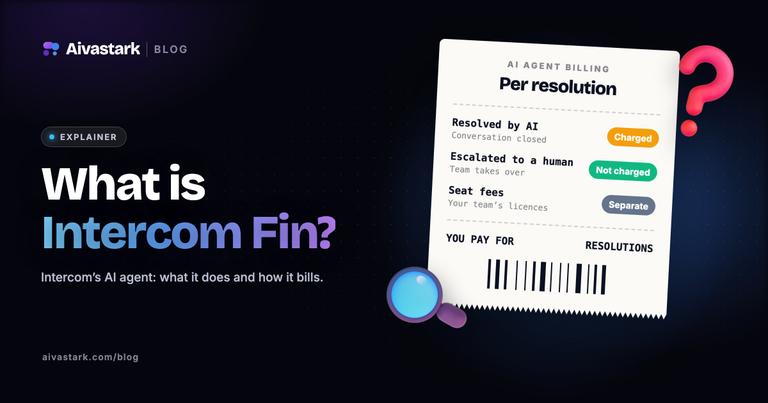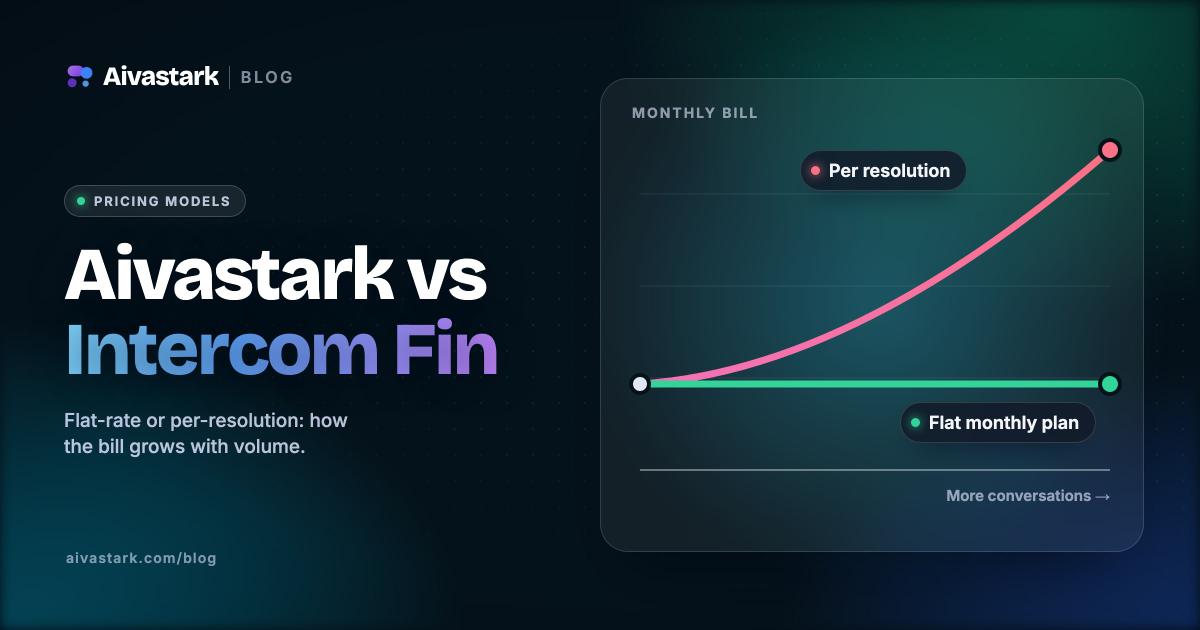
Aivastark vs Intercom Fin: Aivastark is a flat-rate alternative from $39/month on Starter, covering roughly 1,000 conversations, against Fin's $0.99 per outcome (~$990 at the same volume) plus $85/seat for Intercom Advanced billed annually — with seats included instead of priced per seat. Fin wins for teams already on Intercom or needing its phone voice; Aivastark wins when you want the AI bill fixed in advance.
New to Fin? Start with what Intercom Fin is and how its AI agent works, then come back here for the cost comparison below.
For the side-by-side table, with every Intercom figure sourced and dated, see Aivastark vs Intercom Fin.
If you've been running an Intercom workspace and your Fin AI bill keeps climbing past the support headcount you replaced, the pricing model is usually why. This post walks through how Aivastark and Fin actually compare on pricing, channels, branding, setup speed, and · most importantly · what each costs at real conversation volumes.
The short answer (in one table)
| Factor | Aivastark | Intercom Fin |
|---|---|---|
| Pricing model | Flat monthly · $0 (free, permanent) to $319, plus sales-led Enterprise | Per-outcome · from $0.99 each, on top of seat fees |
| Seat fee | None · 1–10 seats included by plan | $39 (Essential) to $139 (Expert) per seat monthly, $29–$132 billed annually; at least one seat |
| Setup | Under 5 minutes from sign-up for a typical site | Intercom workspace, or Salesforce, HubSpot or Freshdesk via standalone Fin |
| Vendor branding | Your name, colours and persona on every plan; badge hidden on Scale; custom white-label on Enterprise, on request | "Powered by Fin" link can be switched off on Advanced and Expert |
| Channels included | Website widget on every plan; WhatsApp, Instagram, Messenger, Telegram and email from Starter | Chat, email and in-app; Instagram, Messenger, Slack, Discord; inbound WhatsApp free; SMS, phone and outbound WhatsApp billed by usage |
| Languages | 80+ with auto-detection | 45+ |
| Bring-your-own knowledge base | Website crawl, files, FAQs and pasted text, Shopify or WooCommerce catalogue | Intercom Articles and other sources (not compared here) |
| Industry presets | Guardrails for ten industries, e.g. dental, legal; store tools for e-commerce | Not compared here |
| Bill predictability | Flat plan, then a published overage rate | Moves with monthly outcomes, plus seats |
Pricing: flat-rate vs per-resolution
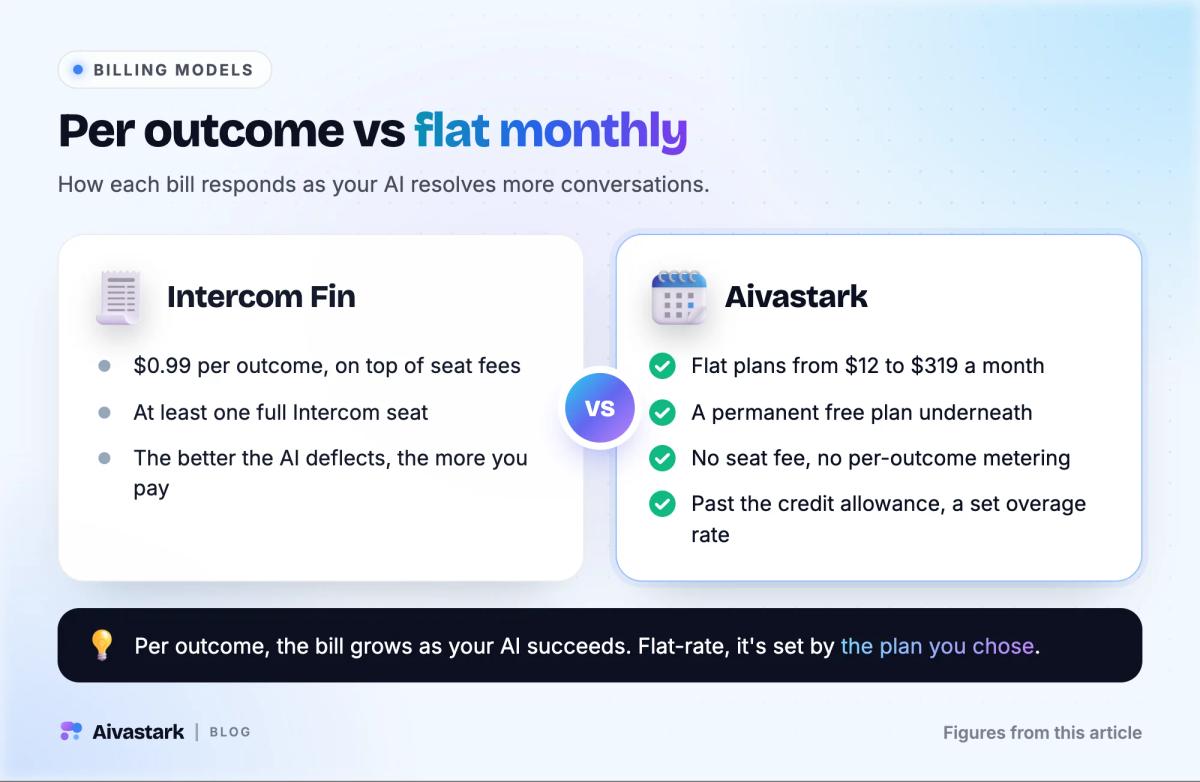
The single biggest difference between Aivastark and Intercom Fin is the pricing model · and the operational consequences of each. Intercom Fin charges from $0.99 per AI outcome, on top of Intercom seats: Essential lists at $39 a seat monthly or $29 annually (Intercom is testing $29 and $19), Advanced $99 or $85, and Expert $139 or $132, with at least one seat. Aivastark charges a flat monthly price — $12 on Solo, $39 on Starter, $129 on Growth, $319 on Scale, with a permanent free plan underneath and sales-led Enterprise above — and no per-seat fee or per-outcome metering. Intercom figures checked October 2026.
One wrinkle worth knowing: Intercom renamed "resolution" to "outcome", and an outcome now also covers a conversation Fin hands to a person or workflow through a Procedure, disqualifies or routes to self-serve. You are charged at most once per conversation, and not when Fin escalates under its default rules or the customer asks for a person, but the charge is not strictly limited to cases the AI closed by itself. A sales qualification is a $9.99 outcome.
In a per-outcome model, your bill scales with your success. The better your AI gets at deflecting tickets, the more you pay · which is an awkward incentive structure for any team that's actually trying to reduce support cost. In a flat-rate model, your bill is the plan you chose, plus a published overage rate past its credit allowance, and additional deflection is upside.
Cost at volume · the actual math
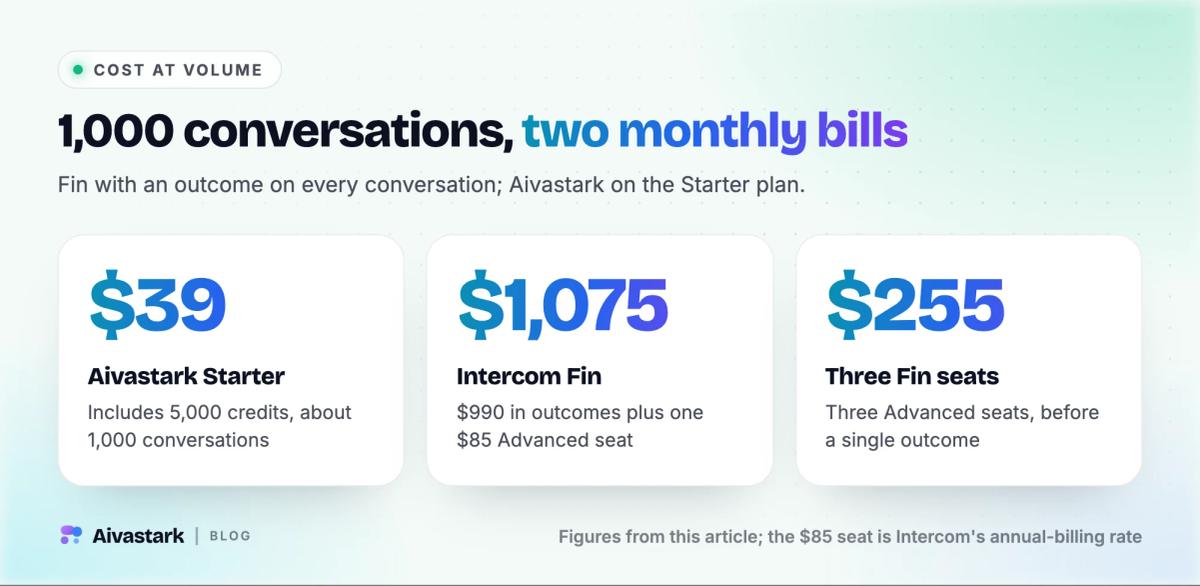
Here's what each model looks like at three realistic monthly conversation volumes for an SMB-to-mid-market support workload, assuming a single Advanced seat on Intercom (billed annually) and the cheapest Aivastark plan from Starter (the first with messaging channels) that handles the volume, overage included. Aivastark meters weighted credits rather than conversations — a standard reply is one credit, so a conversation with four to six AI replies costs four to six credits, roughly 5,000 credits per 1,000 conversations.
| Monthly conversations | Aivastark | Intercom Fin (Advanced + Fin) |
|---|---|---|
| 1,000 (~5,000 credits) | $39 · Starter | $85 seat + $990 Fin = $1,075 |
| 5,000 (~25,000 credits) | $99 · Starter + 20,000 credits at $3.00 per 1,000 | $85 seat + $4,950 Fin = $5,035 |
| 10,000 (~50,000 credits) | $174 · Starter + 45,000 credits at $3.00 per 1,000 | $85 seat + $9,900 Fin = $9,985 |
Two important caveats. First, an "outcome" in Fin's pricing is not the same as a conversation · it is charged at most once per conversation where Fin reaches an outcome, which includes Procedure handoffs but not every conversation it touches. At 76%, the average rate Intercom's own calculator uses, 1,000 conversations cost about $752 of Fin rather than $990, and 5,000 cost about $3,762. The order of magnitude doesn't change. Aivastark's side, meanwhile, is an estimate in the other direction: gpt-4o replies (10 credits each), images and tool steps burn credits faster than the five-per-conversation rule of thumb, and past the allowance Starter bills $3 per additional 1,000 credits rather than stopping.
Second, the Intercom side of the bill rarely stays at the seat minimum. Most teams need more than one seat once the AI escalates real conversations to humans. At three Advanced seats, the floor moves from $85 to $255/month before a single Fin outcome lands. Aivastark's Starter includes three seats, and a busier team would pick Growth ($129) for its five.
Syed Anas, founder of Aivastark: "Per-resolution pricing made sense in 2023 when AI was a buzzword and 'resolution' was scary-defined. In 2026, customers know what a resolved ticket is worth · usually a few cents of compute and a few cents of LLM tokens. Charging a dollar for it is a tax on AI being useful. Flat-rate is the only pricing that actually aligns with the customer's incentive to deflect more."
Channels and branding
Aivastark ships with website widget + WhatsApp + Instagram + Messenger + Telegram + email in one inbox, with no per-channel surcharge — the widget is on every plan and the rest from Starter (Meta bills its own WhatsApp message fees to your WhatsApp Business account). Intercom covers chat, email and in-app on every plan, plus Instagram, Messenger, Slack and Discord, with inbound WhatsApp free, but SMS, phone and outbound WhatsApp are billed by usage on top of seats and Fin outcomes. For a multi-channel deployment, this is where the bill can grow in practice.
Branding is the other place the two products differ. On Aivastark the agent carries the name, colours, logo and persona you choose on every plan; a small "Powered by Aivastark" badge shows by default and can be switched off on Scale. White-labelling beyond that is a custom arrangement on Enterprise, on request, and there is no custom-domain feature. On Intercom, the "Powered by Fin" link can be switched off on the Advanced and Expert plans. Agencies reselling AI support under their own brand should raise it with sales before choosing either.
Setup speed and the operational cost of switching
Sign-up to a live widget takes under 5 minutes for a typical site: connect a knowledge source (a website crawl, or PDF, DOCX, TXT or Markdown files), pick a persona name and brand colors, copy a single <script> tag onto your site. Intercom Fin runs inside an Intercom workspace with seats, the Messenger and your help-centre content, or on Salesforce, HubSpot or Freshdesk through standalone Fin (a $49 monthly minimum with 50 outcomes included, no seats). Fin also has mature testing and simulation tools for checking answers before they go live.
For deeper background on the build-vs-buy decision behind this entire category, see white-label AI chatbot vs building your own and the procurement-grade rubric in our fintech buyer's playbook.
When Intercom Fin is the right choice
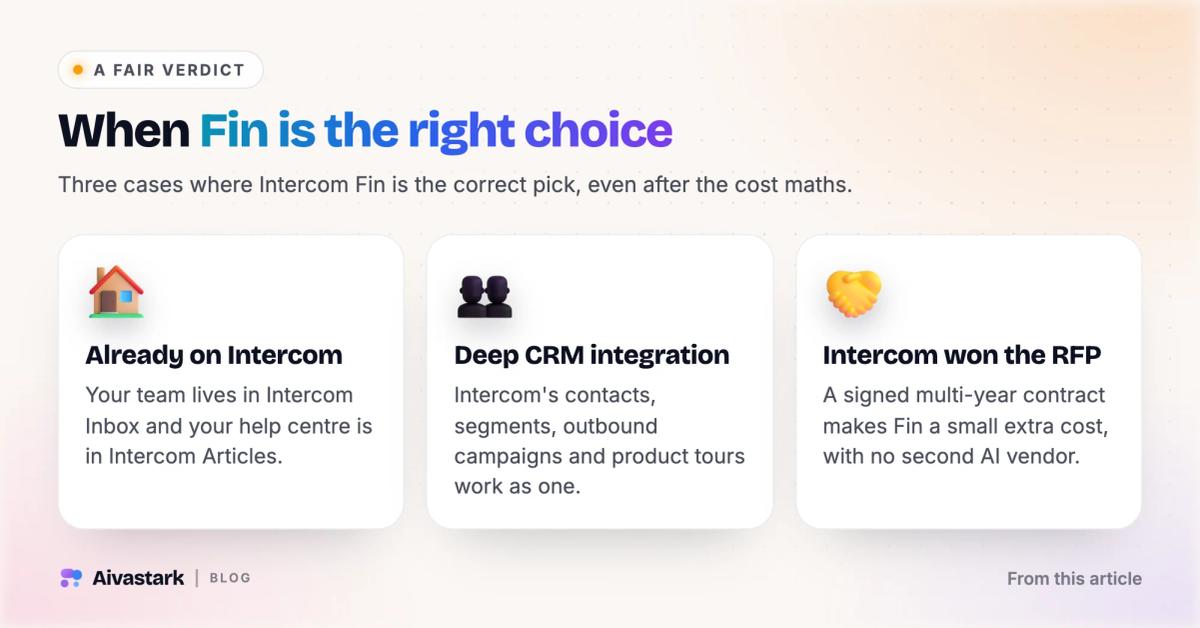
We're not going to pretend Fin is the wrong answer for everyone. There are three scenarios where Intercom Fin is the correct procurement decision, even after running the cost math above:
- You are already deeply on Intercom. If your support team lives in Intercom Inbox, your help center is in Intercom Articles, and your CSMs are tracking accounts in Intercom, ripping it out to save a few thousand dollars a month is a false economy. Fin is the natural AI layer on a workflow your team has already adopted.
- You need deep CRM integration. Intercom's contact model, segmentation, outbound campaigns, and product-tour tooling are more mature and better integrated than Aivastark's. Aivastark has a lighter contacts CRM and pushes tickets to HubSpot, Zendesk, Freshdesk or a webhook, but it has no product tours.
- You're enterprise and Intercom has already won the RFP. Procurement-heavy enterprises that have signed multi-year Intercom contracts already pay for the seats, and adding Fin avoids running two AI-support vendors in parallel.
Fin is also the better pick if you need phone voice (Fin Voice, $1.99 per voice outcome) or the enterprise features on its Expert plan, such as SSO and SLAs. Outside of those cases · particularly for SaaS startups under $5M ARR, e-commerce stores on Shopify or WooCommerce, and agencies building for client portfolios · the per-resolution math doesn't survive contact with real volume.
Best fit by vertical
Aivastark ships guardrail presets for ten industries (Starter), such as dental, legal and finance, that add careful "refer, don't advise" rules. Three verticals have their own pages:
- Dental practices · 24/7 AI receptionist that answers questions about treatments, hours, fees and insurance from your own information, books into Google Calendar or Cal.com (Starter), and hands the rest to your front desk. It answers messages, not calls, and has no practice-management integration.
- Law firms · intake agent that answers prospective clients from your practice-area pages and fee policy, collects matter details, books consultations, and routes each enquiry to the right teammate by rules you set. It is instructed not to give legal advice (a guardrail, not a guarantee) and runs no conflict checks.
- E-commerce stores · live Shopify or WooCommerce order lookups for "where is my order?", return and exchange requests, delivery-address changes before the parcel ships, live products and add-to-cart, and shipping, sizing and policy answers from your own content. It does not issue refunds or cancel orders.
How Aivastark stacks up against other Intercom Fin alternatives
Intercom Fin sits in a competitive set with several other named platforms · Chatbase (priced per reply credit), Twig (Sera, an AI front desk priced per chat), Tidio (its Lyro AI priced per conversation) and Gorgias (priced per AI interaction). We've broken down the two most-asked comparisons in their own posts:
- Aivastark vs Chatbase · flat plans vs Chatbase's reply credits, plus channels and branding.
- Aivastark vs Twig · flat plans vs Twig's per-chat pricing, and when a phone-first front desk is the better fit.
Frequently asked questions
Is Aivastark really cheaper than Intercom Fin at every volume?
At almost any volume the AI line is lower, because Aivastark's price doesn't rise per conversation: Starter at $39 a month covers about 1,000 conversations at five standard replies each, against about $990 in Fin outcomes, or about $752 at the 76% rate Intercom's calculator uses, before seats. Fin can make sense at very low volume or if you need its voice and enterprise features.
Can I keep my Intercom workspace and add Aivastark instead of Fin?
Yes. Aivastark installs with a single script tag. You can keep Intercom for in-app messaging, outbound campaigns, and product tours, and put Aivastark on the public site, marketing pages, and on Instagram, WhatsApp and Messenger, where volume is highest and per-outcome pricing hurts most.
Does Aivastark do everything Fin does?
Not everything. It covers the AI customer-support core: answers from your knowledge base, human handoff to your inbox when a customer asks for a person, sounds upset or is still not helped, messaging channels and email from Starter, 80+ languages auto-detected, and conversation analytics. It has no phone line, Fin's testing and simulation tools are more mature, and Aivastark does not replace Intercom's CRM, outbound-campaigns, or product-tour tooling.
What about white-label and agency use?
Your agent carries your own name, colours, logo and persona on every plan. A small "Powered by Aivastark" badge shows by default and can be switched off on Scale. White-labelling beyond that is a custom arrangement on Enterprise, on request, and there is no custom-domain feature. On Intercom, the "Powered by Fin" link can be switched off on Advanced and Expert.
What's the migration time off Intercom Fin?
Knowledge-base content moves over by pointing Aivastark at your existing help-center URLs or uploading your source docs directly. Run a parallel deployment (Fin still answering live, Aivastark running on a subset of pages), then cut over once Aivastark's answers hold up. Conversation history stays in Intercom.
Will my Fin-trained team have a learning curve on Aivastark?
It should be small. The configuration surface (instructions, knowledge sources, handoff rules, persona) is similar in shape. The biggest delta is scope · Aivastark's dashboard centres on the AI agent and its inbox, while Intercom's surface area covers a full helpdesk and CRM.
Where does Aivastark fall short vs Intercom Fin?
Several. Aivastark doesn't ship Intercom-grade outbound campaigns or product tours, its contacts CRM is lighter, and it has no phone line (Fin Voice) or SSO (Intercom's Expert plan). If any of those are deal-breakers, Intercom is the better fit · accept the per-outcome math as the cost of the broader platform.
Bottom line
For SaaS founders, e-commerce ops teams, and agencies, the per-resolution model that made sense in 2023 has become a tax on AI being good at its job. Aivastark replaces the AI-customer-support layer at a flat price: $39/month on Starter covers roughly a thousand monthly conversations, and $129 on Growth roughly five thousand with five seats, with every messaging channel and email included. For teams already deep in Intercom's CRM ecosystem, or needing phone voice, Fin is still the right call · pay the per-outcome premium for the platform synergy. For everyone else, the question stopped being "build or buy" two years ago and is now "flat-rate or per-resolution."
See the live pricing page, or read on: Aivastark vs Chatbase for the reply-credit breakdown, or Aivastark vs Twig for the phone-vs-messaging comparison.
More questions
When is Intercom Fin the right choice over Aivastark?
Four scenarios: you are already deeply on Intercom (Inbox, Articles, CRM all in one workspace), you need deep CRM and outbound-campaigns tooling that Aivastark doesn't match, you need phone voice (Fin Voice) or Expert-plan features such as SSO and SLAs, or you're enterprise with Intercom already won at the RFP level.
Sources
- Intercom pricing (seats, Fin outcome price, channel usage)
- Fin pricing (standalone minimum, Fin Voice, qualifications)
- Intercom help: Fin outcomes
- Intercom help: usage-based channels (inbound WhatsApp free)
- Fin channels and languages
- Fin guarantee (90 days; 76% average rate)
- Intercom help: removing "Powered by Fin"