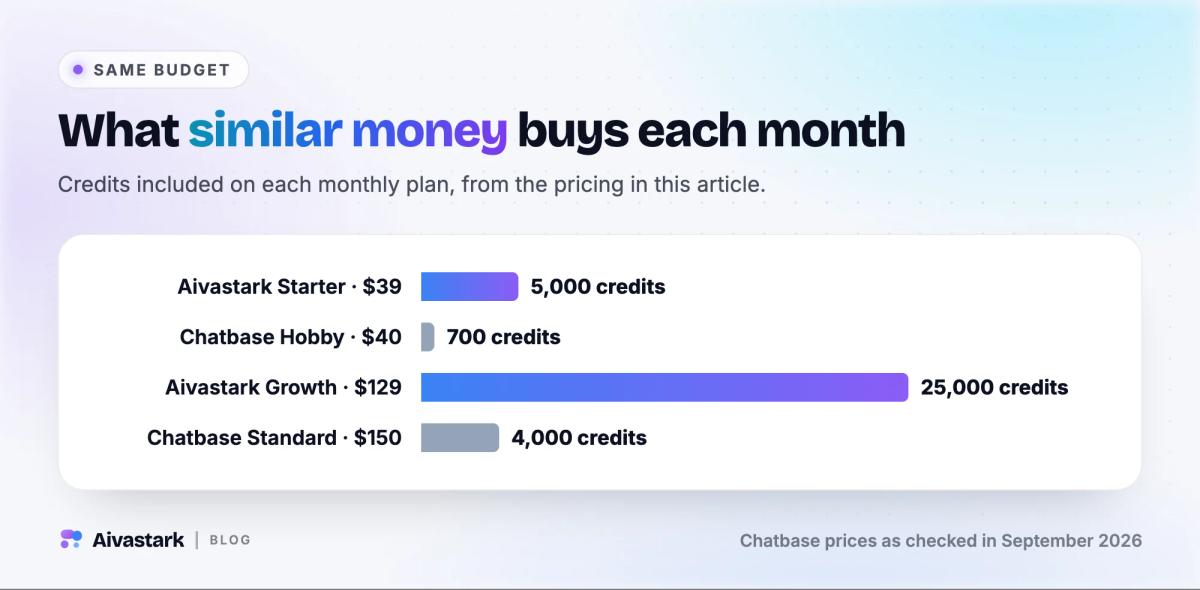
Aivastark vs Chatbase: both are AI agents that answer from your own content on your website, WhatsApp, Instagram, Messenger and email. Aivastark wins on replies per dollar (5,000 on its $39 Starter plan against 700 on Chatbase's $40 Hobby plan) and keeps answering past the allowance on paid plans; Chatbase wins on model choice, phone voice and cheaper badge removal at low volume.
For the side-by-side table, with every Chatbase figure sourced and dated, see Aivastark vs Chatbase.
Chatbase is one of the most established AI agent platforms on the SMB side · a polished dashboard and a large install base ("10,000+ businesses", per its pricing page). Where the two differ is on three axes that matter most to teams running AI support at volume or for several clients: replies per dollar, what happens when you run out, and control over the model and the branding. This post compares the two on each.
Aivastark vs Chatbase (in one table)
| Factor | Aivastark | Chatbase |
|---|---|---|
| Pricing model | Flat monthly, replies included · $0 (free, permanent) to $319, plus Enterprise | Per-reply message credits · a free plan, $40 Hobby, $150 Standard and up |
| About $40/month | Starter ($39): 5,000 replies | Hobby ($40): 700 replies |
| About $130–$150/month | Growth ($129): 25,000 replies | Standard ($150): 4,000 replies |
| When you run out | Paid plans keep answering · overage $1.20–$4.00 per 1,000 | Agent stops unless auto-recharge is on · $40 per 1,000 |
| Channels | Widget on every plan · WhatsApp, Instagram, Messenger, Telegram, email from Starter | Widget on every plan · WhatsApp, Instagram, Messenger, Slack, email from $40 · voice from $150 |
| Model choice | Aivastark picks the standard model · gpt-4o from Starter | OpenAI, Anthropic, Gemini, Mistral and others on paid plans |
| "Powered by" badge | Shown by default · can be hidden on Scale ($319) | $99/month add-on on any paid plan |
| White-labelling | Custom arrangements on Enterprise, on request | On Enterprise |
| Client sites per account | 2, 5 or 15 (Starter, Growth, Scale) | One agent per plan · extra agents $25/month |
| Languages | 80+ with auto-detection | 95+ |
Chatbase figures checked October 2026. A standard Aivastark reply is 1 credit, a gpt-4o reply 10.
What "white-label" actually means in practice
"White-label" gets used loosely in this category, and neither product offers full white-labelling below Enterprise. Here's the operational definition we'd recommend procurement teams use:
- Brand name and persona · the agent has the name, colours and persona you choose. Both platforms support this; on Aivastark it's every plan, Free included.
- Custom domain hosting · the widget loading from chat.yourbrand.com. Aivastark doesn't offer a custom domain, so ask each vendor directly if you need one.
- Email from your address · with the email channel (Starter), Aivastark answers from your own mailbox over IMAP/SMTP.
- The "Powered by" badge · Aivastark shows a small badge by default and lets you switch it off on Scale ($319/month). Chatbase sells branding removal as a $99/month add-on on any paid plan, so Hobby without the badge is $40 + $99 = $139/month (checked October 2026). At low volume, Chatbase is the cheaper way to lose the badge.
- Several client sites under one account · Aivastark runs 2, 5 or 15 sites from one account (Starter, Growth, Scale) on a flat price. Every Chatbase plan includes one agent; each extra agent is $25 a month.
If you're an agency reselling AI support under your own brand, the badge and the client-site count usually decide the procurement; anything deeper is an Enterprise conversation with either vendor. For background on what genuine white-label means, see our explainer on what is a white-label AI chatbot.
Channels: where customers actually are
Chatbase is no longer just a website widget. It answers on WhatsApp, Instagram and Messenger from its $40 Hobby plan, plus Slack and email, and adds voice and phone from its $150 Standard plan. Aivastark includes the website widget on every plan, and WhatsApp, Instagram DMs, Facebook Messenger, Telegram and email from Starter ($39/month), with the same agent answering everywhere from a single inbox.
So channel count alone no longer separates the two. Aivastark adds Telegram, which Chatbase doesn't list, and with human handoff switched on (Solo and up) passes the full thread to a person when the customer asks or isn't helped. Chatbase's shared inbox (its Helpdesk) and phone voice start on the $150 Standard plan. Aivastark has no phone line, so if your customers call rather than message, Chatbase wins.
Pricing model · per-message vs flat-rate
Chatbase prices by message credits · a free plan ($0, 50 credits a month), Hobby ($40, 700), Standard ($150, 4,000) and larger plans above that, with one agent per plan and extra agents at $25 a month. When credits run out, the agent stops answering unless auto-recharge is on, at $40 per 1,000 credits, and branding removal is $99/month on top (checked October 2026).
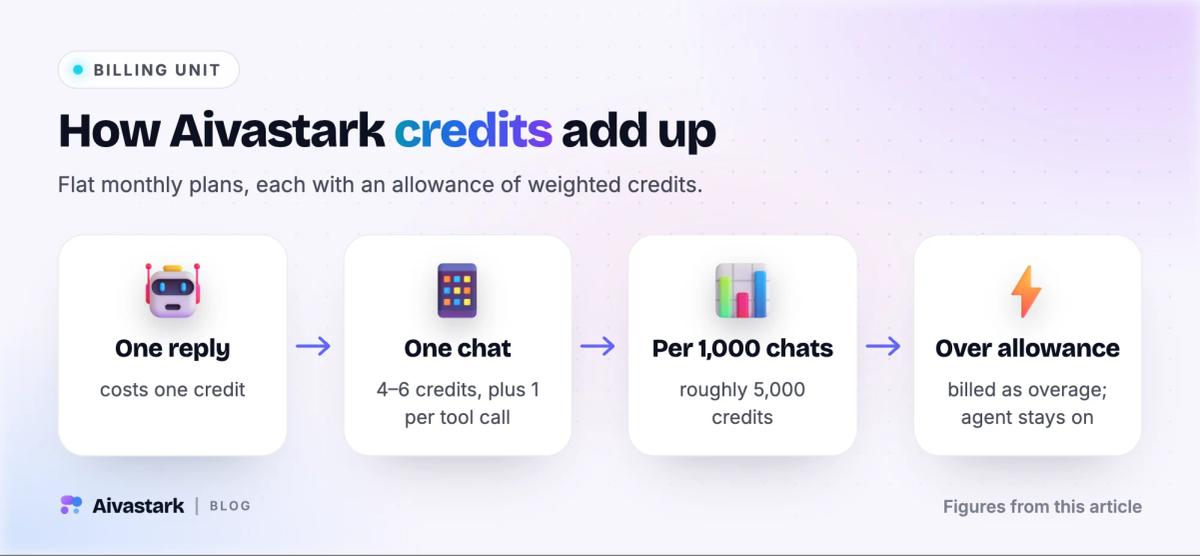
Aivastark prices by weighted credit, flat: Free ($0, permanent, 300 credits), Solo ($12, 1,000), Starter ($39, 5,000, 2 websites), Growth ($129, 25,000, 5 websites) and Scale ($319, 75,000, 15 websites), plus a sales-led Enterprise plan. A credit is one standard reply, so a typical four-to-six-reply support conversation costs four to six credits, plus one per tool step · call it roughly 5,000 credits per 1,000 conversations. Past the allowance, paid plans bill published overage ($1.20–$4.00 per 1,000 credits; $2 on Growth) rather than switching the agent off. Costs at common operational volumes for a small SaaS or e-commerce store:
| Workload | Aivastark | Chatbase comparable |
|---|---|---|
| 1 site · 1,000 conversations/mo (~5,000 credits) | $39 · Starter | Standard $150 (4,000 credits) plus a $40 recharge · about $190 |
| 5 sites · 5,000 conversations/mo (~25,000 credits) | $129 · Growth | Well past Standard's 4,000 credits · a larger plan or $40 recharges, plus $25 per extra agent |
| Agency · 20 client widgets across mixed volumes | $319 · Scale covers 15 websites; Enterprise beyond that | One agent per plan · $25/month per extra agent |
Two honest caveats. First, the table leaves the badge out (Aivastark's stays on below Scale; Chatbase drops it for $99 a month), and vendor pricing moves · always check the live pricing page before procurement. Second, Aivastark's 5-website cap on Growth is a real ceiling for agencies; Scale covers 15, and Enterprise is the plan beyond that.
Syed Anas, founder of Aivastark: "We didn't price Aivastark cheaper than Chatbase because we want a race to the bottom · we priced it flat because metered pricing makes agency P&L impossible to forecast. An agency owner can't quote a client $250/month for AI support if their underlying cost depends on whether the client's customers chat a lot in November."
RAG quality and knowledge-base ingestion
Both platforms answer from your own content, retrieving the relevant passages before they reply. The bigger difference is model choice: Chatbase lets you run the agent on OpenAI, Anthropic, Gemini, Mistral and others, while Aivastark picks and monitors the model behind standard answers and lets you switch a project to gpt-4o from Starter. On Aivastark, visitors don't see source citations; your team sees the passages behind each reply in the inbox "Why?" drawer.
Where the two diverge on ingestion: Aivastark ingests a website crawl, file uploads (PDF, DOCX, TXT and Markdown), hand-written FAQs, pasted text and your Shopify or WooCommerce catalogue. It doesn't connect to Notion or Google Drive, so content kept there needs exporting first. For the procurement-grade hallucination test methodology, see the 90-minute test rig in our fintech buyer's playbook · it works equally well as a generic vendor evaluation framework.
Setup speed and operational onboarding
Aivastark's headline is under 5 minutes from sign-up to a live widget for a typical site: add your URL, let it crawl, then paste one script tag or install the official WordPress plugin. We haven't timed Chatbase, so we don't quote a figure for it. Where the operational paths diverge is in vertical-specific deployment.
For a dental practice that wants bookings, a law firm that needs careful intake, or an e-commerce store needing live-order lookup, Aivastark's Starter plan adds booking into Google Calendar or Cal.com, Shopify and WooCommerce order tools, and industry guardrail presets for ten industries that add "refer, don't advise" rules. Chatbase has its own catalogue of ready-made actions (Stripe, Shopify orders and returns, Calendly, Cal.com, Salesforce), so compare the specific action you need. See how to add an AI chatbot to your website in 10 minutes for the generic deployment walkthrough.
When Chatbase is the right choice
Four scenarios where we'd recommend Chatbase over Aivastark, even after the comparison above:
- You want to choose the AI model. Chatbase offers OpenAI, Anthropic, Gemini, DeepSeek, Mistral and others. Aivastark picks the standard model, with gpt-4o as the one alternative from Starter.
- Your customers phone you. Chatbase has built-in voice and telephony from its $150 Standard plan. Aivastark has no phone line.
- You only need to drop the badge, at low volume. Chatbase Hobby plus the $99 add-on is $139 a month; Aivastark hides its badge only on Scale ($319/month).
- Your team has already standardized on Chatbase across multiple clients. If you've already trained 20 client teams to use Chatbase dashboards, the switching cost on workflow muscle memory is real. The savings from moving to flat-rate need to outweigh the retraining cost.
Outside of those cases · particularly if volume is what you pay for, you run several client sites from one account, or you want Telegram alongside WhatsApp, Instagram and Messenger · the migration math favors Aivastark.
Best fit by vertical
From Starter, Aivastark adds industry guardrail presets (ten industries, including dental and legal) to the tools below:
- Dental practices · 24/7 AI receptionist that answers treatment, hours, fees and insurance questions from your own information, books into Google Calendar or Cal.com, and hands patients to your front desk. It answers messages, not calls, and has no practice-management integration.
- Law firms · intake agent that answers from your practice-area pages and fee policy, collects matter details, books consultations and routes each enquiry to the right teammate. It is instructed not to give legal advice and runs no conflict checks.
- E-commerce stores · "where is my order?" answered with live Shopify or WooCommerce lookups, return and exchange requests filed for your team, delivery-address changes before shipping, and live products added to the cart. It never issues refunds or cancels orders.
How Aivastark compares to the rest of the alternative set
Chatbase shares its competitive set with several other named platforms. We've written up the most-asked comparisons on their own:
- Aivastark vs Intercom Fin · flat-rate vs per-outcome pricing math at 1k/5k/10k monthly conversations.
- Aivastark vs Twig · the AI front-desk comparison: Twig's Sera answers phone calls on every plan, and its $49 plan includes 500 chats.
- Aivastark vs Tidio · Tidio bills per billable conversation and prices Lyro on top; the same flat-versus-metered question, in the live-chat category.
- Aivastark vs Gorgias · the Shopify helpdesk comparison, where the AI Agent bills roughly $0.90–$1.00 per interaction.
Frequently asked questions
Is Aivastark just a Chatbase clone?
No. Both are AI agents that answer from your own content on your website, WhatsApp, Instagram, Messenger and email. The real differences are how many replies your money buys, what happens when you run out, and how much model choice you get: Aivastark includes far more replies per dollar; Chatbase lets you pick the model and adds phone voice.
Can I migrate from Chatbase to Aivastark without losing my training data?
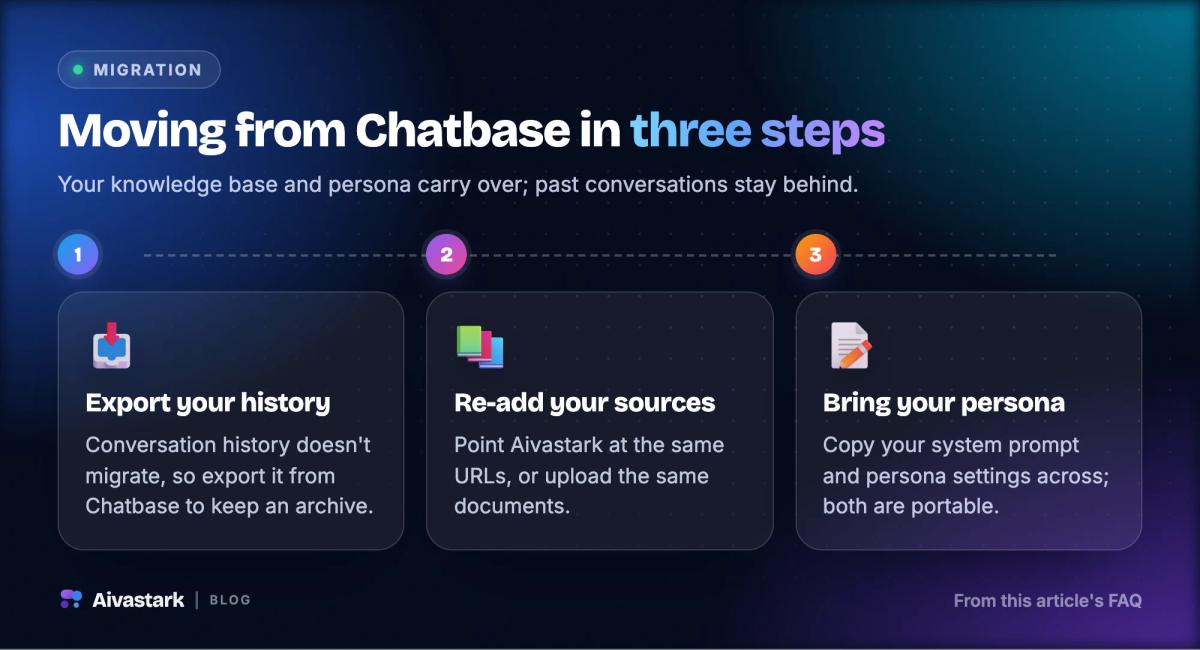
Yes. Knowledge-base content (URLs, PDFs, documents) ports cleanly · you re-point Aivastark at the same source URLs or upload the same documents directly. System prompt and persona configuration are portable. The conversation history is the one piece that doesn't migrate · you can export it from Chatbase for archival before switching.
Does Aivastark actually handle Instagram and WhatsApp natively?
Yes · both are included from the Starter plan ($39/month), alongside Messenger, Telegram and email, in one inbox with your website chats. The same agent answers on every channel and, with handoff on, passes the full thread to a person when asked. Chatbase includes WhatsApp, Instagram and Messenger from its $40 Hobby plan too.
What about the "Powered by Chatbase" badge?
Chatbase removes it with a $99/month add-on on any paid plan. Aivastark shows a small "Powered by Aivastark" badge by default on every plan and lets you switch it off on Scale ($319/month). On both, the agent carries your name, colours and persona.
Which platform is better for agencies?
It depends on volume. Aivastark lets one account run 2, 5 or 15 client sites (Starter, Growth, Scale) on a flat price. Every Chatbase plan includes one agent, and each extra agent is $25 a month. Neither offers white-labelling below Enterprise, and at low volume Chatbase is the cheaper way to drop the badge.
What's the hallucination rate difference?
We haven't published a head-to-head test, so we won't quote one. Run the 90-minute test rig from the fintech buyer's playbook on both free plans (300 replies a month on Aivastark, 50 on Chatbase) if regulatory exposure is high.
Why isn't Aivastark on the public listicles of "best Chatbase alternatives"?
Listicle inclusion is a function of how long a brand has been pitching the editors who maintain those pages. Aivastark is newer to the category and is in the process of pitching listicle editors directly. That's also why this comparison page exists · so procurement buyers evaluating Chatbase can find a fair side-by-side without waiting for third-party listicles to catch up.
Bottom line
Chatbase is a polished, established AI agent platform that earned its place in the category. If you want to choose the model, need phone voice, or only need to drop the badge at low volume, it's a defensible choice. If volume is what you're paying for, Aivastark is far cheaper per reply · from $12/month, $39 on Starter for 5,000 replies against 700 on Chatbase Hobby, WhatsApp, Instagram, Messenger, Telegram and email from Starter, and published overage instead of a hard stop.
See the live Aivastark pricing, or compare the rest of the category: Aivastark vs Intercom Fin for the per-outcome math, or Aivastark vs Twig for the phone-versus-messaging breakdown.
More questions
When is Chatbase the right choice over Aivastark?
If you want to choose the AI model (Chatbase offers OpenAI, Anthropic, Gemini, DeepSeek, Mistral and others), your customers phone you (Chatbase has voice from its $150 Standard plan; Aivastark has no phone line), you only need to drop the vendor badge at low volume (Chatbase Hobby plus its $99 add-on is $139 a month), or your team is already standardized on Chatbase across multiple clients.
Sources