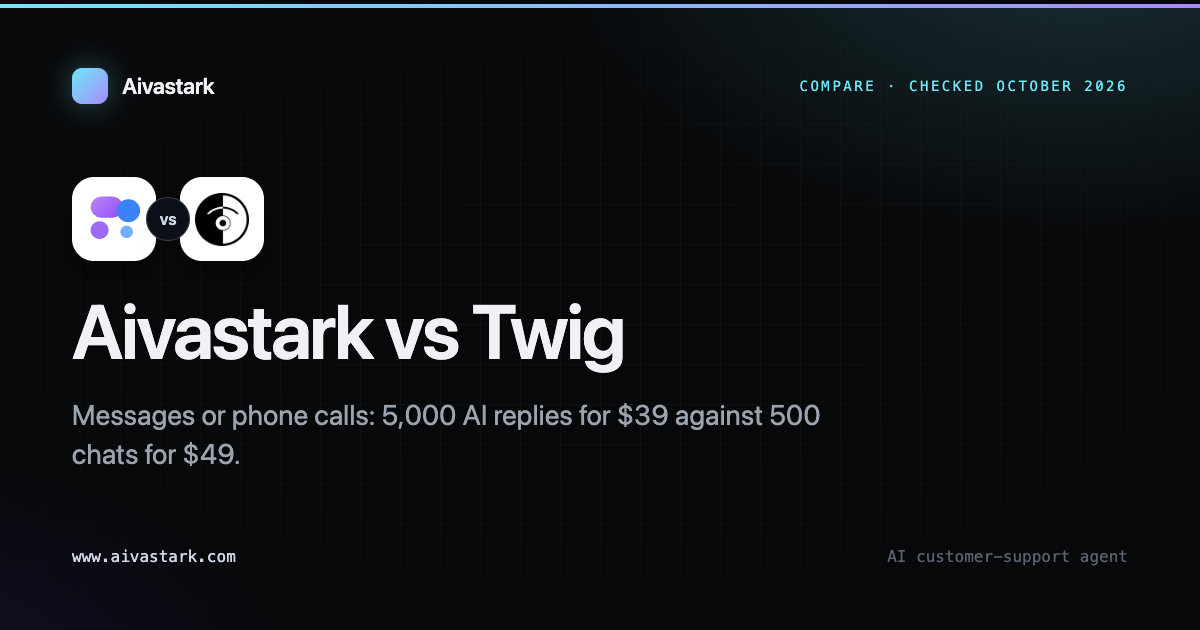
Aivastark vs Twig: choose Twig if your customers phone you, and Aivastark if they message you. Twig's Sera is an AI front desk that answers calls on every plan, from $49 a month for 500 chats. Aivastark answers messages from $12 a month, with 5,000 AI replies for $39 on Starter, a permanent free plan and no sales cycle.
Updated October 2026. Twig now sells Sera, a self-serve AI front desk, so this post has been rewritten around Twig's current plans, checked on 7 October 2026. For the side-by-side table, with every Twig figure sourced and dated, see Aivastark vs Twig.
Both answer questions, book appointments and hand off to a person. Twig aims Sera at appointment businesses that take calls; Aivastark is an AI customer-support agent built around messaging, on flat monthly plans from $12 to $319 and live in under 5 minutes. This post lays out where each is the correct procurement call.
The short answer (in one table)
| Factor | Aivastark | Twig |
|---|---|---|
| Built around | Messaging · website, WhatsApp, Instagram, Messenger, Telegram, email | Phone front desk (Sera) · plus SMS, web chat, email and WhatsApp |
| Pricing model | Flat monthly · five self-serve plans from $0 (free, permanent) to $319, plus Enterprise | Per chat, plus voice minutes |
| Entry paid plan | $12 Solo (1,000 replies) · $39 Starter (5,000 replies) | Twig Starter, $49 (500 chats, voice included) |
| Setup time | Self-serve · under 5 minutes, sign-up to a live widget | Twig sets up your number, knowledge base and booking during the trial |
| Phone calls | No phone line (in-widget voice calling is in beta) | Yes, on every plan (300 minutes on Twig Growth) |
| Appointment booking | From Starter ($39), into Google Calendar or Cal.com | From Twig Growth ($499) · not on Twig Starter |
| Human handoff | From Solo ($12) · when a customer asks for a person, sounds upset or still isn't helped | From Twig Growth ($499) · confidence-based escalation |
| Removing vendor branding | Badge hidden on Scale ($319) · custom white-label arrangements on Enterprise, on request | "Powered by Sera" removed on Twig Growth ($499) and Twig Scale |
| Free plan and trial | Free plan, permanent, no card · 7-day trial on paid plans, card required | No free plan · 15-day trial on every plan, no card |
| Industry fit | Industry guardrail presets · dentists, law firms, e-commerce | Dental, clinics and med-spas, home services, real estate, insurance, car dealers |
| Best fit | Customers who message you | Customers who phone you |
Aivastark allowances are counted in credits: a standard reply is 1 credit and a gpt-4o reply 10; images, voice and tool steps add more. Twig figures come from twig.so/pricing, the Twig homepage and twig.so/security, checked 7 October 2026.
Aivastark vs Twig: phone-first vs message-first, not enterprise vs SMB
The first version of this post filed Twig with enterprise autonomous-support platforms sold on annual, per-ticket contracts. Twig's own site now sells Sera, an AI front desk for small businesses, on self-serve plans from $49 a month. That puts Twig and Aivastark in front of the same buyer, often an appointment-based business, so they really are competing products.
The difference is the front door. Sera is built voice-first around a phone line and answers real calls on every plan. Aivastark doesn't take phone calls: it answers where people type, all into one inbox, including Instagram DMs, Messenger and Telegram, which Twig doesn't list. Functionally the products overlap; how your customers reach you is what separates them.
Total cost of ownership at three volumes
Twig prices per chat: $49 for 500, $499 for 2,000 with 300 voice minutes, and $100 per extra 1,000. Aivastark prices per AI reply: $39 for 5,000 on Starter, $129 for 25,000 on Growth, $319 for 75,000 on Scale, and $1.20–$4.00 per extra 1,000 depending on the plan. Starter is the first Aivastark plan with WhatsApp, Instagram, Messenger and booking, so the table starts there. Treat the numbers below as worked examples · check both pricing pages before you buy.
| Monthly conversations | Aivastark | Twig | What the Twig price includes |
|---|---|---|---|
| 500 | $39 (Starter: 5,000 replies, about 1,000 conversations) | $49 (Twig Starter: 500 chats) | Phone answering · booking and handoff need Twig Growth ($499) |
| 2,000 | $54 (Starter plus 5,000 extra replies at $3.00 per 1,000), or $129 on Growth | $499 (Twig Growth: 2,000 chats) | Phone answering, 300 voice minutes, booking and handoff |
| 10,000 | $179 (Growth plus 25,000 extra replies at $2.00 per 1,000), or $319 on Scale | $1,299 (Twig Growth plus 8,000 extra chats at $100 per 1,000) | As above · Twig Scale, which we didn't price, may cost less at this volume |
Two important caveats. First, the table assumes about five AI replies per conversation; if yours run longer, or use gpt-4o, images or tools, scale the Aivastark column up. Second, the Twig price includes something Aivastark doesn't sell: phone answering. If calls matter to you, this table compares different products, not two prices for the same one.
The answer-accuracy claim
Twig says Sera checks answers against sources before sending, with confidence-based escalation. Aivastark has no confidence threshold: it answers from your knowledge base (and, where that is thin, from general knowledge), your team sees the passages behind each AI reply in the inbox, and with human handoff on it hands over when the customer asks for a person, sounds upset or still isn't helped after repeated tries. Treat any vendor's description of its own accuracy like any self-reported benchmark · directionally useful, not substitutable for testing on your own data.
The procurement-grade method we recommend is the 90-minute hallucination-rate test rig documented in our fintech buyer's playbook: pick 20 questions from your real support inbox (12 easy, 5 adversarial, 3 edge-case), ingest your real knowledge base into the vendor's sandbox, run all 20, and measure the hallucination rate directly. A vendor's accuracy claim that holds up under that test is real; one that drops 4× when measured on your content is not ready for your workload.
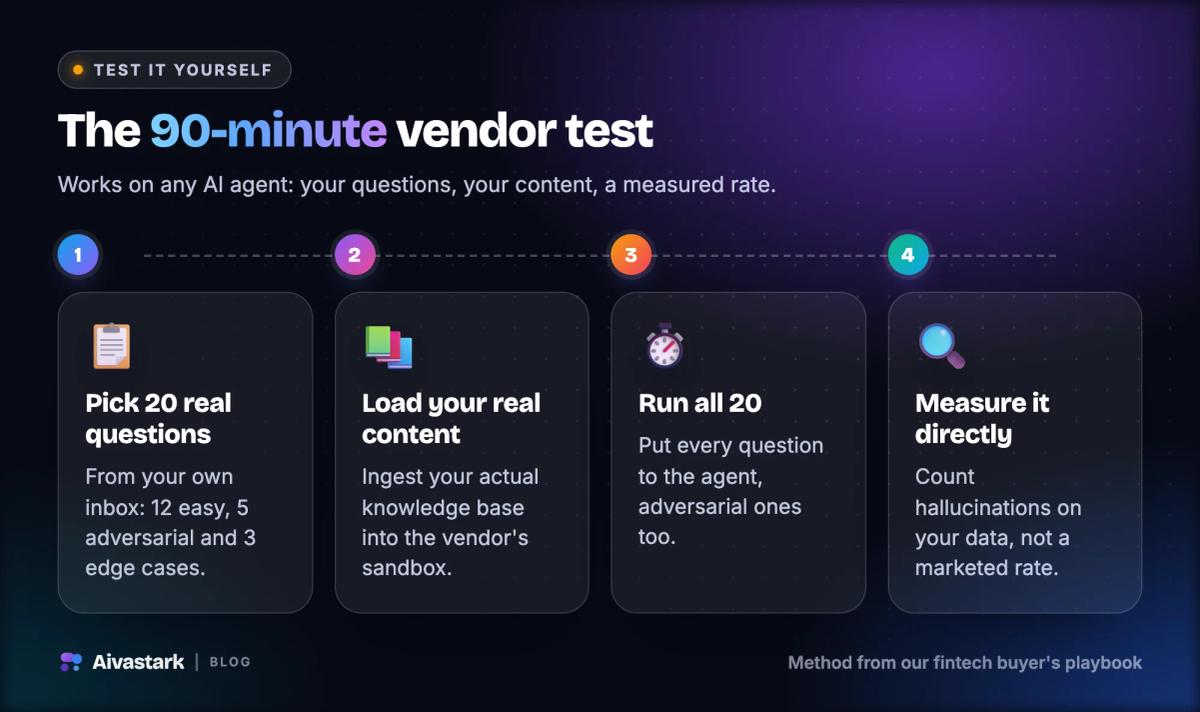
You can run it on Aivastark's free plan or 7-day trial, and on Twig during its 15-day trial. The outcome on either side should be the same: a measured hallucination rate on your data, not a marketed rate from the vendor's deck.
Phone-first vs widget-first deployment
Twig's deployment starts with a phone number, which Twig sets up during the trial along with your knowledge base and booking integration. Booking, missed-call recovery and human handoff are listed from Twig Growth ($499), not Twig Starter.
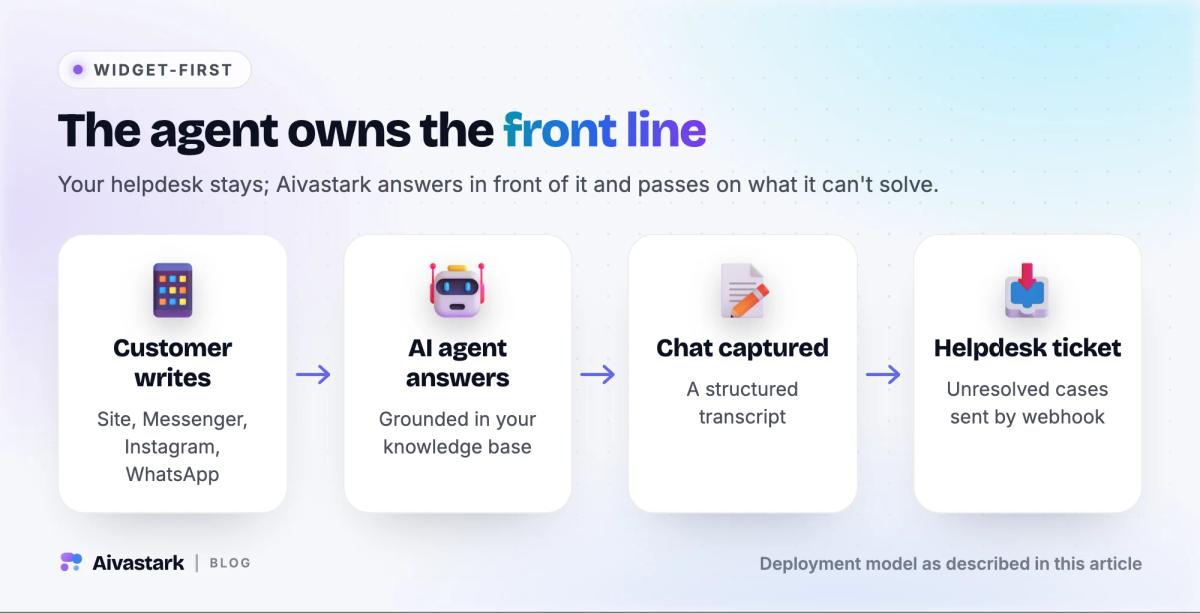
Aivastark's deployment model is widget-first and channel-first: the AI owns the front line on your website on every plan, and on WhatsApp, Instagram, Messenger, Telegram and email from Starter, with every conversation in one inbox. Unresolved cases can become tickets pushed to Zendesk, Freshdesk, HubSpot or a webhook. Either deployment works · teams whose phone rings all day skew toward Twig's model; teams that want the AI agent owning the website and the DMs from day one skew toward Aivastark.
When Twig is the right choice
Twig is the correct procurement call in three scenarios:
- Your customers phone you. Sera answers real calls on every plan, from Twig Starter at $49 a month. Aivastark has no phone line: in-widget voice calling (beta) is on Growth, but there's no phone number.
- You want calls, texts and chats in one agent. Sera covers phone, SMS, web chat, email and WhatsApp, so a conversation that starts in chat can finish on a call. Aivastark has no SMS channel.
- You need SSO/SAML sign-in or a done-for-you setup. Twig lists SSO/SAML and sets up your number, knowledge base and booking integration during the trial. Aivastark doesn't offer single sign-on, and setup is self-serve, with done-for-you setup on request.
Outside of those three, particularly for online stores and any team whose customers message on Instagram, Messenger or Telegram, which Twig doesn't list, or that wants booking on the entry plan rather than from $499, Aivastark is the better fit.
Best fit by vertical
Aivastark ships industry guardrail presets from Starter, which add conservative rules for dental, legal, e-commerce and other industries on top of the standard setup. Twig pitches Sera at some of the same businesses, dental practices among them, so for those the phone-or-messages question decides it:
- Dental practices · answers patients' questions about treatments, hours, fees and insurance from your own information, books into Google Calendar or Cal.com, and hands the rest to your front desk. There is no practice-management integration, and Aivastark doesn't sign HIPAA business associate agreements, so keep treatment details out of the chat. If most patients phone, Twig may suit you better.
- Law firms · intake agent that answers prospective clients from your practice-area pages and fee policy, collects the details of their matter, books the consultation and routes each enquiry to the teammate you choose. Your team runs the conflict check from the details it collects. Any practice area you describe in your own content works.
- E-commerce stores · WISMO, returns, sizing and shipping questions. On Shopify and WooCommerce the agent looks up the real order, files return requests once the shopper confirms, shows live products and adds them to the cart; it never issues refunds or cancels orders. On other platforms it answers from your content but can't look up orders.
How Aivastark compares to the rest of the alternative set
Twig now sits with AI receptionists that answer the phone. Aivastark sits with AI support agents that answer by message, such as Chatbase and Intercom Fin, and covers appointment businesses on its AI receptionist page. We've written the two adjacent comparisons in their own posts:
- Aivastark vs Intercom Fin · flat-rate vs per-outcome pricing at 1k/5k/10k monthly conversations.
- Aivastark vs Chatbase · AI replies per dollar, channels and branding, and where Chatbase's choice of AI models wins.
Frequently asked questions
Is Aivastark trying to compete with Twig?
For the same buyer, yes; on the same channel, no. Both are AI agents for small businesses that answer questions, book appointments and hand off to a person. Twig's Sera is built voice-first around a phone line and answers calls on every plan; Aivastark is built around messaging and has no phone line. Which one fits depends mostly on how your customers reach you.
Can Aivastark match the answer checking Twig markets?
Accuracy is primarily a function of knowledge-base quality, not platform. Twig says Sera checks answers against sources before sending; Aivastark shows your team the passages behind each reply and hands off when a customer asks for a person, sounds upset or still isn't helped. On a sparse or contradictory knowledge base, neither will do well. The procurement question isn't "what does the vendor claim?" · it's "what rate do they hit on your data?" Use the 90-minute test rig on both.
When should I shortlist Twig over Aivastark?
When your customers phone you: Sera answers calls on every plan, and Aivastark has no phone line. Also when you want calls, texts and chats in one agent, or need SSO/SAML sign-in. If your customers message you, Aivastark is the simpler and cheaper fit: $39 buys 5,000 AI replies against $49 for 500 chats on Twig Starter.
Does Aivastark integrate with my existing helpdesk?
Yes · unresolved conversations can become tickets pushed to Zendesk, Freshdesk, HubSpot or a webhook; captured leads go to your own systems or HubSpot through the lead webhook; and conversations can be exported as CSV. Aivastark doesn't replace your helpdesk · it owns the front-line AI layer in front of it.
What about audit trails and compliance?
Every conversation lands in your inbox with the full thread, your team sees the passages behind each AI reply, and a team activity audit log comes with Starter. A GDPR Data Processing Agreement is included on every plan, and Aivastark doesn't train or fine-tune AI models on your data. It holds no compliance certification and doesn't sign HIPAA business associate agreements. For regulated industries, see also our fintech buyer's playbook.
What's the migration path from Twig if I'm already deployed there?
Knowledge-base content ports cleanly · point Aivastark at the same website pages and documents. Booking works through Google Calendar or Cal.com, and Calendly can send your booking link. Phone handling doesn't carry over, and conversation history doesn't transfer, so export it from Twig first if you need it.
Why is Aivastark cheaper per conversation · is there a feature gap I'm missing?
Partly because the plans buy different things: Twig's price includes phone answering and voice minutes. The gap is real · no phone calls, no SMS, no SSO, and self-serve setup, with done-for-you setup on request. For teams that need those exact features, that's the gap. For teams whose customers message them, they aren't on the requirements list.
Bottom line
Twig is a real AI front desk that earns its place for businesses whose customers phone them, with booking and handoff from $499. Aivastark replaces the AI front line at $12–$319/month flat for teams whose customers message them, with booking from $39.
If most of your enquiries arrive as calls, trial Twig and run the 90-minute test rig on it. If they arrive as messages, the table above shows how far flat-rate pulls ahead of per-chat pricing as volume grows, and Aivastark is the cleaner procurement call.
See the live Aivastark pricing, the side-by-side Aivastark vs Twig table, or compare the adjacent options: Aivastark vs Intercom Fin for the per-outcome math, or Aivastark vs Chatbase for the channels and branding breakdown.
Sources