
Introduction
The basic unit of knowledge work is changing. Traditional chatbot interactions tend to be short and self-contained — one question, one answer. Agentic AI breaks that pattern entirely. Agents can now work independently for minutes or even hours at a stretch, calling on tools, interacting with real environments, and iterating repeatedly until they arrive at a solution. This shift is quickly making agents the most powerful category of AI tools for getting real work done.
OpenAI's new economic research paper looks at how its own coding and agent tool, Codex, has been adopted both inside the company and by external users — and the numbers show just how fast agentic AI is reshaping the workplace.
 ## From Chatbots to Agents: The Shift Inside OpenAI
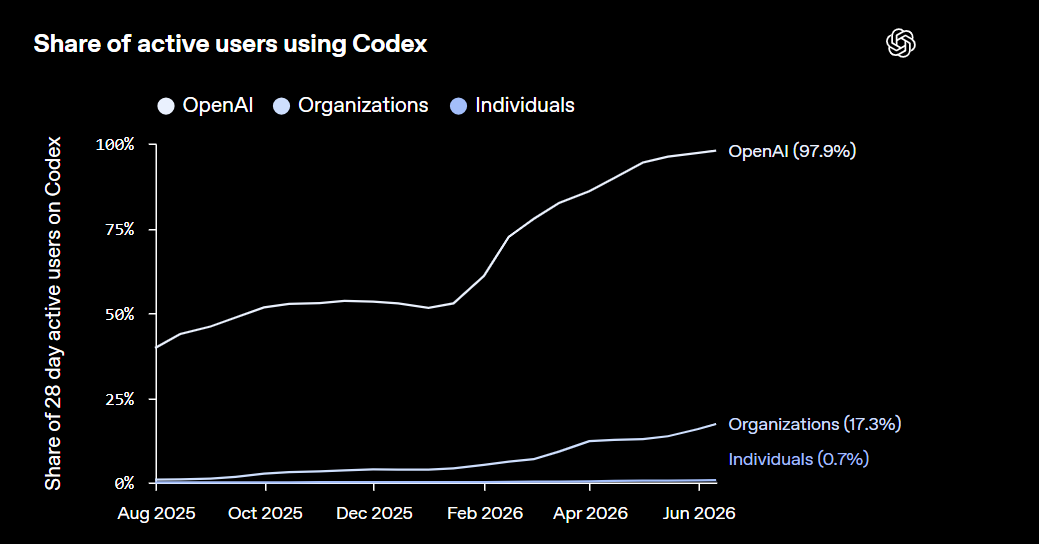
When Codex first launched, ChatGPT remained the default AI tool for work at OpenAI. Through August 2025, the average OpenAI employee spent less than 10% of their AI usage on Codex.
That has changed dramatically. Today, every department at OpenAI — including non-technical ones like Legal and Recruiting — uses Codex as its primary AI tool. This is no longer a story about engineers alone; it has become a company-wide shift.
 ## Four Major Trends Identified in the Report
Across individual users, organizations, and OpenAI's own workforce, the report highlights four consistent trends:
1. People Are Delegating Longer, Harder Tasks to Codex
By May 2026, 80.6% of sampled individual users had made at least one Codex request estimated to exceed 30 minutes of human work. 70.2% had made a request exceeding one hour, and 25.6% had made at least one request estimated to exceed eight hours of equivalent human effort.
2. Codex Became the Primary Tool for Every Department
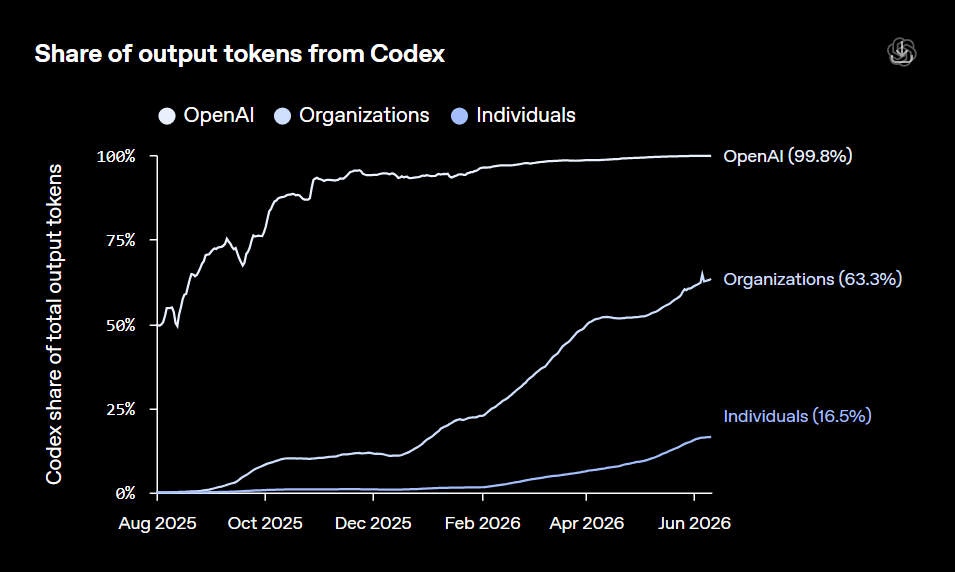
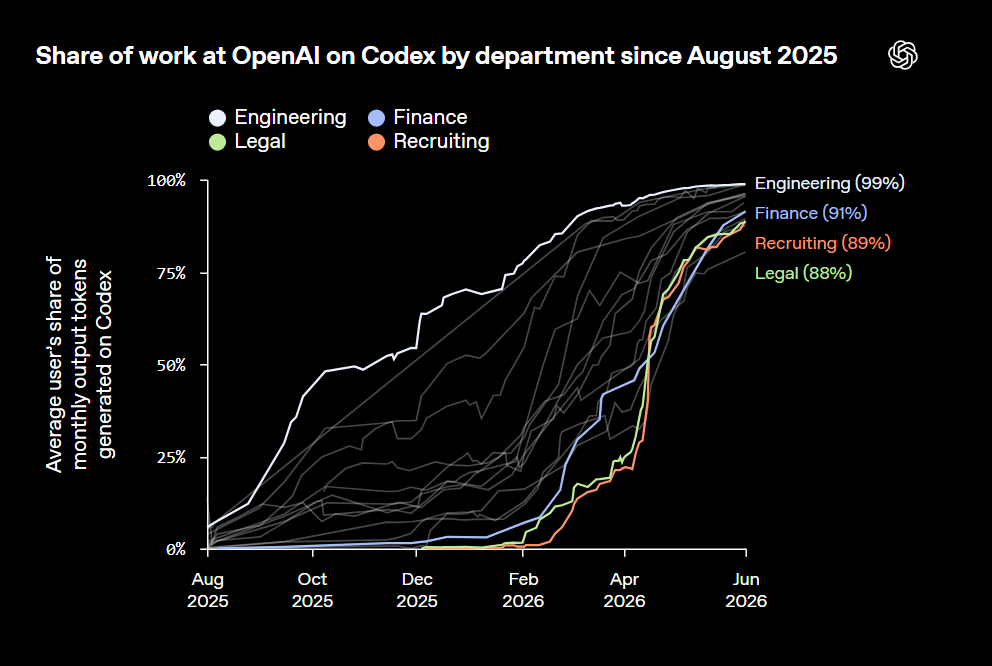
Engineering adopted Codex first, but Legal, Finance, and Recruiting crossed over to making Codex their primary AI tool around April 2026. For the average OpenAI employee, Codex now accounts for more than 85% of output tokens. Among Codex users specifically, it accounts for 99.8% of all weekly output tokens generated within the company.
3. Non-Developers Adopted Faster Than Developers
This is arguably the most striking trend: non-developers picked up Codex even faster than developers did. Since August 2025, non-developer usage has grown 137x among individual users, 189x among organizational users, and 12x within OpenAI itself.
4. Employees Began Doing Work Outside Their Job Description
Non-technical employees started using Codex to take on tasks once considered strictly technical — including automation, data transformation, tooling, debugging, and structured analysis.
Agents Are Working Longer Hours on Harder Tasks
Nearly a quarter of all Codex requests now correspond to tasks that would take a person more than an hour to complete. As Codex became more capable, users shifted away from short, simple queries toward longer and more complex work.
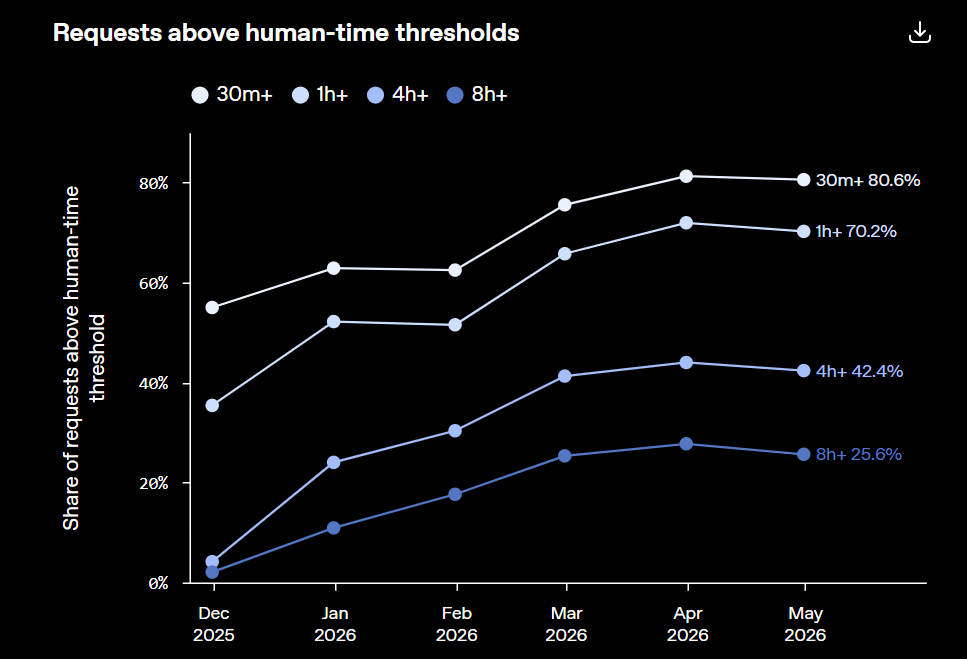 From December 2025 to May 2026, the share of users making requests equivalent to more than 30 minutes of human work rose to 80.6%, and requests equivalent to more than one hour rose to 70.2%. The fastest-growing category, though starting from a much smaller base, was requests equivalent to more than eight hours of work, which climbed to 25.6%.
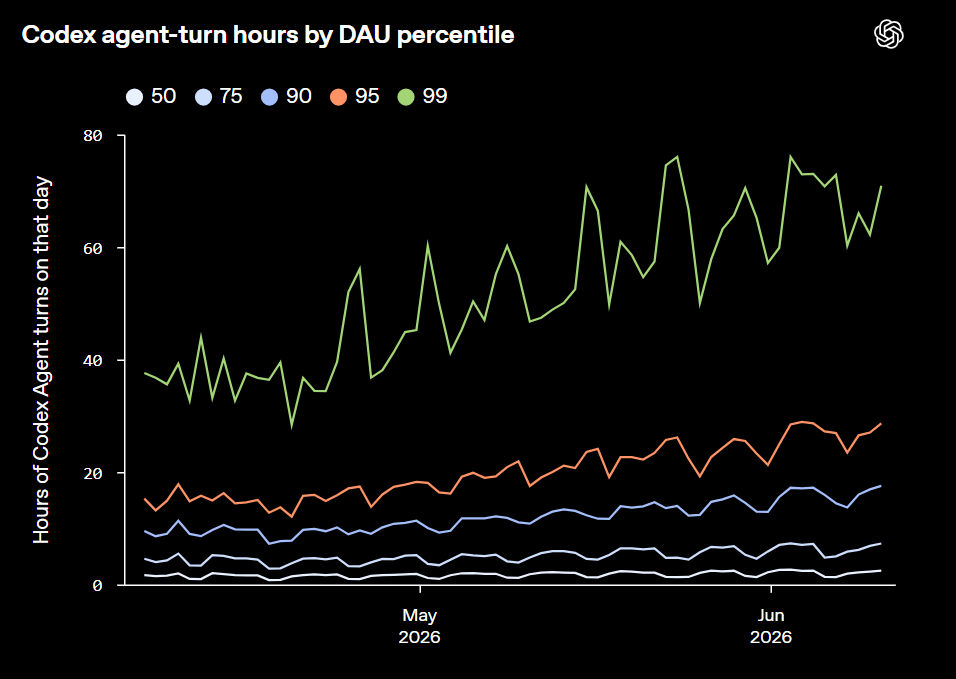
The scale of this shift also shows up in daily usage patterns. By June 2026, the heaviest users at OpenAI (the 99th percentile) were regularly generating more than 60 hours of Codex agent runtime in a single day — spread across multiple parallel agents running at once.
 ## Adoption Is Moving from Engineers to the Rest of the Company
Engineers were the first at OpenAI to adopt Codex, and they did so gradually — the average engineer shifted the majority of their work to Codex by December 2025, and today generates 99% of their output tokens through Codex rather than ChatGPT.
Legal, Finance, and Recruiting crossed over to majority Codex use later, around April 2026 — but their transition happened much faster once it started. Lawyers and recruiters at OpenAI now generate more than 85% of their output tokens on Codex.
 Usage has also deepened sharply across departments over the past six months. By June 2026, Research saw the biggest jump — median usage was roughly 53 times higher than in November 2025. Customer Support grew 32x, Engineering grew 26x, and Legal, while growing more gradually, still reached about 12x its November level.
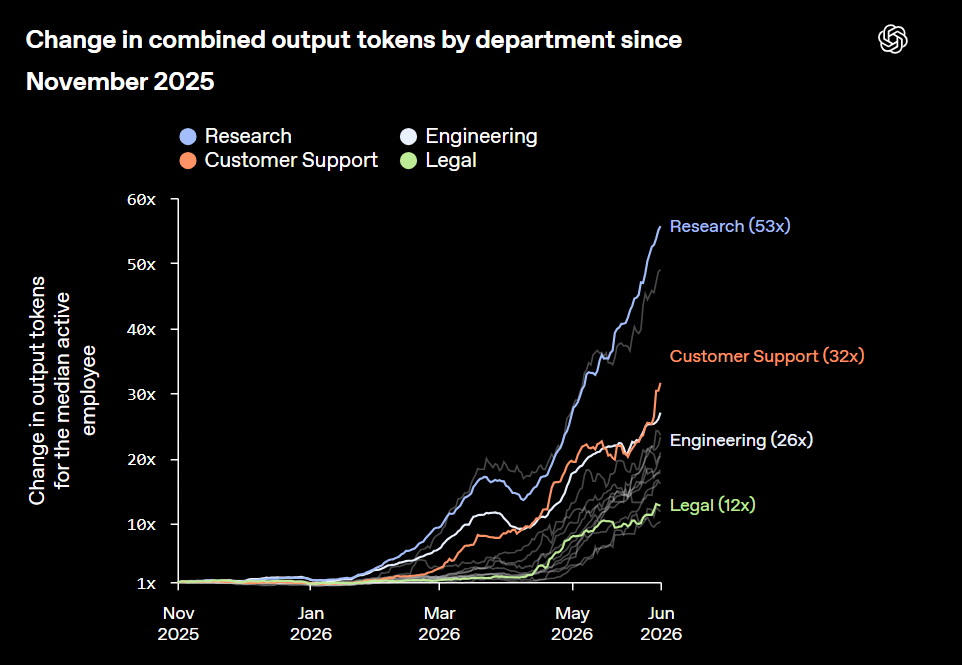 Together, these two patterns show a clear shift across OpenAI: employees are moving from chatbot-style interactions to agent-driven work, and the volume of agentic labor being deployed is growing exponentially.
Non-Developers Are the Fastest-Growing User Group
Across every population studied — OpenAI employees, organizations, and individuals — Codex adoption began with developers, which makes sense given its origins as a coding tool. But as Codex expanded into broader knowledge work, non-developer adoption grew even faster than developer adoption.
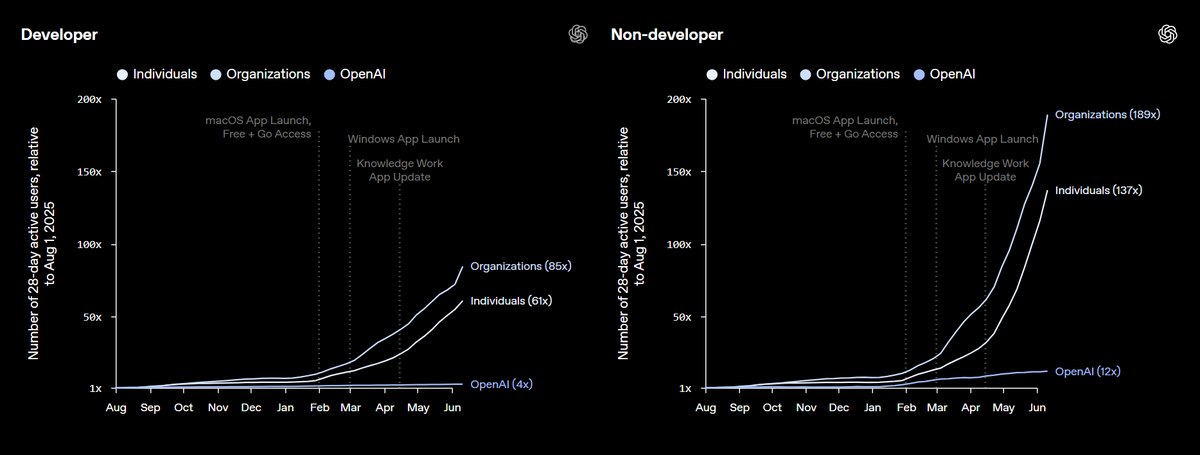 By early June 2026, non-developer individual users had grown 137x since August 2025. Non-developer organizational users grew 189x, and non-developer users within OpenAI grew 12x. This doesn't mean every non-developer is using Codex the way an engineer would — it means a much broader range of people are now using it for some form of agentic work.
Codex Is Expanding the Boundaries of What Counts as "Your Job"
One of the more revealing findings is that Codex use isn't staying neatly within department lines. The chart below compares people's inferred occupations against the actual type of work being done in Codex.
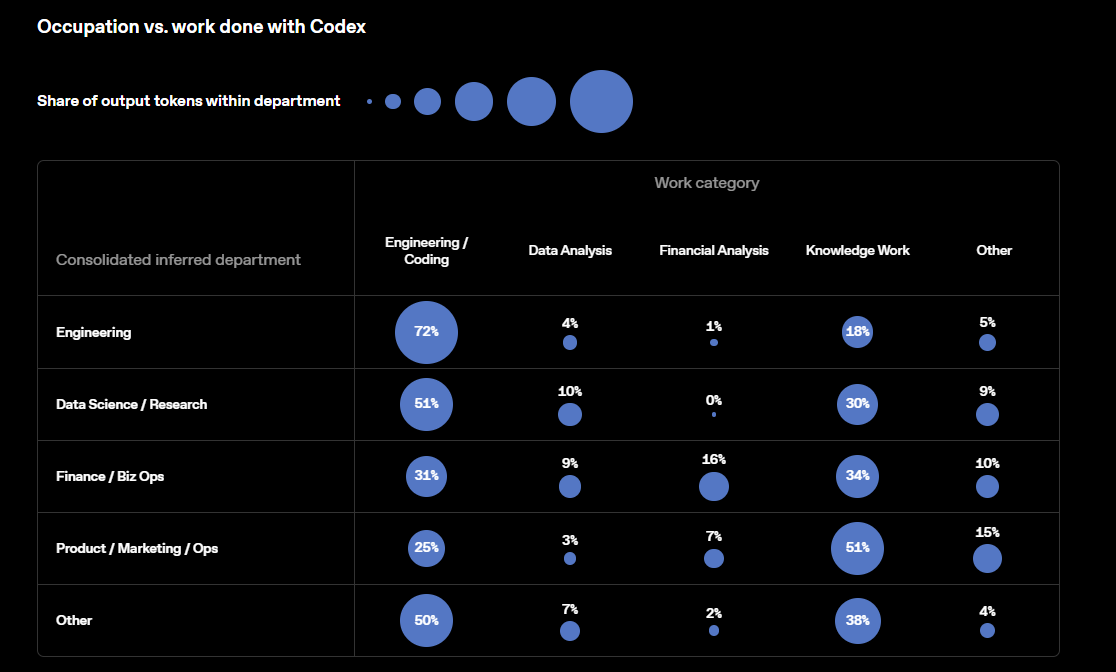 Engineering and coding remain the largest category of work for Engineering and for Data Science/Research teams. But for Finance/Biz Ops, Product/Marketing/Ops, and other departments, general knowledge work dominates — while still drawing meaningfully on data and financial analysis.
Notably, more than a quarter of all Codex work done by people in business functions was engineering or coding-related. That suggests agentic tools are lowering the cost of crossing task boundaries, letting employees take on adjacent work that previously required dedicated technical support.
| Department | Engineering/Coding | Data Analysis | Financial Analysis | Knowledge Work | Other |
|---|---|---|---|---|---|
| Engineering | 72% | 4% | 1% | 18% | 5% |
| Data Science/Research | 51% | 10% | 0% | 30% | 9% |
| Finance/Biz Ops | 31% | 9% | 16% | 34% | 10% |
| Product/Marketing/Ops | 25% | 3% | 7% | 51% | 15% |
| Other | 50% | 7% | 2% | 38% | 4% |
What This Means for the Future of Work
The report suggests that when people are given broad, low-friction access to capable agentic tools, they naturally gravitate toward longer, more complex, and more cross-functional work. This matters for three groups in particular:
- Businesses that need to rethink how workflows are designed around agentic tools rather than single-turn AI interactions.
- Employees, who will need to develop the skills that remain valuable as agents take on more delegated work.
- Policymakers and researchers, who need better data to understand how agentic AI is reshaping the labor market.
OpenAI's own internal experience is presented as a preview of what may become the broader norm: as agentic tools keep improving, work itself is likely to shift toward longer, harder, and more cross-functional tasks — carried out with the help of AI agents working alongside, and increasingly on behalf of, human employees.
Frequently asked questions
Q: What is Codex, according to this report?
A: Codex is OpenAI's agentic AI tool, originally built for coding, that can now handle long, independent tasks across technical and non-technical work.
Q: Are non-technical employees really using AI agents like Codex?
A: Yes — non-developer adoption at OpenAI, in organizations, and among individuals grew faster than developer adoption over the past year.
Q: How long can AI agents like Codex work independently?
A: Some users now delegate tasks equivalent to 8+ hours of human work, and top users run over 60 hours of agent work per day across parallel tasks.
Q: Which departments adopted Codex fastest?
A: Engineering adopted first, but Legal, Finance, and Recruiting later crossed over to majority Codex use even faster once they started.
Sources