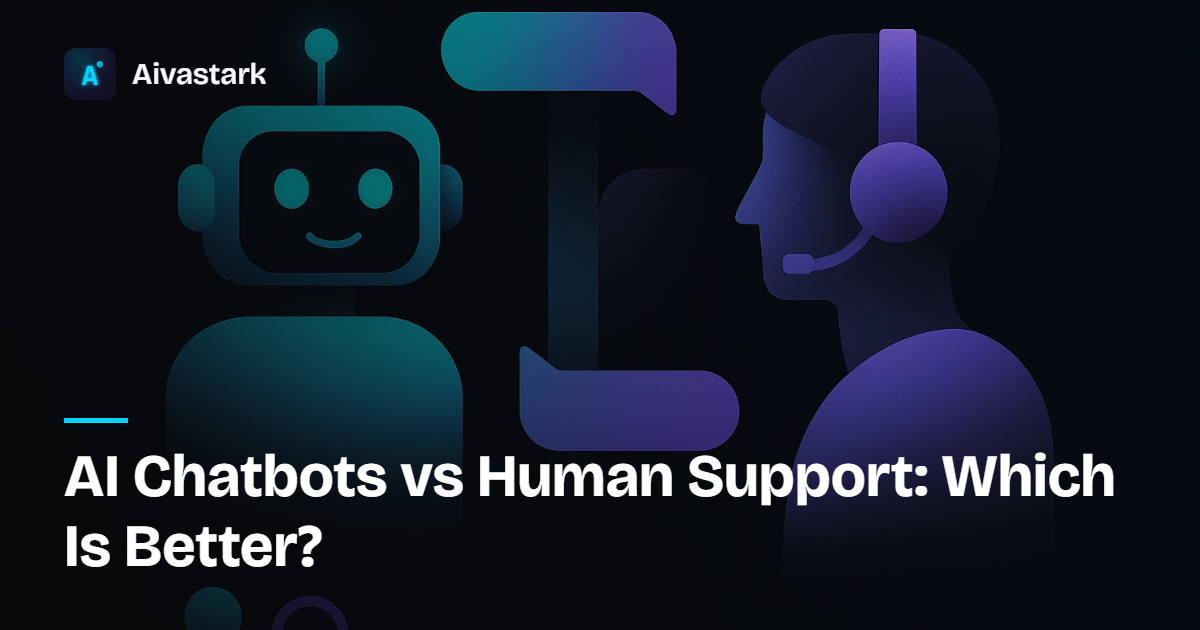
The debate over AI chatbots vs human support has moved from a fringe conversation among CX leaders to a boardroom-level decision that shapes budgets, staffing, and customer loyalty. On one side, AI promises instant answers at infinite scale. On the other, human agents offer the empathy and judgment that no algorithm has fully replicated. If you run a support team—or you're deciding how to build one—you're not really asking which side wins outright. You're asking where each approach earns its place, and how to combine them without frustrating the people you serve.
This article breaks down the real evidence on both sides, looks at what happens when the two go head-to-head in controlled testing, and lays out a practical framework for finding the right balance for your brand.
AI Chatbots vs Human Support: Defining the Two Approaches
Before comparing performance, it helps to be precise about what each term actually means.
AI chatbots are software agents—usually powered by natural language processing and, increasingly, large language models—that interact with customers via chat or voice. They simulate a conversation to answer questions, guide users through processes, and resolve routine issues without a human in the loop. As Flatline Agency notes, these agents are designed to help customers at scale while operating around the clock.
Human support refers to live customer service representatives who assist customers through channels like live chat, email, and phone. Humans bring context, discretion, and emotional intelligence—qualities that matter most when a situation is sensitive, ambiguous, or high-stakes.
Adoption of the AI side is accelerating fast. Gartner has predicted that roughly 80% of companies will use chatbots in some capacity, a signal that automation is becoming table stakes rather than a differentiator. But adoption speed shouldn't be mistaken for a verdict. The real question isn't "Which one replaces the other?" It's how to strike a balance that serves both efficiency goals and customer expectations. As industry analysts increasingly emphasize, the most effective strategies treat AI as a complement to human agents—not a substitute.
If you want a deeper distinction between conversational bots and more autonomous systems, our guide on AI Agent vs AI Chatbot: What's the Difference? unpacks the nuances.
Where AI Chatbots Win: Speed, Scale, and Availability
There are categories of support where AI is simply hard to beat, and pretending otherwise ignores measurable business results.
Always-on availability
Customers now expect help the moment they need it, regardless of time zone or business hours. Human agents work in shifts; chatbots don't. As Kortical points out, intelligent chatbot software runs 24/7 without human intervention, delivering consistent, uninterrupted assistance. The next generation of support teams, as Crisp argues, won't win by adding more agents—they'll win by designing systems that never sleep yet still feel human.
Instant responses and high-volume handling
AI excels at first-response time and at absorbing large volumes of repetitive, standardized queries—password resets, order status checks, "where's my refund," and basic onboarding questions. These are the tickets that bog down human agents with time-consuming busy work. Offloading them to automation frees your specialists to focus on the interactions that actually require a person.
Measurable business impact
The results back this up. According to Master of Code Global's 2026 statistics:
- 91% of businesses using AI in support units are satisfied with the effects.
- 69% report improved customer service.
- 55% report decreased wait times.
- 54% report more streamlined workflows.
On top of that, conversational AI has measurably boosted customer service specialists' productivity by automating low-value tasks. That's the core value proposition: AI doesn't just answer faster, it changes what your human team spends their time on. If you're evaluating platforms that deliver these outcomes, our roundup of the best AI customer support software in 2026 compares leading options.
Where Human Agents Win: Empathy, Trust, and Complexity
Now for the other side of the ledger—and it's a sobering one for anyone tempted to automate everything.
Customer sentiment strongly favors people. A SurveyMonkey study cited by both Forbes and ClairVista found that 79% of customers prefer interacting with a human over an AI agent, while only 8% prefer AI. That preference is stronger among women.
The trust gap goes further. Gartner data reported by ClairVista shows:
- 64% of customers prefer companies that do not use AI for customer service.
- 53% would consider switching providers if AI is used.
The single most common complaint isn't that bots are inaccurate—it's the difficulty of reaching a human. When customers feel trapped in automated loops with no escape hatch, frustration compounds fast. Kustomer reports that 42% of British consumers admit being ruder to AI chatbots, often precisely because they feel misunderstood or stuck.
The real risk of over-automating isn't a slightly worse answer—it's eroded trust. When customers can't reach a person on a high-stakes issue, they don't just lower their CSAT score; they start planning their exit.
This is where humans win decisively: emotional nuance, judgment under ambiguity, de-escalation of upset customers, and any situation where being heard matters as much as being answered. For regulated or sensitive industries—think our guidance on AI chatbots for legal firms—the human escalation path isn't optional. It's a requirement.
Head-to-Head: What Real Testing Reveals
Preferences and statistics are useful, but controlled testing tells a more concrete story. The team at Betterproposals ran a direct comparison of AI versus human live chat, keeping the test fair by using live chat only—no "we'll get back to you in 2–3 business days" email delays.
Both AI bots and human agents received the same questions, split across three categories:
- Onboarding
- Billing
- Technical support
Each interaction was then evaluated on three metrics:
- First response time
- Resolution time
- Accuracy and understanding
The pattern that emerged is consistent with everything above. AI dominated on speed—first response times were near-instant, and for straightforward queries, resolution was quick. But humans edged ahead on nuanced accuracy and genuine understanding, especially when a question required reading between the lines or handling an edge case the bot hadn't been trained on. Nextiva reaches a similar conclusion: AI is exceptional at streamlining routine tasks and is popular with customers who want self-service, while more complex queries still benefit from a person.
Interestingly, the empathy gap may be narrowing on paper. Kustomer notes that 71% of CX organizations believe AI agents can be empathetic. But belief among CX leaders and skepticism among actual customers are two different things—and the customer skepticism, as we've seen, remains high. The takeaway: test on your real ticket types before deciding what to automate. Averages hide the categories where AI quietly fails.
| Dimension | AI chatbot | Human agent |
|---|---|---|
| First response time | Near-instant | Depends on queue depth |
| Resolution time, straightforward queries | Quick | Slower |
| Accuracy on nuanced or edge-case questions | Weaker — misses subtext | Stronger |
| Availability | 24/7 | Shift-bound |
| Handling a volume spike | Absorbs it at no extra cost | Only by hiring |
| Perceived empathy | 71% of CX organisations believe AI can be empathetic; customers stay sceptical | Trusted |
The Winning Answer: A Hybrid Human + AI Model
If you've been keeping score, you've probably already reached the conclusion the research supports: neither approach wins alone. The strongest strategy is a hybrid model where AI and humans each do what they're best at.
Harvard Business School's Working Knowledge captures the current consensus well:
"AI currently works best as a complement to human intelligence, rather than a replacement." — Harvard Business School Working Knowledge
The most useful framing comes from Kustomer's best-practices research: think of AI not as a replacement for agents, but as an agent's co-pilot—a tool that amplifies human capabilities to deliver faster, more accurate, and more personalized support. In practice, that means:
- AI handles first contact, deflects repetitive tickets, and drafts responses for agents to review.
- Humans take over the moment complexity, emotion, or high stakes enter the conversation.
- Clear escalation paths exist for VIP customers and high-priority cases, so the most valuable relationships never get stuck in a loop.
Real brands are already operating this way. Kustomer highlights UntuckIt, the menswear retailer, blending live human agents with AI in their support flow—AI handles the front line, and humans step in seamlessly when needed. For ecommerce operations specifically, this blend maps neatly onto the customer journey; our piece on AI chat commerce from add to cart to checkout shows how automation and human intervention can coexist across the funnel.
How to Implement the Right Balance for Your Brand
Knowing hybrid is the answer is easy. Building it well is the hard part. Here's a practical framework.
1. Automate the repetitive, route the complex
Start by auditing your ticket volume. Identify the high-frequency, low-complexity queries—shipping status, hours, password help, basic FAQs—and automate those first. Route anything involving nuance, negotiation, or emotion to a human. This is the single highest-ROI move, because it captures the productivity gains without exposing customers to AI in the moments where they least tolerate it.
2. Be transparent, and always offer a human
Transparency is non-negotiable. Clearly tell users when they're talking to a bot, and reassure them that a human is available. This matters more than most teams realize: 88.8% of consumers believe it's essential that brands always offer the option to speak with a human. Hiding the bot or burying the escape hatch is the fastest way to trigger the switching behavior we saw earlier.
3. Match support type to segment, channel, and complexity
Not every customer or channel deserves the same treatment. Segment by value, urgency, and query type. A first-time buyer with a simple question is an ideal candidate for AI self-service; an enterprise account reporting a billing error deserves an immediate human path. The right split varies dramatically by industry—support expectations for dental practices or real estate differ from those in SaaS or fintech. Tune your model to your customers, not to a generic benchmark.
4. Measure, then tune the split continuously
The human-AI balance isn't a one-time setting—it's a dial you adjust based on data. Track:
- Resolution rate (and specifically AI resolution rate before escalation)
- CSAT, broken down by AI-handled vs human-handled interactions
- Escalation rate and what triggers it
- First response and resolution times across both paths
When AI resolution rates climb and CSAT holds steady, you can safely automate more. When escalations spike in a given category, pull it back. This feedback loop is what separates a hybrid model that improves over time from one that quietly annoys customers.
For teams ready to deploy, choosing the right foundation matters. If you're deciding whether to build in-house or adopt a proven platform, our comparison of a white-label AI chatbot vs building your own walks through the tradeoffs in cost, speed, and control.
The Bottom Line
The honest answer to AI chatbots vs human support is that framing it as a competition is the mistake. AI wins on speed, scale, and 24/7 availability, with hard numbers—91% business satisfaction, 55% reduced wait times—to prove it. Humans win on empathy, trust, and complexity, backed by an equally hard reality: 79% of customers still prefer them, and more than half will switch over bad automation.
The businesses that come out ahead treat AI as a co-pilot, not a replacement. They automate the routine, keep humans on the meaningful, stay transparent, always offer an off-ramp to a person, and measure relentlessly. Get that balance right, and you don't have to choose between efficient and human—you get both.
Ready to build a support experience that blends automation with a clear human path? Explore what Aivastark offers, dig into the features, or see how it fits your sector on our industries overview.
Frequently asked questions
Do customers prefer AI chatbots or human support?
Customers strongly prefer humans. A SurveyMonkey study found 79% of customers prefer interacting with a human over an AI agent, while only 8% prefer AI. Additionally, 88.8% believe it's essential that brands always offer the option to speak with a human.
Where do AI chatbots outperform human agents?
AI chatbots excel at always-on 24/7 availability, instant first-response times, and handling high volumes of repetitive, standardized queries like password resets, order status checks, and basic onboarding questions.
Where do human agents outperform AI chatbots?
Humans win decisively on emotional nuance, judgment under ambiguity, de-escalation of upset customers, and any situation where being heard matters as much as being answered—especially in regulated or sensitive industries.
What is the best model for combining AI and human support?
A hybrid model where AI acts as an agent's co-pilot: AI handles first contact, deflects repetitive tickets, and drafts responses, while humans take over the moment complexity, emotion, or high stakes enter the conversation, with clear escalation paths for VIP customers.
What does testing reveal about AI vs human support?
Controlled testing across onboarding, billing, and technical support found AI dominated on speed with near-instant first responses, but humans edged ahead on nuanced accuracy and genuine understanding, particularly on edge cases and questions requiring reading between the lines.
How do you implement the right balance of AI and human support?
Automate high-frequency, low-complexity queries first and route complex ones to humans; be transparent and always offer a human; match support type to segment, channel, and complexity; and continuously measure and tune the split using resolution rate and CSAT data.
Sources
- Master of Code Global — AI in customer service statistics
- ClairVista — Human agents vs AI
- Kustomer — AI vs human customer service agents
- Betterproposals — AI vs human support
- Harvard Business School Working Knowledge — When AI chatbots help people be more human
- Kustomer — AI customer service best practices