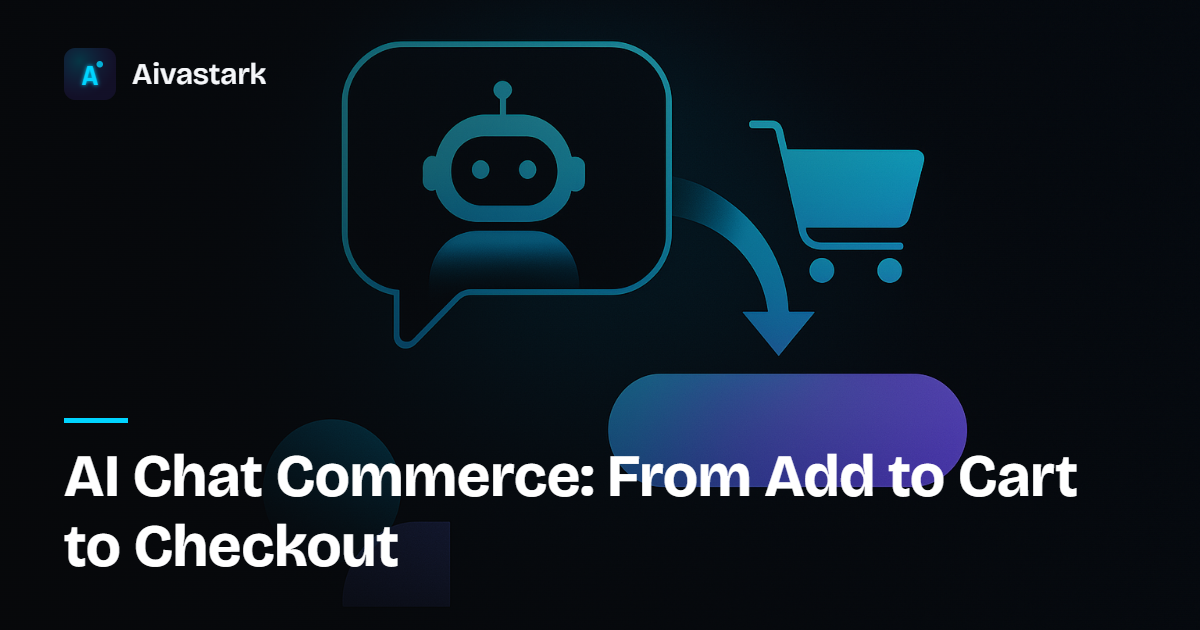
AI chat commerce is quietly rewriting the rules of online retail: instead of pushing shoppers through a maze of category pages, filters, and checkout forms, the conversation itself becomes the storefront. When a customer can ask a question, see a recommendation, add it to their cart, and pay—all inside a single chat window—the friction that kills conversions disappears. For brands running a white-label chatbot, this shift turns support from a cost center into a revenue channel.
This article walks through the full journey, from add-to-cart to checkout, and shows how conversion tracking, abandonment recovery, and the emerging agentic commerce era fit together.
Why the Conversation Is the New Storefront
Shopping behavior has moved faster than most storefronts. In a recent study of 2,739 consumers, 58% of people had used AI tools like ChatGPT for shopping in just the past week—and buying decisions were happening inside the chat, not after a click-out to a product page. That data was gathered before Instant Checkout rolled out, so the real figure is almost certainly higher today.
Meanwhile, the traditional path to purchase is punishingly long. The average online checkout takes 22 clicks, and every click between recommendation and purchase is another chance to lose the sale. Shoppers increasingly expect to browse, decide, and buy without ever leaving the chat window.
That expectation is exactly why conversational support has become strategic. A white-label chatbot that only answers "where's my order?" leaves money on the table. One that can also carry a shopper from question to completed purchase becomes a revenue channel in its own right. If you're evaluating whether to build that capability yourself or deploy a ready-made solution, our comparison of a white-label AI chatbot vs building your own breaks down the trade-offs.
The most important shift isn't that AI answers questions faster—it's that the decision-making moment and the transaction moment are now the same moment.
Add to Cart Inside the Chat: Removing the Navigation Gap
The first job of AI chat commerce is to collapse the gap between deciding to buy and acting on it. That means the cart has to live inside the conversation.
Shopper-initiated and AI-powered cart actions
Modern conversational commerce supports two complementary modes. In the first, the shopper initiates the action—they see a product and add it themselves. In the second, the agent does it for them. Cart actions can be configured to be AI powered, so the AI agent can add recommended products to a shopper's cart during the conversation, helping shoppers move more smoothly from discovery to purchase.
Rich product cards deliver social proof at the decision moment
Text alone rarely closes a sale. Rich product cards—with images, prices, star ratings, and a direct add-to-cart button—bring the storefront into the chat. This matters because social proof lands hardest at the moment of decision. Products rated four stars or above capture 94% of purchases, and when those ratings show up inside the AI chatbot conversation, the shopper gets that reassurance exactly when they need it—not after navigating to a separate page.
The chatbot as a virtual cashier
Transactional chatbots effectively act as virtual cashiers. As Yellow.ai describes, these bots streamline the buying process from adding items to the cart to guiding through checkout. Picture a customer who wants a laptop: the chatbot helps select the model, adds compatible accessories, applies a discount code, and moves them toward payment—all in one thread.
Universal carts for complex, multi-session shopping
Not every purchase happens in one sitting. A universal cart can hold items across multiple sessions and even multiple stores, so a returning shopper picks up exactly where they left off. This is the infrastructure that lets an agent handle complex shopping tasks that span multiple conversations without forcing the customer to rebuild their basket every time. For ecommerce teams specifically, our AI chatbot for ecommerce page covers how these flows map onto real store setups.
From Cart to Checkout Without Leaving the Window
A full cart is worthless if the shopper still has to jump to a separate checkout page and re-enter their details. The next stage of AI chat commerce keeps the purchase inside the conversation.
Checkout loads natively inside the chat
Rather than redirecting, a checkout kit can load a native purchase flow directly inside the conversation. The shopper enters payment and shipping details in the same window where they made their decision—no context switch, no lost momentum.
Instant Checkout and open protocols
The platform giants are moving in the same direction. OpenAI has launched Instant Checkout inside ChatGPT, enabling users to complete purchases directly within the conversation. It's built on a co-developed, open-source Agentic Commerce Protocol and powered by Stripe. That's a signal, not just a feature: commerce is being redesigned around the assumption that the transaction happens where the conversation happens.
Available today for Shopify brands
This isn't purely future-facing. Shopper-initiated cart actions are available immediately for Shopify brands, meaning shoppers can already add products and proceed to checkout directly from a conversation experience. The building blocks are shipping now.
Design for brand continuity
Continuity is what makes the whole thing feel trustworthy. The checkout should feel at home in your experience, not like a bolted-on third-party form. As one agentic commerce platform puts it, every detail is yours to control from interaction to styling. This is precisely where white-label matters—your branding, your styling, your voice, end to end. If you're new to the concept, start with what a white-label AI chatbot is.
Closing the Loop: Conversion Tracking That Proves ROI
You can't optimize what you can't measure, and AI chat commerce generates measurable events at every step.
Track every cart action as a conversion event
Each cart action from a chat session should be recorded as a discrete conversion event. When a customer adds a product through the chat, the system captures which product, what quantity, the price, and whether it succeeded. Checkout initiation is logged the same way.
Capture purchase completion via a JS fallback
The final data point—purchase completion—closes the loop. A common approach uses a JavaScript fallback on the order confirmation page, where the store fires a trackPurchase call with the order ID and total. That ties the completed sale back to the specific conversation that produced it, so you can attribute revenue to chat with confidence.
Real-time session personalization
Tracking isn't only for reporting. When the assistant tracks behavior like views, clicks, and cart adds in real time, it can personalize every message within the same session—surfacing the right product, answering the right objection, and nudging at the right moment.
The numbers behind the case
The results are the reason this matters to a P&L. Brands deploying assistants of this kind typically see a 62% lift in conversions from chat, 10% higher average order value, and a 5x return on investment (Gorgias). Those figures are what separate a support tool that costs money from one that earns it. For a wider view of how these platforms compare, see our roundup of the best AI customer support software in 2026.
Turning Abandonment Into Recovery and Nurture
Even the smoothest funnel leaks. The difference between a mature AI chat commerce program and a basic one is how it treats the shoppers who almost bought.
Abandonment is a signal, not an event
The key mindset shift: treat cart abandonment as a real-time signal rather than a one-time event. Cart recovery works when you treat abandonment as a signal, not a static list you email once a day. Conversational AI can capture the moment it happens and act on it.
Capture the full behavioral picture
Effective recovery depends on rich data. The system should capture add-to-cart events, checkout drops, coupon attempts, and payment failures, all tied to an identified or stitched user profile. A failed payment and an abandoned cart call for very different follow-ups—and you only know which is which if you're capturing the right events.
Score the next best action
From there, the AI runs a decision flow. It scores the next best action based on conversion likelihood and value at stake, so high-value carts get prioritized attention and low-intent browsers aren't spammed.
Pick the right channel and timing
Finally, re-engagement has to reach people where they actually respond. The AI selects the right channel—WhatsApp, SMS, or Instagram DM—and times the outreach for maximum effect. If you're expanding into social channels, our guide to AI-powered social media responses covers how these conversations connect back to your core assistant.
Recovery isn't about sending more messages. It's about sending the right message, on the right channel, to the right person, at the exact moment their intent is still warm.
Preparing for the Agentic Commerce Era
The trajectory is clear, and it's worth planning for now rather than reacting to later.
Agents are becoming buyers
The most consequential shift is that AI agents are becoming buyers on behalf of humans. As the launch of Instant Checkout signaled, brands now have to be discoverable and transactable inside AI surfaces, not just on their own websites. Products that can't be found or bought inside an AI conversation simply won't be considered.
Capture intent before it exits
Speed of decision cuts both ways. In that same consumer study, 46.4% of AI users said they "got what they needed" and left. That's a huge window of intent—and if your chat can't convert it in the moment, that shopper walks out with an answer but no purchase. Capturing intent before it exits is the whole ballgame.
Free your humans for the hard problems
Automating routine purchase paths doesn't eliminate your team—it redeploys it. With conversational AI handling routine inquiries, customer service reps can focus on complex issues that genuinely need a human. One supplement brand cited in that guide handled 42% more tickets after automating routine questions. The AI takes the "add these to my cart" and "where's my order?" volume; humans take the nuanced, high-stakes cases. For teams weighing this build across sectors, our industries overview shows how the same pattern applies beyond retail.
Adopt open protocols and white-label chat
The safest long-term bet is to build on open standards and a chat experience you fully own. Open protocols like the Agentic Commerce Protocol keep you interoperable with the AI surfaces where shoppers increasingly live, while white-label chat ensures every conversation converts under your brand, end to end. If you're comparing that approach against incumbents, our breakdown of why every business needs an AI agent in 2026 puts the strategic case in context.
Bringing It Together
AI chat commerce isn't a single feature—it's a connected loop. Rich product cards and in-chat carts remove the navigation gap. Native checkout kits and Instant Checkout close the sale without a context switch. Conversion tracking proves the ROI (a 62% conversion lift and 5x return are attainable, not aspirational). And real-time abandonment recovery reclaims the intent that would otherwise slip away.
The brands that win the agentic era will be the ones that make every conversation transactable today. To see how a fully brandable assistant handles this journey from first question to completed checkout, explore the Aivastark platform and its feature set—or dig into the details on the pricing and FAQ pages before you decide.
Frequently asked questions
What is AI chat commerce?
AI chat commerce is an approach to online retail where the conversation itself becomes the storefront—shoppers ask questions, see recommendations, add items to their cart, and pay all inside a single chat window, removing the friction that kills conversions.
Can shoppers complete checkout inside a chat?
Yes. A checkout kit can load a native purchase flow directly inside the conversation so shoppers enter payment and shipping details in the same window. OpenAI's Instant Checkout enables purchases directly in ChatGPT, and shopper-initiated cart actions are available today for Shopify brands.
How is conversion tracked in AI chat commerce?
Each cart action is recorded as a discrete conversion event capturing product, quantity, price, and success. Purchase completion is captured via a JavaScript trackPurchase fallback on the order confirmation page, tying the sale back to the specific conversation.
What results do brands see from AI chat commerce?
Brands deploying these assistants typically see a 62% lift in conversions from chat, 10% higher average order value, and a 5x return on investment.
How does AI chat commerce handle cart abandonment?
It treats abandonment as a real-time signal rather than a one-time event, captures the full behavioral picture (checkout drops, coupon attempts, payment failures), scores the next best action by value and likelihood, and re-engages on the right channel—WhatsApp, SMS, or Instagram DM—at the right time.
What is the agentic commerce era?
It's the emerging shift where AI agents become buyers on behalf of humans, meaning brands must be discoverable and transactable inside AI surfaces, not just on their own websites. Products that can't be found or bought inside an AI conversation won't be considered.
Sources
- 58% of consumers used AI tools for shopping in the past week
- Rich product cards and visual commerce in AI chat
- Checkout from chat: a faster path from conversation to conversion
- OpenAI launches Instant Checkout inside ChatGPT
- AI chat cart operations and ecommerce checkout tracking
- Conversion lift, AOV, and ROI figures for chat assistants