Intercom Fin is Intercom's AI support agent · a system that resolves customer questions automatically by retrieving answers from your Intercom Help Center and connected sources using retrieval-augmented generation (RAG), running multi-step actions through Fin "Procedures," and escalating to a human agent when its confidence is low. Fin is priced at $0.99 per resolution, billed on top of Intercom seat fees of $29–$139 per seat per month.
Disclosure: Aivastark, the publisher of this guide, builds a flat-rate AI support agent that competes with Intercom Fin. The explanation of what Fin is and how it works below is written to be accurate and vendor-neutral · if Fin is the right tool for your team, this guide should help you say so with confidence.
Is Fin an AI agent or a chatbot?
Fin is an AI agent, not a rule-based chatbot, and the distinction matters. A rule-based chatbot follows a fixed decision tree · it can only answer the branches a human scripted in advance, and it breaks the moment a customer phrases something off-script. An AI agent reasons over a body of knowledge, generates an answer in natural language, and can take actions on the customer's behalf. Fin reads your Intercom Help Center articles and other connected content, finds the passages relevant to each question, and writes a grounded reply rather than matching against a script.
Intercom markets the product as the "Fin AI Agent," and in 2026 the terms Fin, Intercom Fin, and Intercom's AI agent all refer to the same product. It belongs to the same category explained in what a white-label AI chatbot is · the difference is that Fin is branded as Intercom's, not as yours.
How Intercom Fin works
Under the hood, Fin uses the retrieval-augmented generation (RAG) pattern common to modern support agents. The pipeline has four stages:
- Ingestion · Fin indexes your Intercom Help Center articles and, depending on plan, external URLs, PDFs, and content snippets you add. This indexed content is the agent's source of truth.
- Retrieval · when a customer asks a question, Fin searches the indexed content for the passages most relevant to it.
- Generation · a large language model writes an answer grounded in those passages. Intercom has built Fin on frontier models from OpenAI and Anthropic.
- Action and escalation · for workflows that go beyond answering · issuing a refund, looking up an order, updating a record · Fin runs deterministic "Procedures." When confidence is low or the customer asks for a person, Fin hands off to a human agent in the Intercom Inbox.
Fin answers on Intercom's Messenger and supports 45+ languages with automatic detection. Because it lives inside Intercom, every Fin conversation, decision, escalation, and handoff is logged in the same workspace your support team already uses · which is one of Fin's genuine strengths for audit-trail depth.
How much does Intercom Fin cost?
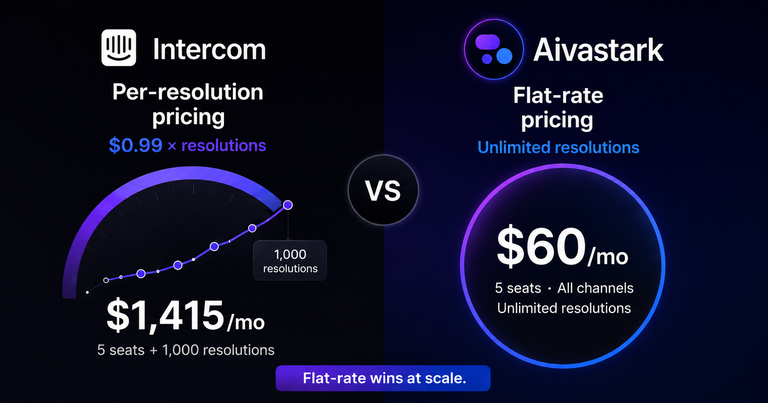
Fin uses per-resolution pricing: $0.99 per resolution. A "resolution" is a conversation Fin closed without a human · you are not charged when Fin hands the conversation to an agent. That charge sits on top of an Intercom subscription, whose seats run from $29/seat/month (Essential) to $139/seat/month (Expert).
The practical consequence is that your AI bill scales with how well the agent works: the more conversations Fin resolves, the more you pay. At 1,000 monthly resolutions that is roughly $990 in Fin charges before seats; at 10,000 it is roughly $9,900. We worked the full cost math · including how per-resolution compares with flat-rate pricing at 1k, 5k, and 10k conversations · in Aivastark vs Intercom Fin.
What Intercom Fin is good at
- Native to the Intercom workspace · if your team already lives in Intercom Inbox and your help center is in Intercom Articles, Fin is the lowest-friction AI layer to add.
- Deep CRM and outbound tooling · Intercom's contact model, segmentation, outbound campaigns, and product tours are more integrated than any standalone agent offers.
- Audit-grade logging · Fin logs every input, decision, escalation, and handoff in real time and exposes them via API · useful for SOC 2 and regulated workflows.
- Mature action framework · Procedures let Fin execute multi-step workflows, not just answer FAQ-style questions.
Limitations and when to look at alternatives
Fin's constraints follow from the same design choices that make it strong inside Intercom:
- It requires an Intercom workspace. Fin is not a standalone product · you pay for Intercom seats whether or not you use the rest of the suite.
- Per-resolution pricing penalizes success. Teams whose deflection rate climbs find the bill climbing with it · an awkward incentive for anyone trying to reduce support cost.
- White-labeling is partial. Intercom branding is present in the Messenger and escalation flows, which is usually disqualifying for agencies reselling AI support under their own brand.
- Channel add-ons stack up. SMS, WhatsApp, and email automation carry separate usage fees on top of seats and the per-resolution charge.
If you are already deep in Intercom's ecosystem, none of these are deal-breakers · Fin is the right call. If you are an SMB, an e-commerce store, or an agency that wants flat, predictable pricing and full white-label control, the per-resolution model is usually where teams start shopping for alternatives.
Intercom Fin alternatives
Fin sits in a competitive set of AI support agents at different price points and depths:
- Aivastark · flat $20–$60/month with no per-resolution metering, true white-label, and Messenger, Instagram, and WhatsApp included · built for SMBs and agencies that want a predictable bill.
- Chatbase · a per-message web-widget chatbot focused on single-tenant workspaces.
- Twig · enterprise autonomous resolution billed per ticket.
- Ada, Decagon, Lorikeet · enterprise platforms for $5M+ ARR teams with high support volumes. See the fintech buyer's playbook for the full category map and a vendor-neutral selection rubric.
Frequently asked questions
Is Intercom Fin an AI agent?
Yes. Intercom markets it as the "Fin AI Agent." It uses retrieval-augmented generation to answer from your knowledge base, runs multi-step actions through Procedures, and escalates to a human when confidence is low · the defining traits of an AI agent rather than a scripted chatbot.
How much does Intercom Fin cost?
$0.99 per resolution, on top of Intercom seat fees of $29–$139 per seat per month. You are charged only for conversations Fin resolves without a human, not for escalations.
What does Fin count as a "resolution"?
A resolution is a conversation Fin closed on its own · the customer's question was answered and they did not need a human agent. If Fin hands off to a person, that conversation is not billed as a Fin resolution.
Does Intercom Fin work without Intercom?
No. Fin runs inside the Intercom platform and requires an Intercom subscription. If you want a standalone AI support agent that drops onto any site with a single script tag, look at standalone alternatives like Aivastark.
What LLM does Intercom Fin use?
Intercom has built Fin on frontier large language models from OpenAI and Anthropic. As with any RAG agent, answer quality depends less on the specific model and more on the quality of the knowledge base it retrieves from.
What are the best Intercom Fin alternatives?
For SMBs and agencies wanting flat pricing and white-label control, Aivastark; Chatbase for a web-only widget; Twig, Ada, Decagon, and Lorikeet for enterprise autonomous resolution.
Want the side-by-side cost math and feature comparison? Read Aivastark vs Intercom Fin, or see Aivastark's flat-rate pricing and feature set.
More questions
What does Intercom Fin count as a 'resolution'?
A resolution is a conversation Fin closed on its own: the customer's question was answered and they did not need a human agent. If Fin hands the conversation to a person, it is not billed as a Fin resolution.
Sources