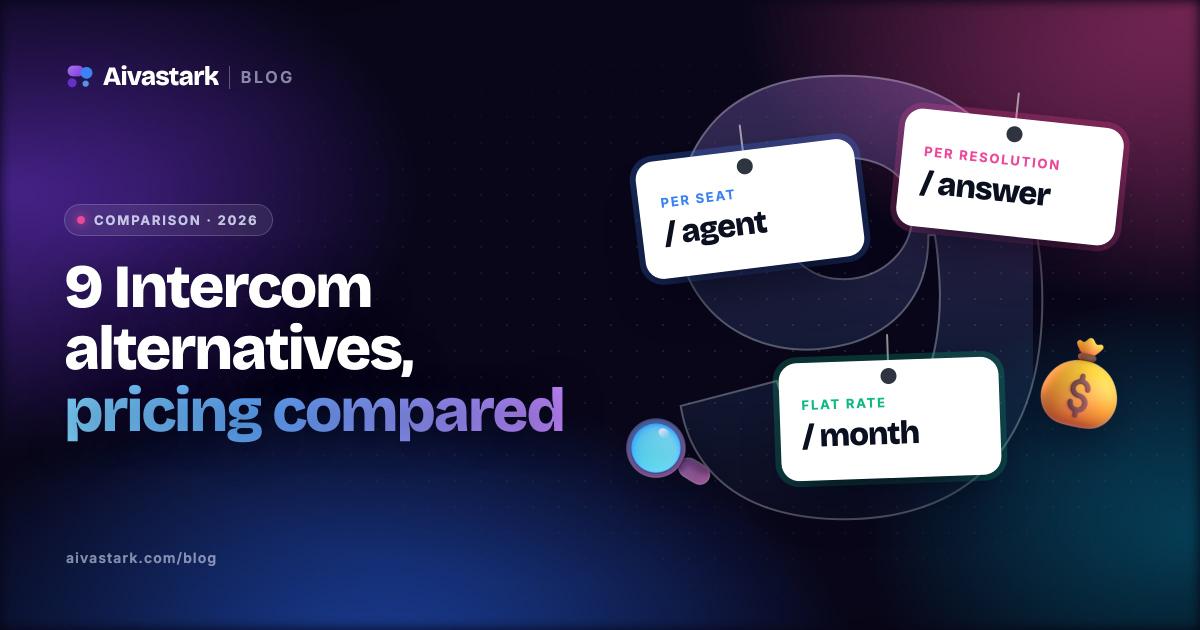
The best Intercom alternative depends on what's driving you off Intercom. If it's the $0.99-per-resolution Fin pricing, a flat-rate tool like Aivastark wins. For B2B SaaS, Plain. For ecommerce, Gorgias. For enterprise ticketing, Zendesk. Full breakdown below.
TL;DR: Intercom now charges per seat and $0.99 for every Fin AI resolution, so costs scale with both team size and ticket volume. A 5-seat Advanced team resolving 1,000 tickets with Fin pays roughly $1,415/month. The nine alternatives below trade that variable bill for flat-rate, outcome-based, or open-source pricing — pick by use case, not by feature-count.
For scale, a 5-seat Intercom Advanced team resolving 1,000 tickets with Fin pays about $1,415/month. The same volume on Aivastark's $129/month Growth plan is covered by its 25,000-credit allowance.
Key takeaways
- Intercom's real cost is hybrid: ~$29–$132 per seat/month plus $0.99 per Fin AI resolution (annual billing). Usage spikes hit your bill directly. (Intercom pricing)
- No single "best" replacement — the right Intercom alternative is the one that matches your channel mix, AI needs, and pricing tolerance.
- Flat-rate is the fastest-growing switch reason. Tools that price on a fixed monthly allowance — Aivastark's Growth plan is $129/month for 25,000 credits, against roughly $1,415/month for a comparable Intercom + Fin setup — make support spend forecastable.
- Migration is low-risk. Most knowledge-base content (URLs, PDFs, help docs) ports in 1–3 days with a parallel deployment before cut-over.
Why teams are leaving Intercom in 2026
Intercom is still a capable platform — the problem is the bill. In 2026 it runs a hybrid pricing model: a fixed per-seat fee for platform access, plus a separate, usage-based charge for its Fin AI Agent.
Here's the math that's pushing teams to look elsewhere, using Intercom's published rates:
| Cost component | Rate (annual billing) |
|---|---|
| Essential seat | ~$29 / seat / month |
| Advanced seat | ~$85 / seat / month |
| Expert seat | ~$132 / seat / month |
| Fin AI Agent | $0.99 per resolution |
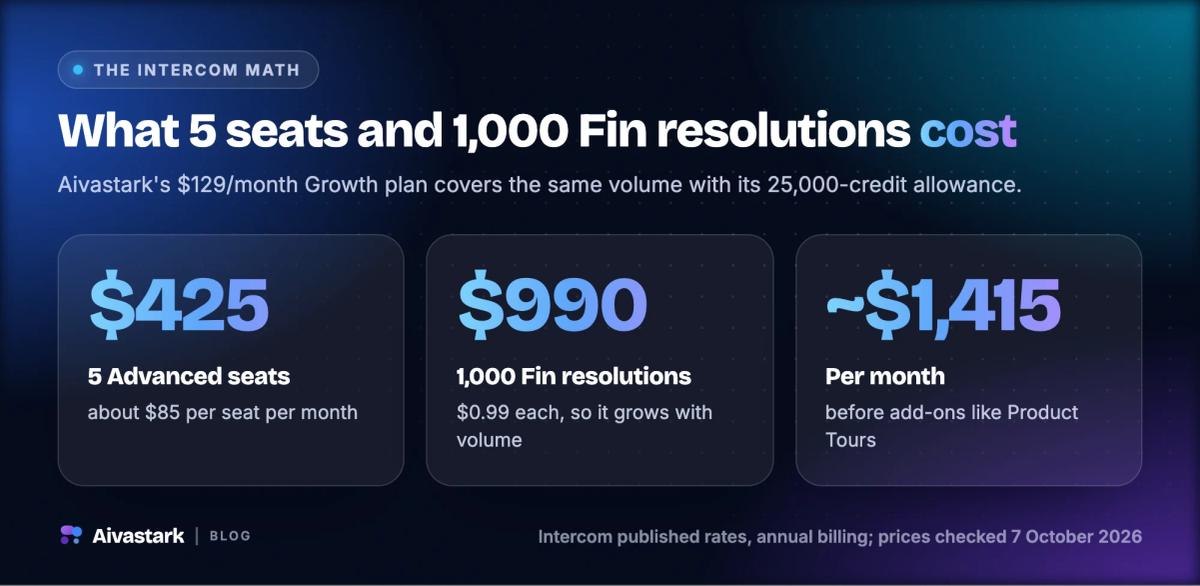
A 5-seat team on Advanced ($425 in seats) that resolves 1,000 tickets/month with Fin ($990) lands at roughly $1,415/month — before add-ons like Product Tours (~$199). That's nearly double the headline seat price, and the Fin line item grows every time your support volume grows. (Chatarmin pricing breakdown, Intercom)
The three reasons teams cite for switching:
- Pricing predictability — per-resolution billing punishes growth and busy seasons.
- AI context depth — some teams need AI grounded in CRM/product data, not just help-center articles.
- Platform fit — many businesses pay for a full CRM-and-campaigns suite when they only need AI chat support.
Definition — what makes a good Intercom alternative? A strong alternative matches Intercom's core (AI-grounded answers, human handoff, multi-channel inbox) while fixing your specific pain: predictable pricing, deeper data context, or a lighter, cheaper footprint.
How we ranked these alternatives
We scored each tool on four buyer criteria, not raw feature count:
- Pricing model & predictability — flat-rate, per-seat, per-resolution, or open-source?
- AI quality — RAG-grounded retrieval, hallucination control, honest "I don't know" handoff.
- Channel coverage — web widget only, or Messenger / Instagram / WhatsApp / email too.
- Best-fit buyer — SMB, agency, ecommerce, B2B SaaS, or enterprise.
For a deeper rubric on evaluating AI support vendors (including a 90-minute hallucination test you can run on any free trial), see our AI customer service buyer's playbook.
The 9 best Intercom alternatives in 2026
1. Aivastark — best flat-rate, multi-channel alternative
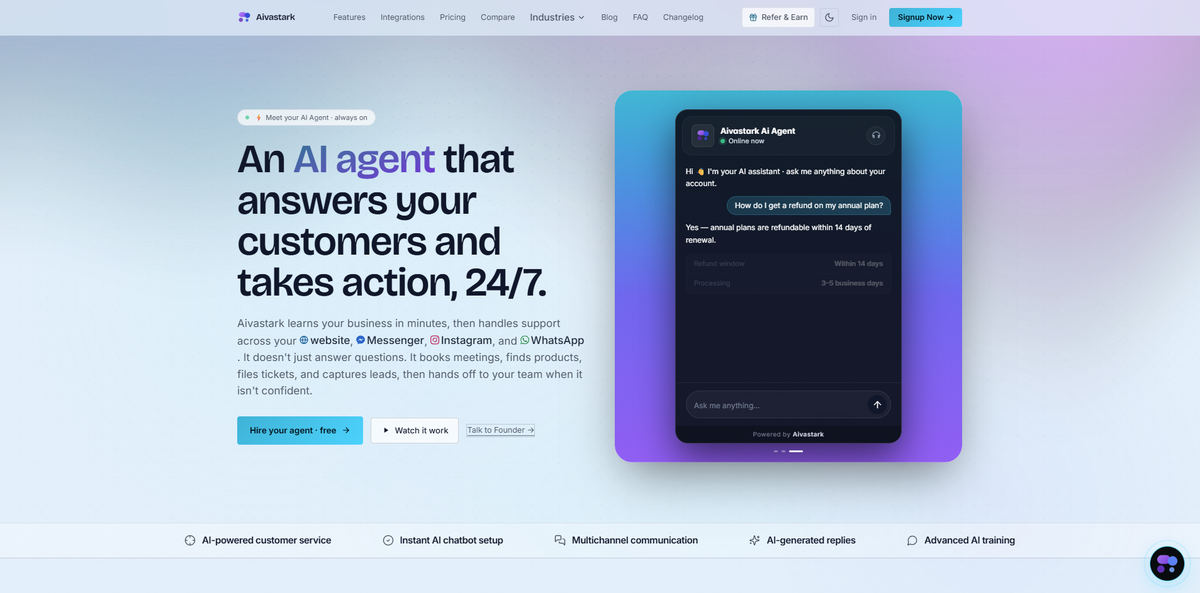
Best for: SMBs, agencies, and mid-market teams that want predictable cost and full branding control.
Aivastark is an AI support agent and chatbot built on retrieval-augmented generation (RAG): it trains on your own knowledge base, answers customer questions with cited sources, and, with human handoff switched on, passes the chat to your team when a customer asks for a person, sounds upset or still isn't helped. The headline difference versus Intercom is the pricing model. Plans run from a permanent free tier (300 credits, no card) through Solo at $12/month, Starter at $39/month for 5,000 credits, Growth at $129/month for 25,000, and Scale at $319/month for 75,000. There's no per-seat fee and no per-resolution meter. Past your allowance, overage is billed at a published rate — $4.00 down to $1.20 per 1,000 credits depending on plan — rather than the agent being switched off, so a busy month means a slightly larger invoice, not a dead bot on your busiest day.
It also answers on Messenger, Instagram, WhatsApp and Telegram from the $39 Starter plan (Intercom charges separately for several channels), shows your own name, colours and logo (the Aivastark badge can be hidden on Scale), and installs with a one-line script tag in under five minutes.
- ✅ Fixed monthly price with a published overage rate — no per-seat fee, no per-resolution meter
✅ Native multi-channel (web, Messenger, Instagram, WhatsApp)
✅ Your branding on every plan (badge hidden on Scale; custom white-label on Enterprise, on request)
⚠️ The newest and smallest tool on this list. No public reviews yet, a two-person team behind it, and no third-party security certification — if you need a vendor with an audit trail and a decade of reference customers, Zendesk or Intercom is the safer buy.
⚠️ Not a full CRM or outbound-campaign suite — it's the AI support layer, not a Salesforce replacement
For the head-to-head cost math against Intercom's Fin, see Aivastark vs Intercom Fin: flat price vs $0.99 per outcome.
2. Plain — best for B2B SaaS
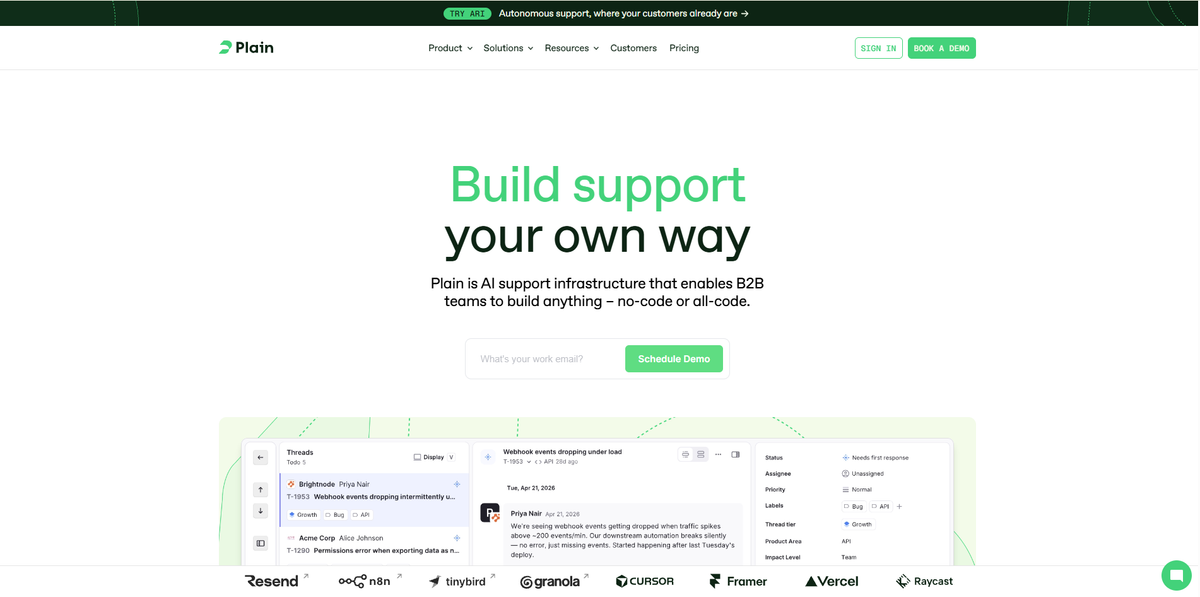
Best for: technical B2B SaaS teams that live in Slack and Linear.
Plain is purpose-built for complex B2B support, with native Slack and Microsoft Teams support, two-way Linear integration, and an API-first architecture. Where Intercom leans B2C, Plain is engineered for engineering-heavy support loops. (Plain)
3. Help Scout — best for human-first, simple support
Best for: small teams that want a clean shared inbox without enterprise sprawl.
Help Scout is the long-standing "human-first" alternative — a polished shared inbox, knowledge base, and AI priced by successful resolution / outcome rather than per seat. A good fit if you value simplicity over a sprawling feature matrix.
4. Tidio — best SMB live chat + Lyro AI
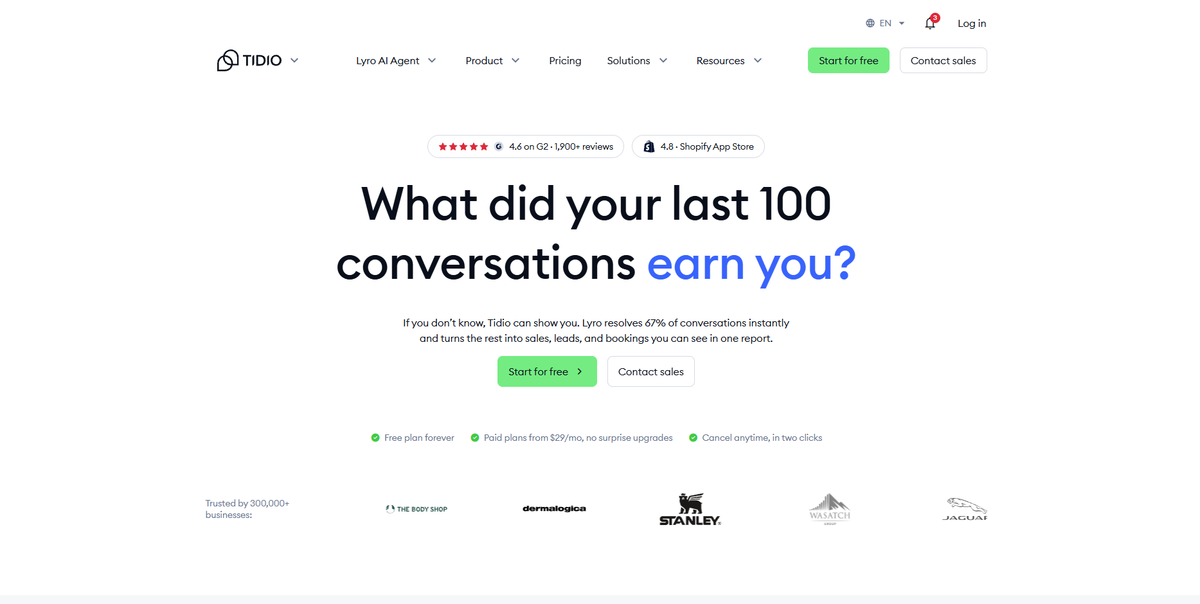
Best for: small ecommerce and service businesses wanting live chat plus an AI agent.
Tidio pairs live chat with its Lyro AI agent. Plans start around $24.17/month (Starter, ~100 billable conversations) and scale to Growth (~$49.17/mo); a typical small business pays $68–$150/month for Tidio + Lyro combined. (Tidio pricing, Featurebase)
5. Gorgias — best for ecommerce
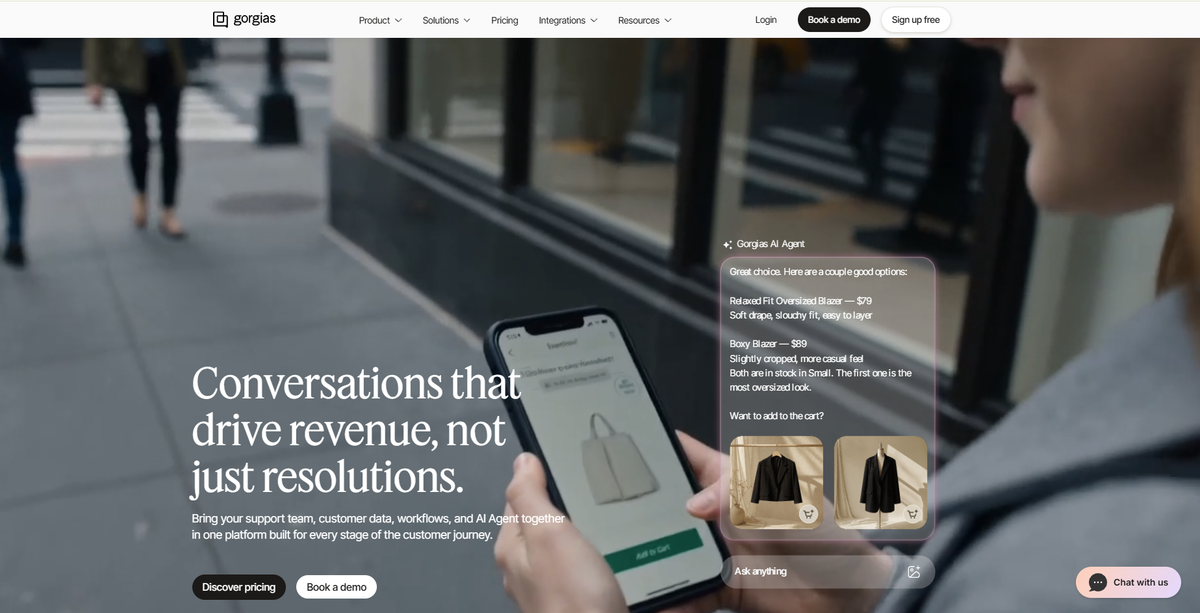
Best for: Shopify and ecommerce stores managing orders, returns, and refunds.
Gorgias integrates deeply with ecommerce platforms to handle order lookups, returns, and refunds inside support tickets. Helpdesk plans run $10 (Starter) → $900 (Advanced)/month, with the AI Agent billed at $0.90–$1.00 per interaction. (Gorgias pricing data)
6. Zendesk — best for enterprise ticketing
Best for: larger support orgs that need mature ticketing, routing, and reporting.
Zendesk is the heavyweight ticketing suite: Suite Team from $49/agent/month up to Enterprise at $150/agent/month. It's more tool than most SMBs need, but unmatched for complex, high-volume queues. (Zendesk pricing reference)
7. Freshdesk — best for intelligent ticket routing
Best for: teams that want automated triage and a generous free tier.
Freshdesk earns repeated "best for ticket routing" mentions across 2026 alternative roundups, with strong automation and sentiment-based triage. (The CX Lead)
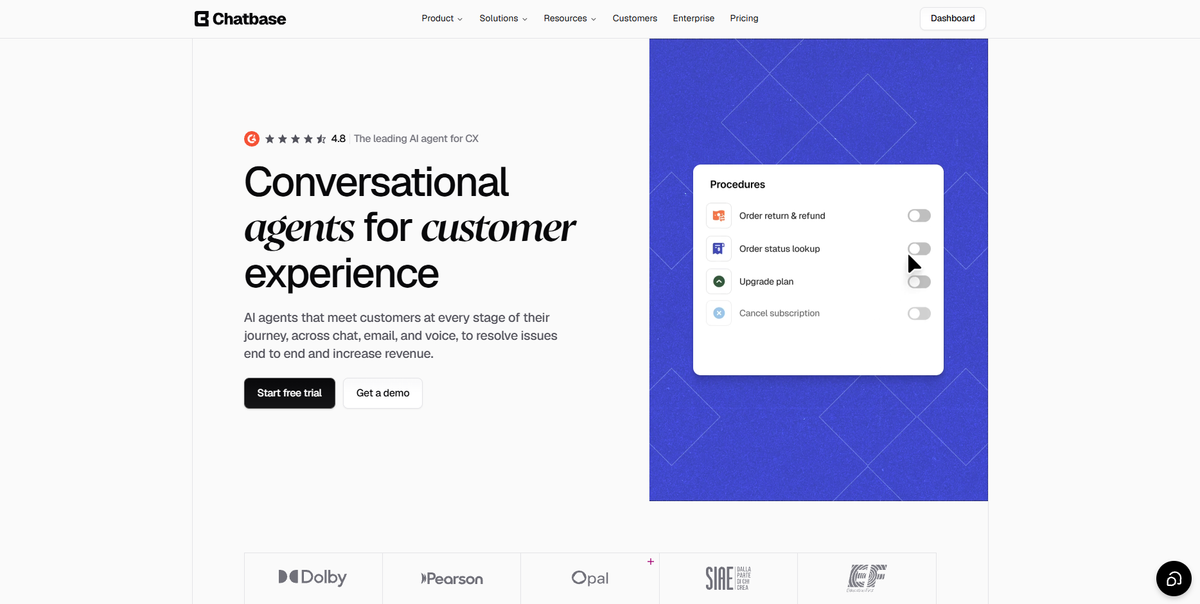
8. Chatbase — best quick web-widget bot
Best for: solopreneurs and small sites wanting a fast website chatbot.
Chatbase makes it easy to spin up a RAG bot, with paid plans from $40/month (Hobby, 700 AI replies). It answers on a website widget, WhatsApp, Instagram, Messenger and email, and stands out on model choice. See Aivastark vs Chatbase for replies per dollar, overage and branding.
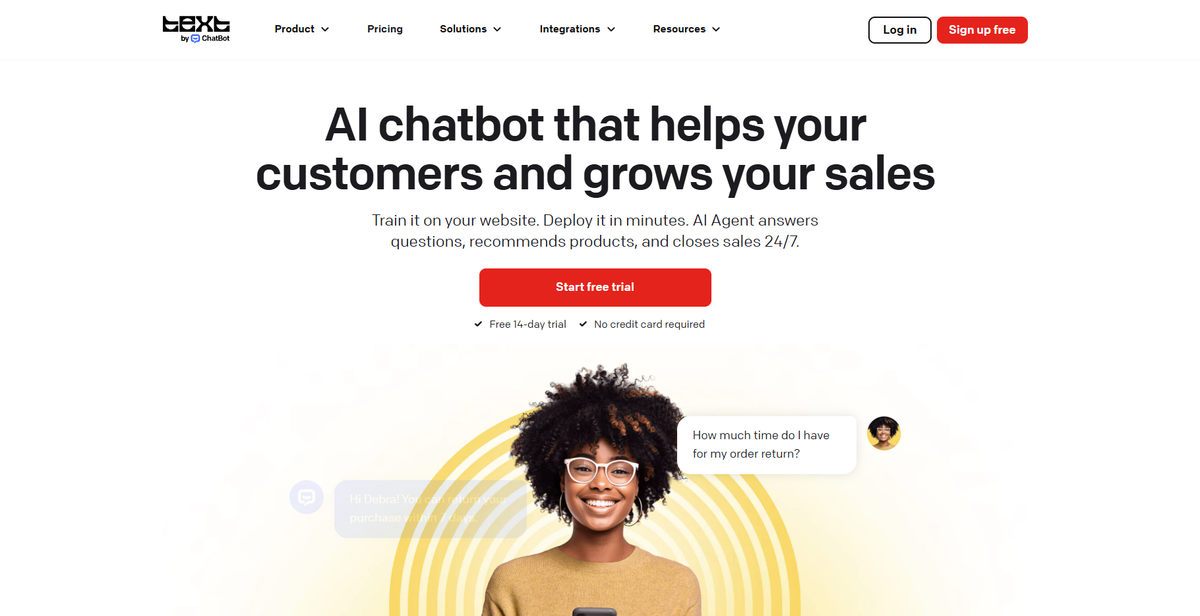
9. ChatBot.com — best no-code visual bot builder
Best for: teams that want to design conversation flows visually rather than train a bot on documents.
ChatBot (from the LiveChat family) is a long-established drag-and-drop bot builder with a mature visual editor and a large template library. Its 2026 pricing combines both of the models teams usually leave Intercom to escape: a per-user fee and a capped resolution allowance. Essential is $25/user/month ($19 annual) with 10 AI resolutions per month; Growth is $99/user/month ($79 annual) with 200 resolutions. Above that, Enterprise is sales-led. Strong if your support is rule-based and scripted; expensive per resolution if volume is real. (ChatBot pricing)
Also consider: Lorikeet / Decagon — best for enterprise autonomous resolution
Best for: enterprises buying a high-autonomy AI agent with a sales-led process.
For teams resolving tens of thousands of tickets a month, enterprise autonomous platforms like Lorikeet and Decagon compete directly with Intercom's high end. They're powerful but procurement-heavy — overkill below ~50,000 monthly tickets, where a self-serve tool wins on simplicity. (Lorikeet)
Intercom alternatives compared at a glance
| Tool | Best for | Pricing model | Native multi-channel | White-label |
|---|---|---|---|---|
| Aivastark | Flat-rate AI support, agencies | Fixed monthly + overage ($0–$319/mo) | ✅ Web, Messenger, IG, WhatsApp | Partial (badge hidden on Scale) |
| Plain | B2B SaaS | Per-seat | Slack / Teams focus | Partial |
| Help Scout | Human-first SMB | Per-seat + per-resolution AI | Email / chat | ❌ |
| Tidio | SMB live chat | Tiered + AI add-on | Web / social | ❌ |
| Gorgias | Ecommerce | Tiered + per-interaction AI | Ecommerce channels | ❌ |
| Zendesk | Enterprise ticketing | Per-agent | ✅ | Partial |
| Freshdesk | Ticket routing | Per-agent (free tier) | ✅ | Partial |
| Chatbase | Quick web bot | Tiered ($40–$500) | ✅ Web, WhatsApp, IG, Messenger | Partial |
| ChatBot.com | Visual flow building | Per-user + capped resolutions | Web / messaging | Partial |
| Lorikeet/Decagon | Enterprise autonomous | Custom / per-resolution | ✅ | Varies |
Prices checked 7 October 2026 against each vendor's published pricing page. Vendors change pricing often — confirm before you commit.
For a line-by-line price comparison with one tool, see Aivastark vs Intercom Fin and the other comparison pages.
How to switch off Intercom without downtime
Migrating is lower-risk than most teams expect. Run a parallel deployment, then cut over once deflection rates match. Follow these steps:
- Export your knowledge base — pull help-center articles, FAQs, and PDFs from Intercom.
- Pick one alternative to pilot, using the use-case guide below.
- Ingest your content into the new tool's sandbox (URLs, PDFs, docs).
- Test with 20 real questions from your inbox — include 5 adversarial ones where "I don't know, escalating" is the correct answer.
- Deploy in parallel on a subset of pages while Intercom still answers live traffic.
- Compare deflection and accuracy for 1–3 days.
- Cut over the script tag and decommission Fin once rates match.
Most teams complete this in 1–3 days. Knowledge-base content ports cleanly; only live conversation history typically stays behind (export it from Intercom for archival first).
Which Intercom alternative is right for you?
- You're leaving because of per-resolution cost → Aivastark (flat-rate, no usage meter). Start with Aivastark vs Intercom Fin.
- You're a technical B2B SaaS team → Plain.
- You run an ecommerce store → Gorgias (or Tidio for lighter needs). Gorgias vs Tidio compares the two.
- You're enterprise with complex queues → Zendesk or Decagon/Lorikeet.
- You're an agency reselling support to clients → Aivastark (your branding on every plan, a separate website per client).
- You just want a simple human inbox → Help Scout.
Still deciding between buying a platform and building your own? Read White-Label AI Chatbot vs Build Your Own — building averages 10–18 engineer-weeks and $60–108k before it answers a single ticket.
Ready to cap your support bill? See Aivastark pricing or start free — live on your site in about 10 minutes.
FAQ
What is the best Intercom alternative in 2026?
There's no single best — it depends on why you're switching. For predictable flat-rate AI support, Aivastark is the top pick. For B2B SaaS, Plain; for ecommerce, Gorgias; for enterprise ticketing, Zendesk; for a simple human inbox, Help Scout.
Why is Intercom so expensive?
Intercom uses a hybrid model: a per-seat fee (~$29–$132/seat/month on annual billing) plus $0.99 for every Fin AI resolution. Because both team size and ticket volume drive the bill, costs climb as you grow. A 5-seat Advanced team with 1,000 Fin resolutions pays around $1,415/month.
What is the cheapest Intercom alternative?
Aivastark has the lowest entry point of the AI-grounded tools here: a permanent free plan with 300 credits and no card required, then $12/month for 1,000 credits and $39/month for 5,000. There's no per-seat fee, and overage past your allowance is billed at a published rate rather than cutting the agent off. For basic ticketing without AI, Freshdesk's forever-free tier is cheaper still.
Is there a free Intercom alternative?
Aivastark's free plan is permanent and includes 300 credits with no card required. Most other AI-grounded chat tools charge once you connect a real knowledge base and go live.
How hard is it to migrate from Intercom?
Low effort. Knowledge-base content (articles, PDFs, URLs) ports cleanly, and most teams run a 1–3 day parallel deployment before cutting over. Live conversation history is the main thing that doesn't migrate — export it from Intercom for archival before you switch.
What's the best Intercom alternative for agencies?
Aivastark, in most cases — your agent's name, colours and logo on every plan (the badge can be hidden on Scale, and custom white-label arrangements are available on Enterprise, on request), a separate website per client (5 on Growth, 15 on Scale), and flat-rate pricing that keeps client P&L forecastable. See Aivastark vs Chatbase for a branding comparison.
More questions
Why are teams leaving Intercom in 2026?
Teams are leaving due to Intercom's hybrid pricing model, which combines per-seat fees ($29–$132/month) plus $0.99 per Fin AI resolution. This makes costs unpredictable and punishes growth—a 5-seat Advanced team resolving 1,000 tickets monthly pays roughly $1,415/month instead of the headline seat price.
How much does Aivastark cost compared to Intercom?
Aivastark charges a flat monthly price with AI replies included: a free plan with 300 replies, then $12 (1,000), $39 (5,000), $129 (25,000) and $319 (75,000) a month, where a standard reply is one credit and paid plans bill overage past the allowance instead of switching off. Intercom charges per seat plus per resolution, so Aivastark's bill is much easier to predict.
What channels do Intercom alternatives support?
Channel coverage varies by tool. Aivastark includes Messenger, Instagram, and WhatsApp on all paid plans. Plain focuses on Slack and Microsoft Teams integration. Gorgias integrates with ecommerce platforms. Coverage depends on the alternative chosen.
Is migrating away from Intercom risky?
Migration is low-risk. Most knowledge-base content (URLs, PDFs, help docs) can be ported in 1–3 days with a parallel deployment before cut-over, making the transition straightforward.
What are the three main reasons teams switch from Intercom?
Teams cite: (1) pricing predictability—per-resolution billing punishes growth, (2) AI context depth—needing AI grounded in CRM/product data beyond help-center articles, and (3) platform fit—paying for a full suite when only AI chat support is needed.
Which Intercom alternative has the best AI?
It depends on the job. For fully autonomous resolution at enterprise scale, Lorikeet or Decagon. For ecommerce support, Gorgias. For a flat monthly price with AI replies included, Aivastark. For a quick bot on one website, Chatbase.
Sources