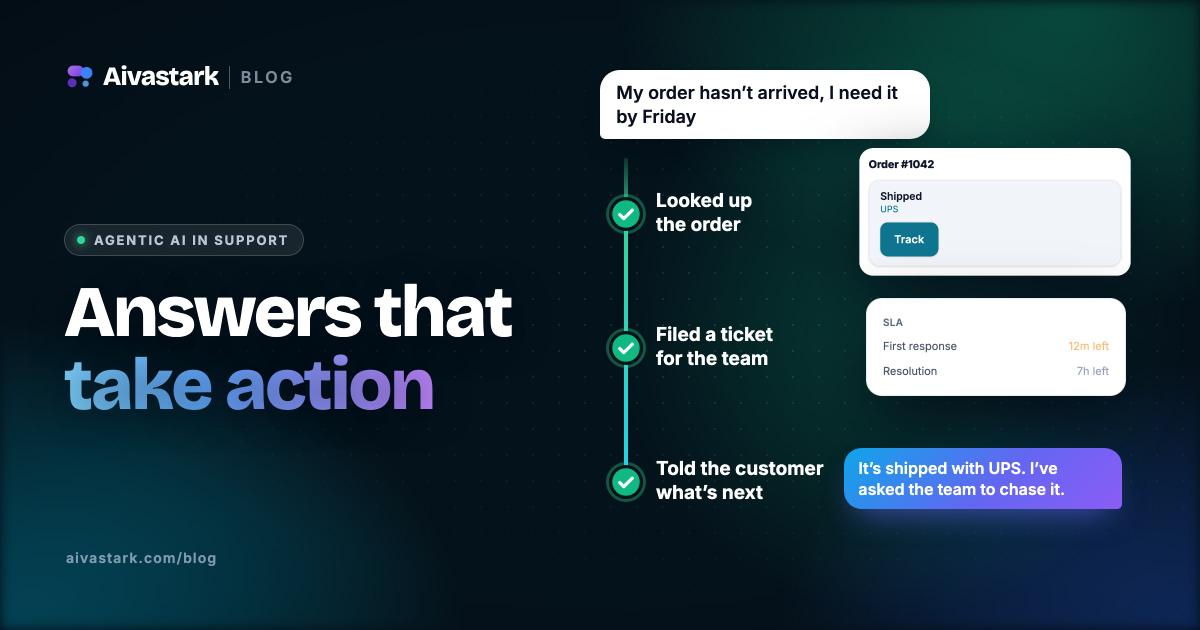
Agentic AI in customer support represents a fundamental shift in how businesses resolve customer issues—moving from systems that simply answer questions to systems that take action on the customer's behalf. For most of the past decade, "AI support" meant a chatbot that matched a query to a scripted response or surfaced a help-center article. Useful, but limited. Agentic AI in customer support changes the equation entirely: instead of pointing a customer toward a solution, the agent reasons through the problem, calls the right systems, executes the fix, and confirms the outcome—all without a human touching the ticket.
This article breaks down what agentic AI actually is, how it operates inside a real support workflow, why it outperforms traditional chatbots, and how to adopt it responsibly using a white-label platform.
What Is Agentic AI (and How It Differs From Chatbots)
Agentic AI describes systems that can reason, plan, and take autonomous actions toward a defined goal. Rather than responding to a single input with a single output, an agent breaks a request into steps, decides which tools to use, executes them, and evaluates whether the goal was met—looping back if it wasn't.
The contrast with traditional chatbots is stark:
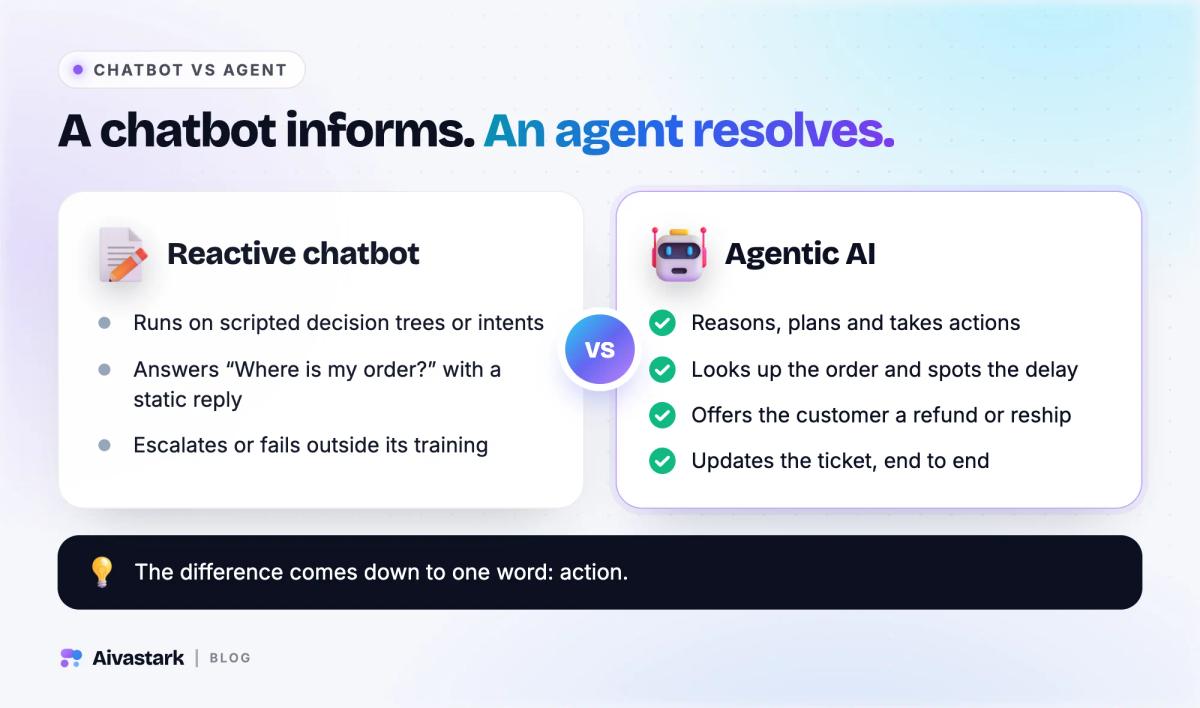
- Reactive chatbots operate on scripted decision trees or intent-matching. They answer "Where is my order?" with a static reply or a link. If the request falls outside their training, they escalate or fail.
- Proactive AI agents interpret the same question, look up the order in your commerce system, detect that it's delayed, notify the carrier, offer the customer a refund or reship, and update the ticket—end to end.
The difference between an AI agent and an AI chatbot comes down to one word: action. A chatbot informs. An agent resolves.
The core components of an agentic system
Four building blocks make this autonomy possible:
- LLM reasoning — a large language model interprets intent, plans multi-step tasks, and generates natural responses.
- Memory — short-term context (the current conversation) plus long-term memory (past interactions, preferences, and account history).
- Tool and API access — the ability to query a CRM, trigger a refund, update an order, or open a ticket in a help desk.
- An orchestration layer — the "controller" that sequences reasoning, tool calls, and verification into a coherent workflow.
Together, these place agentic AI at the top of the conversational AI maturity curve—well beyond FAQ bots and even retrieval-augmented assistants. For a broader view of how these systems are reshaping operations, see how AI agents are transforming work.
How Agentic AI Works in a Customer Support Workflow
To understand the practical impact, follow a single request through an agentic workflow.
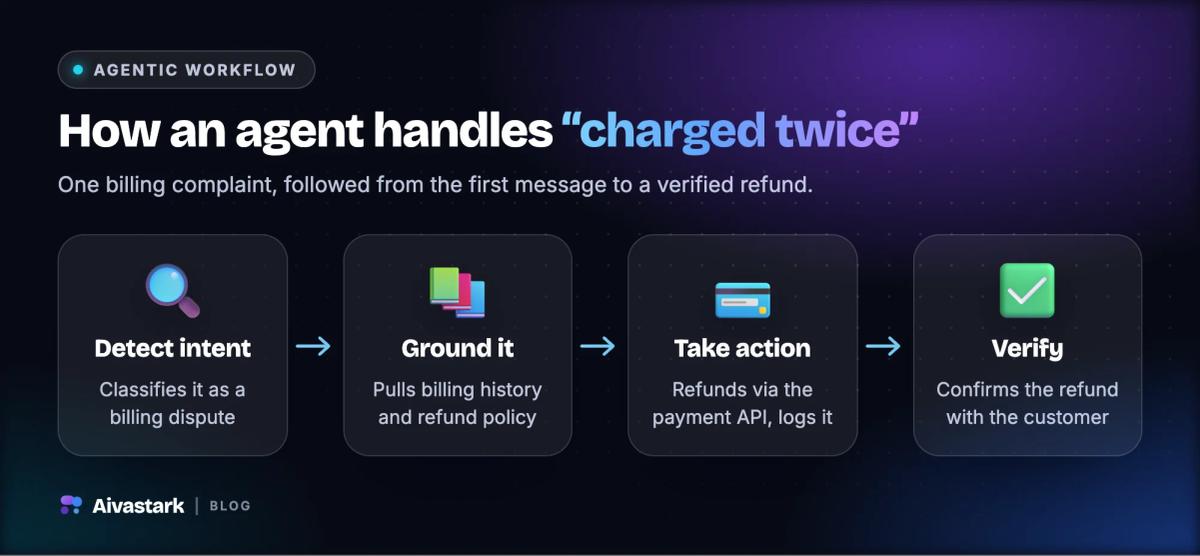
1. Intent detection. A customer writes, "I was charged twice for my subscription this month." The agent classifies the intent (billing dispute) and identifies the entities involved (customer account, subscription, recent charges).
2. Retrieval and grounding. Using retrieval-augmented generation (RAG), the agent pulls the customer's billing history and the relevant refund policy from a connected knowledge base. RAG is critical here because it grounds every response in verified, current data rather than the model's parametric memory—dramatically reducing hallucinations.
3. Action. The agent confirms a duplicate charge exists, checks that it falls within policy, and issues the refund through the payment API. It logs the action in the CRM and updates the ticket status.
4. Verification. Before closing, the agent confirms the refund succeeded, communicates the resolution to the customer, and asks whether anything else is needed.
Tool use in practice
The power of agentic AI comes from its tool integrations. In a mature deployment, an agent can:
- Query a CRM for account status, order history, and entitlements
- Process refunds or issue credits within policy limits
- Update shipping addresses, upgrade plans, or cancel subscriptions
- Escalate to a human with full context when a case exceeds its permissions
"The shift from answering to acting is what separates a support tool from a support colleague. When an AI can safely execute a refund or reschedule a delivery, it stops being a deflection layer and starts being a resolution engine."
Context across channels and long conversations
Because agents maintain persistent memory, they carry context across email, chat, and voice. A customer who starts a request on your website and follows up by email two days later shouldn't have to repeat themselves. Agentic systems recognize the continuing thread and pick up where the conversation left off—something scripted bots structurally cannot do.
Key Benefits Over Traditional Support Chatbots
The move to agentic AI in customer support is not incremental; it changes the underlying economics and experience of support.
Higher first-contact resolution
Because agents do rather than deflect, they resolve issues in the first interaction far more often. Traditional chatbots frequently hand off to humans the moment a task requires a system action. An agent completes the task, closing tickets that would otherwise sit in a queue.
Lower cost-per-ticket at scale
Autonomous resolution reduces average handle time and the volume of tickets reaching human agents. Industry benchmarks routinely place fully automated resolutions at a fraction of the cost of human-handled ones—often 70–90% cheaper per interaction—while scaling instantly to demand spikes without additional headcount.
Improved CSAT through personalization
With access to account context and history, agents deliver relevant, personalized responses instead of generic scripts. The debate over AI chatbots vs. human support is increasingly settled by a hybrid model: agents handle volume with consistency, and humans focus on nuance and empathy where it matters most.
24/7 autonomous coverage
Agents work around the clock in every time zone. This frees human agents from repetitive Tier-1 work so they can concentrate on complex, high-value cases—improving both employee satisfaction and resolution quality.
Real-World Use Cases and Applications
Agentic AI is already delivering value across industries. Here are the most common applications.
Automated order and subscription management
For ecommerce businesses, agents handle order tracking, returns, exchanges, and subscription changes end to end. A customer can cancel, upgrade, or reschedule without waiting for an agent—and the system enforces business rules automatically. This connects naturally to AI chat commerce, where conversational AI drives transactions from discovery through checkout.
Proactive outreach
Agentic systems don't just react—they initiate. They can send outage alerts, renewal reminders, delivery updates, and post-resolution follow-ups. This proactive posture prevents tickets before they're created, which is often more valuable than resolving them faster.
Tier-1 and Tier-2 triage with intelligent handoff
Not every case should be autonomous. Agents excel at triaging: resolving routine issues themselves, gathering context on complex ones, and escalating to the right human team with a full summary attached. This preserves the speed of automation without sacrificing quality on edge cases.
Multilingual and omnichannel support
Agents operate across chat, email, voice, and even social media responses in dozens of languages. For regulated or specialized fields—such as legal firms or dental practices—agents can be scoped tightly to compliant, domain-specific workflows.
Implementation Challenges and Guardrails
Autonomy without governance is a liability. The organizations that succeed with agentic AI in customer support treat guardrails as a first-class part of the design.
Setting boundaries and approval workflows
Every action an agent can take should carry explicit permissions and limits. A refund agent might auto-approve refunds under $50 but require human sign-off above that threshold. Define action limits, approval gates, and clear escalation triggers before going live.
Data security, privacy, and compliance
Support agents touch sensitive customer data, so security is non-negotiable. Insist on encryption, strict access controls, and compliance with frameworks like GDPR and SOC 2. This is especially important in regulated sectors—see the buyer's playbook for AI customer service in fintech for a deeper look at compliance-first deployment.
Preventing hallucinations and errors
RAG and knowledge grounding reduce hallucinations, but they don't eliminate risk. Keep a human-in-the-loop for high-stakes actions, and design confidence thresholds so the agent escalates when uncertain rather than guessing.
Measuring success
You can't improve what you don't measure. Track:
- Resolution rate — the share of tickets the agent closes autonomously
- Escalation rate — how often cases reach a human, and why
- Accuracy — the correctness of actions and responses, verified through sampling and customer feedback
Continuous monitoring turns a good deployment into a great one, tightening the loop between automation and quality over time.
How to Adopt Agentic AI With a White-Label Platform
Building an agentic support system from scratch is expensive and slow—you need reasoning infrastructure, tool integrations, orchestration, security, and monitoring, all maintained as models evolve. A white-label platform collapses that timeline.
Why white-label accelerates time-to-market
For agencies and SaaS brands, white-label solutions like Aivastark provide a production-ready agentic layer you can deploy under your own brand. Instead of hiring an ML team, you configure use cases and connect systems. If you're weighing the trade-offs, our comparison of a white-label chatbot vs. building your own walks through the economics in detail, and what a white-label AI chatbot is covers the fundamentals.
"Time-to-market is the hidden cost of building in-house. A white-label agentic platform lets a brand ship in weeks what would take an engineering team the better part of a year to build and maintain."
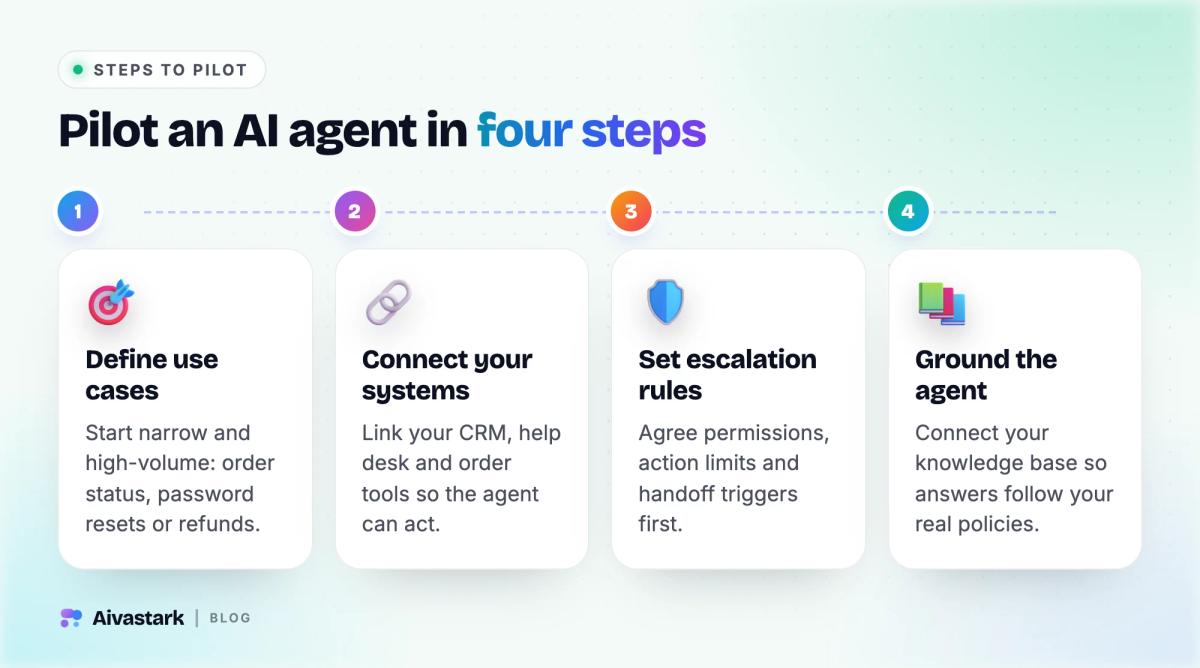
Steps to pilot
- Define use cases. Start with a narrow, high-volume workflow—order status, password resets, or refund requests—where success is measurable.
- Connect your systems. Integrate your CRM, help desk, and payment or order-management tools so the agent can act, not just answer.
- Set escalation rules. Establish permissions, action limits, and clear handoff triggers before enabling autonomous actions.
- Ground the agent. Connect your knowledge base and documentation so responses are grounded in your actual policies.
Integrating with your existing stack
A strong platform plugs into the tools you already use—help desks, CRMs, knowledge bases, and your website (for example, via a WordPress plugin). The goal is to layer agentic capability onto your current workflow, not rip and replace it. Explore the full feature set to map integrations to your environment.
Scaling from assisted to autonomous
The safest adoption path is gradual. Begin in assisted mode, where the agent drafts responses and proposes actions for human approval. As accuracy and confidence data accumulate, expand the scope of fully autonomous resolution—starting with low-risk actions and widening from there. This staged approach builds trust with both your team and your customers while keeping risk contained.
For a broader survey of the tooling landscape as you plan, see our roundup of the best AI agents for business in 2026 and the practical case for why every business needs an AI agent in 2026.
The Bottom Line
Agentic AI in customer support is the natural next step beyond the scripted chatbot era. By combining LLM reasoning, memory, tool access, and orchestration, these systems don't just answer questions—they resolve issues, take action, and free human teams for the work that genuinely requires a human. The upside is higher first-contact resolution, lower cost-per-ticket, and better customer experiences at scale.
The organizations that win will pair that autonomy with disciplined guardrails: clear permissions, strong compliance, human oversight where it counts, and rigorous measurement. And the fastest, lowest-risk way to get there is a white-label platform that delivers agentic capability under your own brand—so you can pilot in weeks, integrate with the tools you already run, and scale from assisted automation to autonomous resolution on your own timeline.
Ready to compare your options? Start with our overview of the best AI customer support software in 2026, then review Aivastark pricing to see how a white-label agentic platform fits your business.
Frequently asked questions
What is agentic AI in customer support?
Agentic AI describes systems that can reason, plan, and take autonomous actions toward a goal. In support, the agent interprets the request, calls the right systems, executes the fix, and confirms the outcome—resolving issues rather than just answering questions.
How is agentic AI different from a traditional chatbot?
Reactive chatbots use scripted decision trees or intent-matching to provide static replies or links, escalating when a task requires action. Agentic AI interprets the request, looks up data, executes the fix end to end, and verifies the result. The difference comes down to one word: action—a chatbot informs, an agent resolves.
How does agentic AI work in a support workflow?
It follows four steps: intent detection (classifying the request), retrieval and grounding via RAG (pulling verified data), action (executing the fix through APIs and logging it), and verification (confirming success and communicating the resolution).
What are the main benefits of agentic AI over chatbots?
Higher first-contact resolution because agents act rather than deflect, lower cost-per-ticket at scale (often 70–90% cheaper per interaction), improved CSAT through personalized responses, and around-the-clock autonomous coverage that frees humans for complex cases.
How do you keep agentic AI safe and accurate?
Set explicit permissions and action limits with approval workflows, enforce encryption, access controls, and GDPR/SOC 2 compliance, use RAG grounding and human-in-the-loop for high-stakes actions, and design confidence thresholds so the agent escalates when uncertain.
How can a business adopt agentic AI quickly?
Use a white-label platform to deploy a production-ready agentic layer under your own brand. Define a narrow high-volume use case, connect your CRM, help desk, and payment tools, set escalation rules, ground the agent in your knowledge base, and scale gradually from assisted to autonomous mode.
Sources