The definition of work has shifted. In 2025, businesses are no longer asking if they should adopt AI agents, but which AI agents for business deliver the fastest return on investment. These autonomous systems—capable of completing complex, multi-step tasks without human intervention—are moving beyond simple chatbots to become core operational infrastructure. The companies winning today are those that use agents to augment their teams, automating the routine so humans can focus on strategy, creativity, and complex problem-solving.
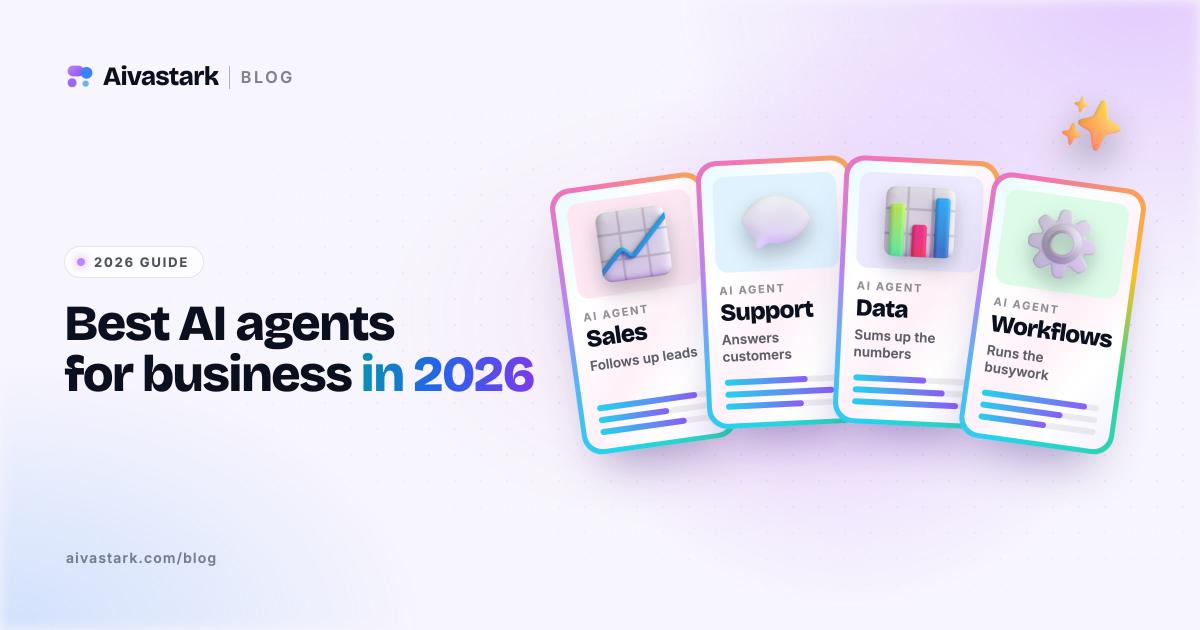
This guide cuts through the hype to deliver a clear, use-case-driven breakdown of the best AI agents for business in 2026. We will cover what they do, how to implement them, and how to select the right platform for your specific needs—whether that is sales, customer support, data analysis, or workflow automation.
What Are AI Agents and Why Do Businesses Need Them in 2026?
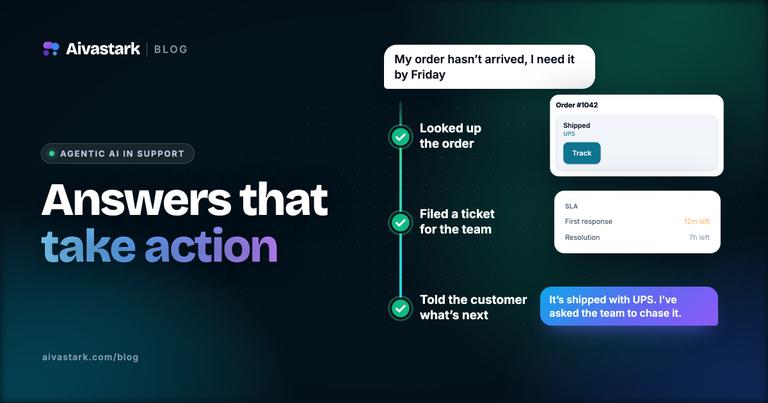
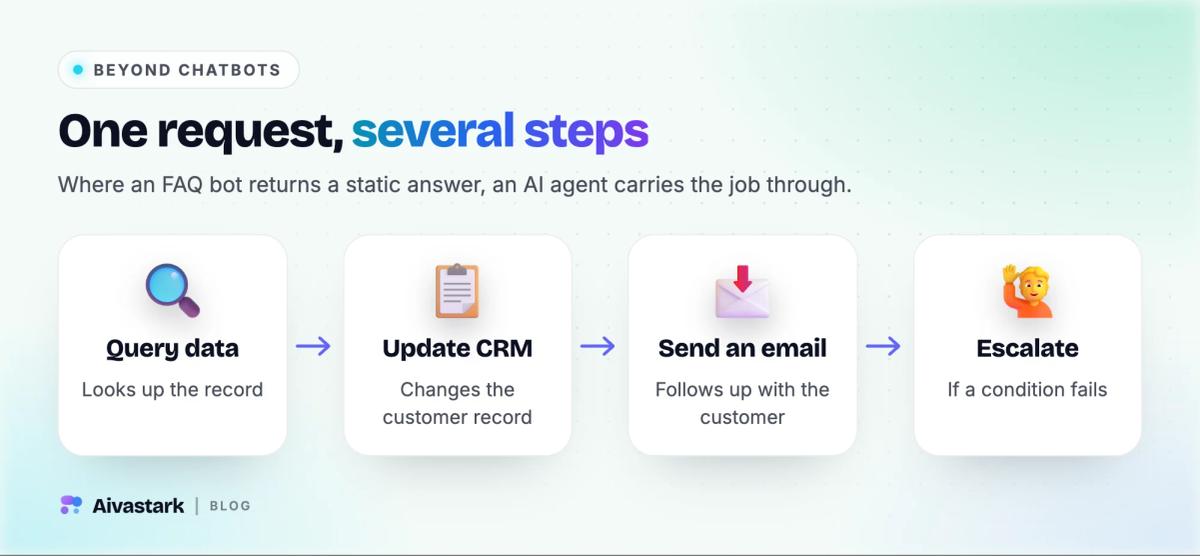
AI agents are more than just advanced chatbots. They are autonomous systems that perceive their environment, make decisions, and execute actions to achieve a specific goal. Unlike a simple FAQ bot that returns a static answer, an AI agent can orchestrate multiple steps: query a database, update a CRM record, send an email, and escalate an issue if a condition is not met.
The key shift in 2026 is the move from task replacement to job augmentation. As noted in industry analysis, "In most cases, AI agents are replacing tasks rather than entire jobs. The biggest impact will be on repetitive work" [S1]. This is critical: agents are not here to eliminate your workforce but to absorb the friction of high-volume, low-judgment activities. This frees your best people for higher-value activities that drive revenue and customer loyalty.
Real-world examples demonstrate this capability at scale. Dropbox uses AI agents for multi-step orchestration, handling complex sequences like scheduling meetings, retrieving documents, and validating execution logic [S15]. In the industrial sector, Leeway Hertz utilizes generative AI models to optimize supply chains, analyzing market conditions, inventory levels, and routes to minimize bottlenecks [S14]. These are not science-fiction use cases; they are production systems running today. For most businesses, the fastest path to similar results starts in customer support, where a white-label AI chatbot can be deployed quickly to handle tier-1 inquiries and triage complex issues.
Top AI Agent Platforms for Sales and Customer Support
Customer-facing teams are seeing the most immediate impact from AI agents for business. Here are the leading platforms categorized by use case and company size.
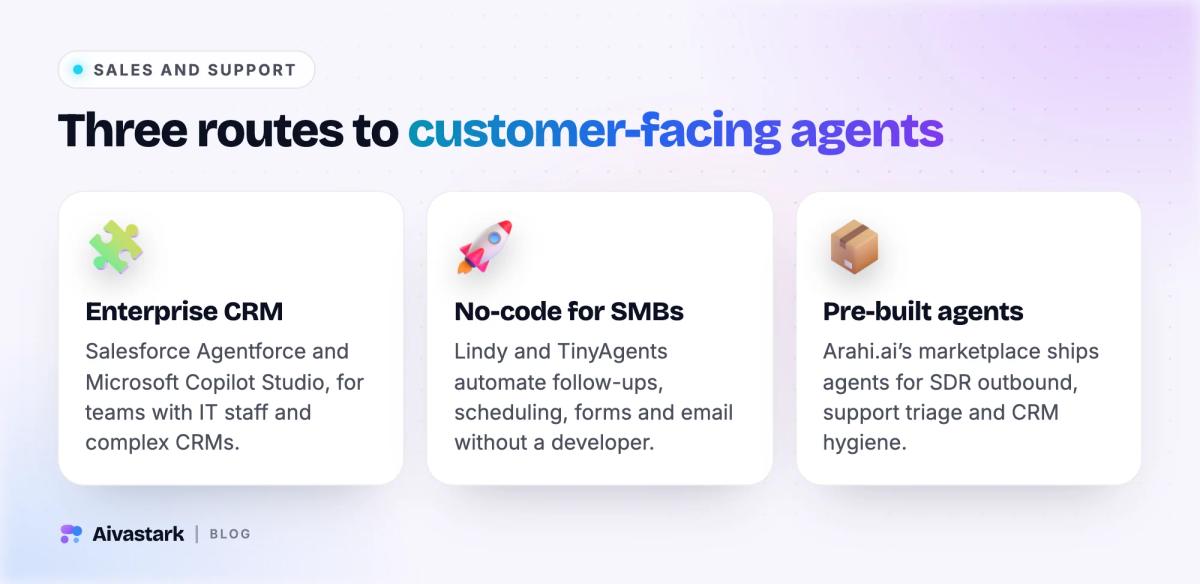
Enterprise CRM Integration: Salesforce Agentforce and Microsoft Copilot Studio
For organizations already deep in the Salesforce or Microsoft ecosystem, these platforms are the most seamless choice. Salesforce Agentforce embeds agents directly into Sales and Service Cloud, allowing them to automatically qualify leads, update opportunity stages, and resolve support tickets within the existing data architecture. Microsoft Copilot Studio offers similar capabilities for Dynamics 365 and Microsoft 365, enabling agents to summarize email threads, schedule meetings, and surface relevant documents from SharePoint [S1]. These are best for companies with dedicated IT teams and complex CRM configurations.
No-Code Excellence for SMBs: Lindy and TinyAgents
Small to mid-size businesses (SMBs) cannot afford months of custom development. Lindy excels here, using AI to understand context and adapt workflows without requiring a developer [S5]. It is ideal for automating lead follow-ups, meeting scheduling, and internal approvals. TinyAgents is another strong contender, built specifically for no-code operations like forms, databases, workflows, and email [S2]. Both platforms emphasize speed to deployment and ease of use.
Pre-Built Agent Marketplaces: Arahi.ai
For the SMB or mid-market buyer who wants production-grade agents without hiring an AI engineering team, platforms like Arahi.ai offer a compelling alternative. Their no-code builder handles complex multi-step workflows, and their marketplace ships pre-built agents for common business use cases including SDR outbound, support triage, and CRM hygiene [S12]. This is particularly valuable for teams that need to automate specific sales processes quickly, such as AI customer service for SaaS companies managing high ticket volumes.
Best AI Agents for Data Analysis and Business Intelligence
Data is the lifeblood of modern business, but raw data is useless without interpretation. Here are the top AI agents for business in the analytics and BI space.
Production-Ready Analysis: Upsolve AI and Julius AI
Upsolve AI leads the category for teams that need to build and ship production-ready data agents. It is designed to handle complex, recurring analytical tasks that integrate directly into your data pipeline [S6]. For lighter-weight, ad-hoc analysis, Julius AI is ideal for solo users working with CSVs or spreadsheets. It can generate visualizations and statistical tests from a simple natural language prompt.
Conversational AI Analytics: Tellius
Tellius acts as a translation layer between your business questions and your raw data. It maps disorganized data columns into business concepts such as Gross Margin or Churn Risk, allowing non-technical stakeholders to ask "What is our gross margin by region?" and receive a chart built from connected data sources [S9]. This reduces the bottleneck on data engineering teams.
Enterprise Visualization: Tableau Next and Power BI Copilot
For large enterprise teams already invested in Salesforce or Microsoft, Tableau Next (with Inspector) and Power BI Copilot offer deep integration with existing analytics platforms. Tableau’s Inspector flags anomalies in visualizations, while Power BI Copilot allows users to generate reports using natural language [S6]. These tools are less about autonomous investigation and more about augmenting the data analyst workflow with generative AI.
AI Agents for Operations and Workflow Automation
Behind every great customer experience is a smooth operational backend. These platforms handle the "invisible" work that keeps the business running.
Enterprise Automation: UiPath and ServiceNow
UiPath and ServiceNow AI Agents are the gold standard for large organizations automating IT, HR, and finance operations. UiPath combines robotic process automation (RPA) with agentic AI to handle tasks like invoice processing and employee onboarding. ServiceNow embeds agents directly into IT service management (ITSM) workflows, allowing them to auto-resolve password resets and software requests while maintaining strong governance controls [S1] [S5].
Multi-Agent Orchestration: CrewAI
Complex workflows often require multiple agents working in concert. CrewAI enables this type of multi-agent orchestration, allowing you to define roles (e.g., a "Researcher" agent and a "Writer" agent) that collaborate to complete a project. It scales from a free Basic plan (50 workflow executions/month) to custom enterprise pricing [S4]. This is ideal for teams building internal tools for content generation, data validation, or cross-departmental approvals.
Integration-First Automation: Activepieces
Agents are only as useful as the systems they can reach. Activepieces helps build integrations across 638+ apps, enabling agents to handle follow-through actions like updating a support ticket in Freshdesk or sending a Slack notification [S9]. For businesses using a platform like Aivastark, these integrations ensure that the agent can not only answer a question but also trigger a real-world outcome, such as creating a discount in your e-commerce backend.
"The biggest mistake companies make is trying to automate everything at once. You roll out AI agents by following a staged roadmap with success criteria at every step, rather than automating everything at once." — Industry best practices on AI implementation [S11]
The platforms at a glance
| Platform | Category | Best for |
|---|---|---|
| Salesforce Agentforce | Sales and customer support | Enterprise CRM integration |
| Microsoft Copilot Studio | Sales and customer support | Microsoft-stack enterprises |
| Lindy | Sales and customer support | No-code automation for SMBs |
| TinyAgents | Sales and customer support | No-code automation for SMBs |
| Arahi.ai | Sales and customer support | Pre-built agent marketplaces |
| Upsolve AI | Data and business intelligence | Production-ready analysis |
| Julius AI | Data and business intelligence | Production-ready analysis |
| Tellius | Data and business intelligence | Conversational analytics |
| Tableau Next | Data and business intelligence | Enterprise visualisation |
| Power BI Copilot | Data and business intelligence | Enterprise visualisation |
| UiPath | Operations and workflow | Enterprise automation |
| ServiceNow | Operations and workflow | Enterprise automation |
| CrewAI | Operations and workflow | Multi-agent orchestration |
| Activepieces | Operations and workflow | Integration-first automation |
How to Implement AI Agents Successfully (Best Practices)
Deploying an AI agent without a strategy is a recipe for failure. Follow this staged roadmap to ensure success.
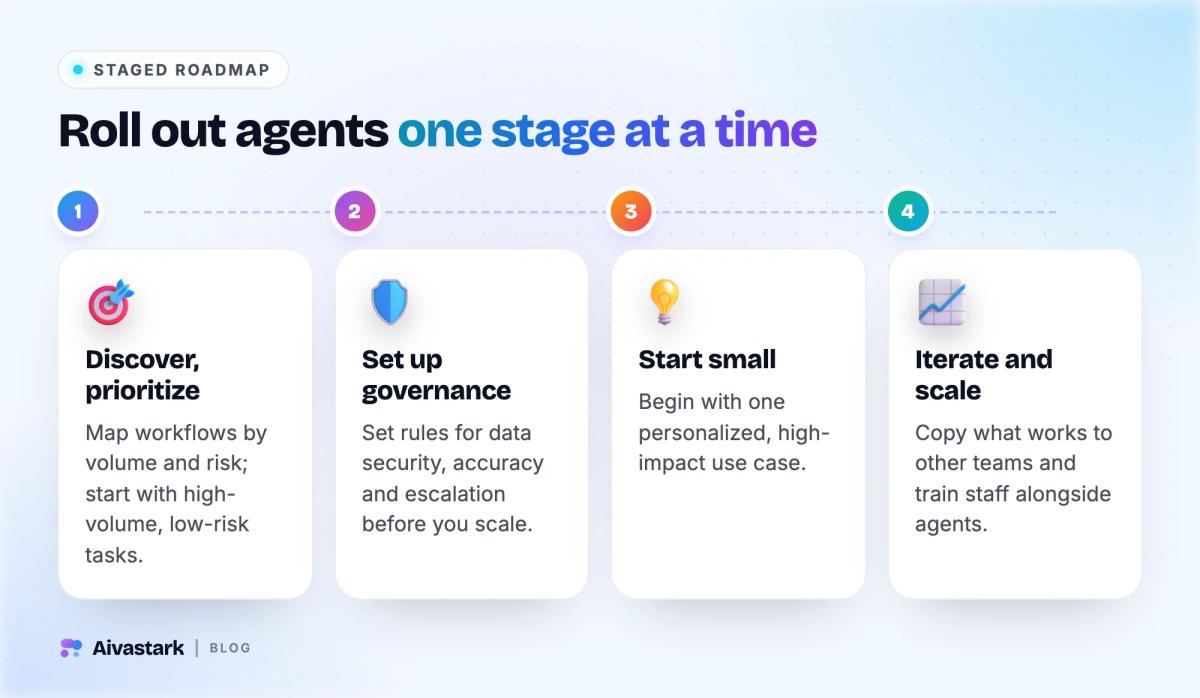
- Discover and Prioritize: Map your workflows by volume, complexity, and risk. Estimate the ROI for each candidate process. Focus first on high-volume, low-risk tasks—like tier-1 customer support or lead qualification [S11].
- Establish Governance: Before scaling, create an internal AI center of excellence. This team defines guidelines for data security, accuracy monitoring, and escalation protocols [S10]. This is critical for maintaining consistent governance as you expand agent usage [S11].
- Start Small, Think Big about Personalization: Do not try to replace your entire support team on day one. Begin with a personalized, high-impact use case. For example, integrating customer data—such as purchase history, preferences, and demographic insights—into an AI workflow allows the agent to tailor interactions from the very first message [S13].
- Iterate and Scale: Once a workflow is proven, replicate the working components for other teams and train staff to work alongside their new digital coworkers.
For businesses new to this space, the easiest entry point is often customer support. Reading about the difference between an AI agent vs AI chatbot can clarify which technology fits your immediate needs.
Choosing the Right AI Agent for Your Business
Selecting the best AI agents for business comes down to three factors: use case, company size, and ecosystem compatibility.
- Match the Agent to the Job: Do not fall for a feature list. A platform optimized for data analysis (like Julius AI) will be a terrible choice for routing support tickets. Similarly, a sales-focused agent (like those in Salesforce Agentforce) lacks the analytical depth of Tellius [S2].
- Consider Your Team's Capacity: Small IT teams should prioritize platforms that offer no-code builders and pre-built agents, such as Arahi.ai or Lindy. These minimize implementation overhead and do not require weeks of Python development [S5]. Larger enterprises with dedicated automation teams can handle the complexity of a platform like CrewAI or UiPath.
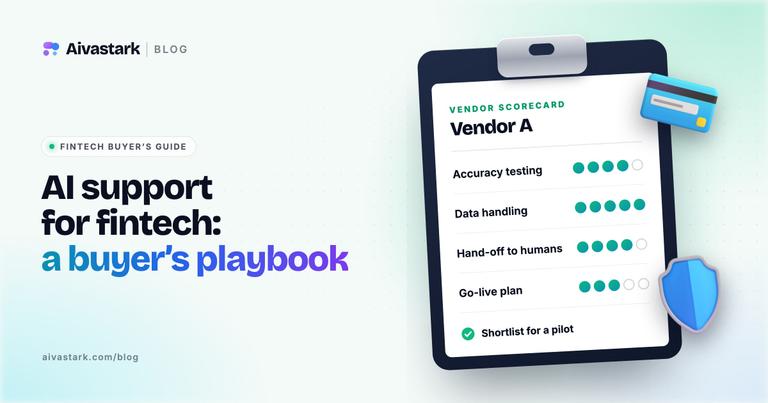
- Evaluate Security and Pricing: Always check for certifications like SOC 2 Type 2 to ensure data privacy [S5]. Pricing models vary widely; some platforms charge per-seat, while others charge per conversation or execution. If your use case is customer support, understand how these costs scale. A platform like Aivastark offers predictable pricing for white-label support automation across various industries.
Conclusion: The Future Is Agent-Augmented
The data is clear: AI agents for business are not a passing trend. In 2026, they are becoming a core part of the operational stack for companies ranging from one-person consultancies to global enterprises. The winners will not be the companies that buy the fanciest AI, but those that implement it intelligently—augmenting their people, automating their friction, and scaling their best workflows. Whether you start by automating a single sales follow-up or an entire customer support department, the key is to begin with a clear use case, a sound governance plan, and a focus on real business outcomes.
Frequently asked questions
What are AI agents for business and how are they different from chatbots?
AI agents are autonomous systems that perceive, decide, and execute multi-step tasks to achieve specific goals, unlike simple FAQ bots that return static answers. They can orchestrate actions like querying databases, updating CRMs, and sending emails without human intervention.
Which AI agent platforms are best for small to mid-size businesses (SMBs)?
Lindy and TinyAgents are top no-code platforms for SMBs, enabling quick automation of lead follow-ups, scheduling, and approvals without requiring a developer. Arahi.ai also offers pre-built agents for common use cases.
How do AI agents improve data analysis and business intelligence?
Platforms like Upsolve AI handle production-ready recurring analytical tasks, Julius AI provides ad-hoc analysis from CSVs, and Tellius maps disorganized data into business concepts for natural language queries, reducing bottlenecks on data engineering teams.
What is multi-agent orchestration and which platform supports it?
Multi-agent orchestration involves multiple AI agents collaborating on complex workflows, with defined roles like 'Researcher' and 'Writer'. CrewAI is a leading platform for this, scaling from free to enterprise pricing.
What is the biggest mistake companies make when implementing AI agents?
The biggest mistake is trying to automate everything at once. Instead, follow a staged roadmap with success criteria at each step, starting with high-volume, low-risk tasks like tier-1 customer support or lead qualification.
How should a business choose the right AI agent platform?
Match the agent to the specific job (e.g., sales vs. data analysis), consider your team's capacity (no-code platforms for small IT teams, complex platforms for larger enterprises), and evaluate security/certifications like SOC 2.
Sources