In some businesses, a slow reply is an inconvenience. In the industries where customer service is everything, a slow reply is lost revenue, a canceled booking, or a one-star review that follows you for years. For owners and CX leaders at small-to-midsize businesses, that distinction decides whether support is a drain on margins or the thing that keeps customers coming back. This article skips the generic "AI for support" pitch. Instead, it pairs five high-stakes industries with the specific support failures that quietly cost them money, then maps each failure to a concrete capability you can actually deploy.
Why Customer Service Defines Success in Some Industries More Than Others
Every company has support tickets. But in certain industries, support is the product. When someone is deciding whether to book a dental appointment, trust a law firm with their case, or complete a $200 cart, the quality of that first interaction isn't a cost center to be minimized. It's the differentiator that wins or loses the customer.
The expectations driving this shift are no longer negotiable. Customers want instant replies, 24/7 availability, and resolution on the first contact. The investment numbers show the market moving in that direction fast. According to Intercom's 2026 Customer Service Transformation Report, 82% of senior leaders invested in AI for customer service during the previous 12 months, while 87% planned to invest in 2026, yet only 10% reported reaching mature deployment. Meanwhile, Gartner predicts that agentic AI will autonomously resolve 80% of common customer service issues without human intervention by 2029.
The gap between ambition and execution matters, because slow or inconsistent service directly causes churn, abandoned purchases, and reputation damage in these fields. A modern AI agent closes part of that gap not by replacing your team, but by resolving routine queries, taking action across your systems, and handing off to a human when it isn't confident. As Fin's guide to AI customer service puts it:
Unlike legacy chatbots that follow rigid scripts or decision trees, modern AI agents manage and resolve customer interactions across channels like chat, email, voice, and social messaging.
That ability to act rather than just reply is what makes AI relevant to the industries below. Aivastark is built on exactly that model: it learns your business, handles support across your website, Messenger, Instagram, and WhatsApp, and books meetings, finds products, files tickets, and captures leads before escalating to your team.
E-commerce and Retail: Speed and Product Help Drive Conversions
The failure that costs you money
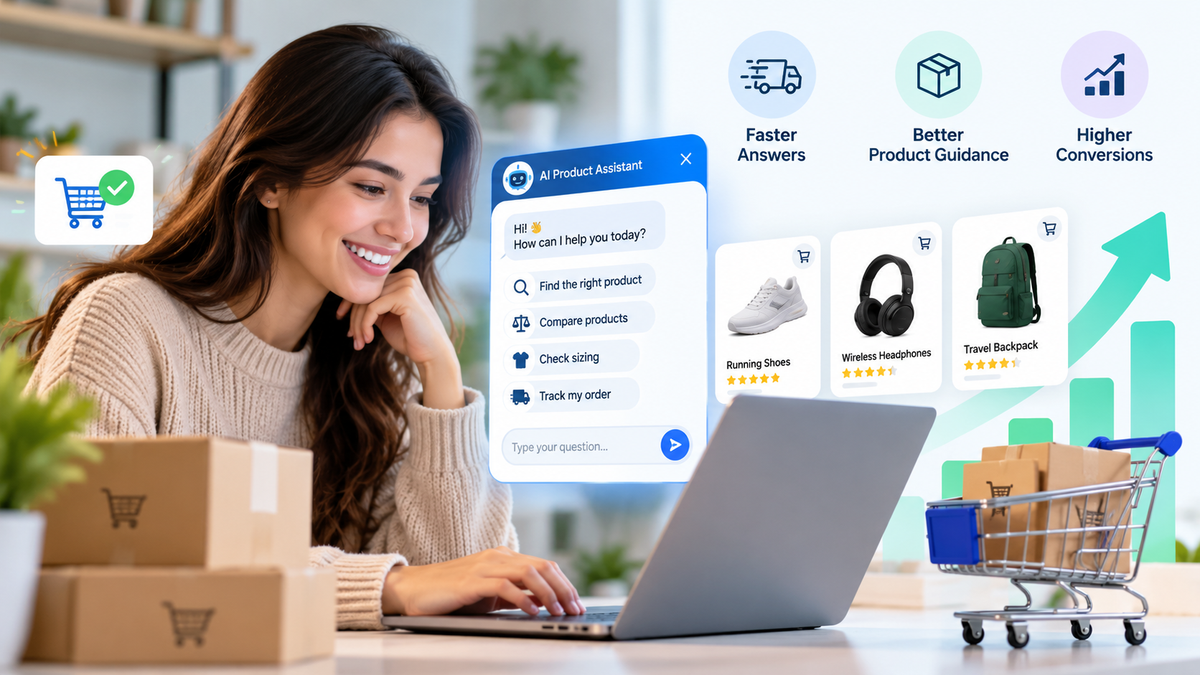
Online shoppers abandon carts for mundane reasons. They can't find the return policy, they're unsure about sizing, or they want to know where their order is and nobody answers. Each unanswered question is a decision point where a buyer either converts or leaves. At scale, those small frictions add up to a significant revenue leak that you never see in a support dashboard because the customer simply vanishes.
The capability that fixes it
This is where an agent that does more than answer FAQs earns its place. Aivastark finds products, answers order-status and returns questions, and captures leads across your website, Instagram, and WhatsApp in one inbox. A shopper asking "do you have this in medium?" at 11pm gets a real answer and a path to checkout instead of a contact form.
High-volume, repetitive queries are the ideal candidate for autonomous resolution. Fin's research groups the business impact of direct resolution as "lower cost per resolution and faster support," which is precisely the economics of retail support, where the same twenty questions account for most of your ticket volume.
The result is higher conversion, fewer abandoned carts, and consistent experiences at scale. If this is your category, our deeper guide on how AI chat widgets increase e-commerce sales and the dedicated AI chatbot for ecommerce page walk through specific setups.
SaaS and Technology: Onboarding, Tickets, and Retention Hinge on Support
The failure that costs you money
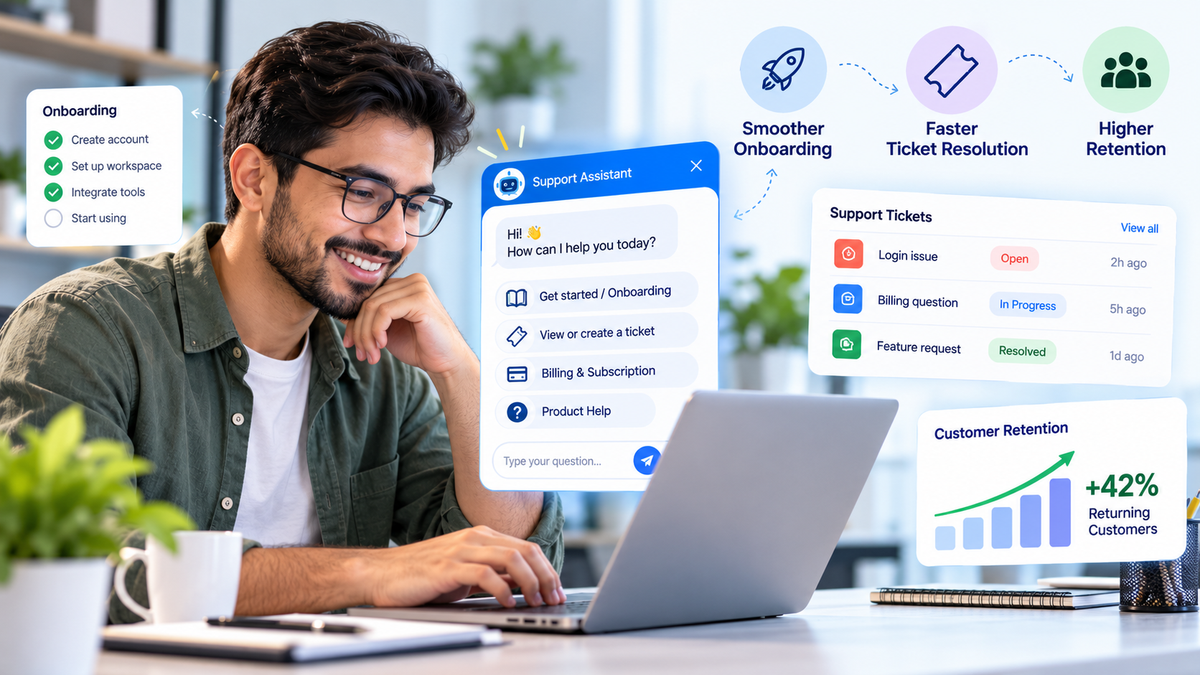
In SaaS, support and product are inseparable. A trial user who hits a wall during onboarding and can't get unblocked fast often never converts to paid. An existing customer who waits two days for a ticket response starts eyeing the exit. Trial-to-paid conversion and churn are both downstream of one thing: how quickly users get a clear answer.
The capability that fixes it
Aivastark learns your product in minutes from your docs, help articles, and FAQs, then answers how-to questions and files tickets automatically when it can't resolve something directly. That means a confused user at 2am gets an accurate walkthrough instead of a silent queue.
Deflecting Tier-1 queries also protects your most expensive resource: your technical team. When routine "how do I reset my password" and "where's the export button" questions are handled autonomously, human agents are freed to focus on the complex integration bugs and edge cases that actually require expertise. Zendesk's guide to AI in customer service frames this as a core benefit of resolving inquiries across channels in one place rather than letting them pile up on overworked staff.
Critically, confident handoff is what keeps this from backfiring. When a query exceeds the agent's scope, Aivastark hands it to a human before frustration builds, rather than looping a user through dead-end responses. For teams weighing their options, our AI chatbot for SaaS page and the breakdown of agentic AI as the new standard beyond chatbots go deeper on this escalation logic.
Healthcare and Wellness: Trust, Availability, and Appointment Booking

The failure that costs you money
Patients rarely have questions only during business hours. They want to know if you accept their insurance, what to bring to an intake appointment, or whether they can reschedule, often late at night or on weekends. Overloaded phone lines and after-hours gaps mean these questions go unanswered, and in a trust-driven field, an unanswered question frequently means a patient books elsewhere.
The capability that fixes it
Availability and consistency are non-negotiable here. Aivastark books appointments and answers common intake questions 24/7, so a prospective patient can get accurate information and secure a slot without waiting for the front desk to open. Because the agent draws from a single trained knowledge base, every patient gets the same correct answer, rather than the inconsistent responses that happen when a rotating staff handles an overloaded phone queue.
The protective layer matters even more in healthcare than elsewhere. When a question moves beyond general information into anything clinical or sensitive, the agent hands off to staff to protect care quality. The AI handles scheduling and logistics; your people handle care. Practices evaluating this can see a focused example on our AI chatbot for dental practices page, and the broader industries overview covers adjacent wellness use cases.
Hospitality and Travel: Round-the-Clock Response Across Time Zones
The failure that costs you money
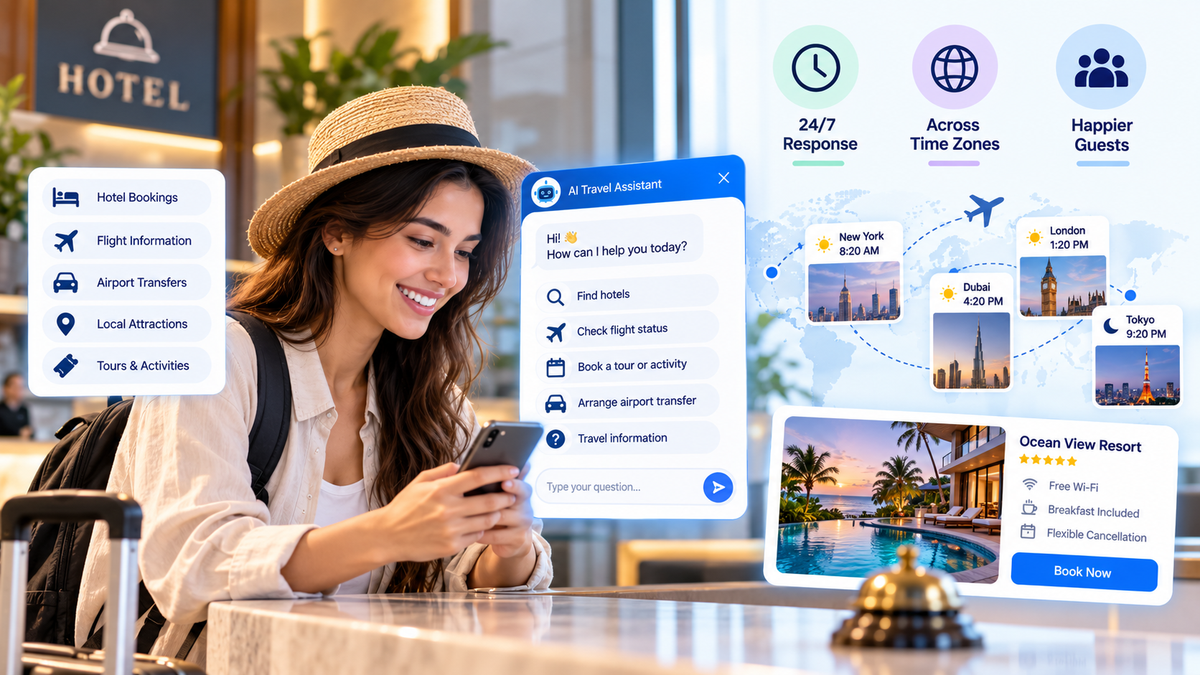
Guests book and ask questions at every hour and from every channel. Someone in another time zone wants to confirm pet policy before booking; a traveler sends an Instagram DM asking about late check-in; a guest messages on WhatsApp to extend a stay. If those arrive at 3am local time and sit unanswered, the booking often goes to the competitor who replied, or to the OTA that charges you commission.
The capability that fixes it
Omnichannel coverage is the whole game here. Aivastark routes inbound Messenger, Instagram DMs, WhatsApp, and your website widget into one inbox, so your agent never sleeps and never loses track of which channel a conversation started on. Instant answers to availability, policies, and booking questions help convert direct reservations and protect your margins.
Faster response times also show up in reviews. Fin's research lists "faster support" and "more consistent experiences at scale" among the measurable impacts of AI agents, and in hospitality those map directly to guest satisfaction scores. Proactive, instant responses are what turn a casual inquiry into a confirmed stay. Our explainer on what omnichannel customer support means and the guide to AI-powered social media responses cover the channel mechanics in detail.
Financial and Professional Services: Accuracy and Lead Capture Matter Most

The failure that costs you money
In financial and professional services, clients demand precise answers and immediate follow-up. A high-intent prospect who fills out a contact form on a law firm or advisory site and hears nothing for hours has already started calling the next firm on their list. The cost of a slow or vague response isn't a lost ticket, it's a lost client worth thousands.
The capability that fixes it
The priority here is lead capture paired with accuracy. Aivastark's smart triggers detect buying intent and surface a lead form mid-conversation; captured leads POST to your webhook so high-intent prospects route straight to your team while the interest is hot. That turns a website visitor into a qualified, contactable lead instead of an anonymous bounce.
AI also improves response consistency and reduces cost per interaction, which Fin identifies as a core "direct resolution" benefit. But in this category, confidence thresholds are what make AI safe to deploy. Sensitive or complex questions, anything touching specific legal advice, account details, or regulated guidance, stay in human hands. The agent qualifies and routes; your professionals advise. For firms in regulated verticals, our AI chatbot for legal firms page and the buyer's playbook for AI customer service in fintech address compliance-minded deployment.
How to Deploy an AI Support Agent Without Losing the Human Touch
Across all five industries, the winning pattern is the same: let AI own the routine and high-volume work, and let humans own the complex and sensitive work. Here's how to put that into practice.
1. Train the agent on your own business data first
Accuracy starts with grounding the agent in your reality, not a generic model. Aivastark learns your business in minutes from website URLs, PDFs, DOCX and TXT files, and FAQs. The quality of your knowledge sources is the single biggest lever on resolution quality, so start there. Our walkthrough on how to add an AI chatbot to your website covers the initial setup.
2. Set clear handoff rules so the agent escalates when unsure
A confident "I'll connect you with someone" beats a confidently wrong answer every time, especially in healthcare, legal, and finance. Define the confidence thresholds and topics that trigger human escalation before you go live. This is the difference between an agent customers trust and one they learn to distrust, a theme we explore in building AI agents customers actually trust and use.
3. Measure resolution rate, deflection, and response time
You can't prove ROI on vibes. Track resolution rate, deflection, and response time from day one so you can quantify the impact against the baseline. It's worth knowing the starting point is low industry-wide: Lorikeet's 2026 roundup, cited by Coworker AI, reports that only 14% of issues actually resolve through self-service today, and 64% of customers wish companies would stop using AI in support. That's a reality check, not a reason to avoid AI. It's an argument for deploying one that escalates well and measurably outperforms the status quo.
4. Keep your brand front and center with a white-label agent
In service-critical industries, the agent is your brand's first impression. A white-label agent means every answer, on every channel, carries your identity rather than a vendor's. For the full argument, see white-label chat explained and the comparison of white-label vs building your own.
The bottom line
The industries where customer service is everything share one trait: the cost of a bad or missing reply is measured in lost revenue and damaged trust, not just a longer ticket queue. Whether you run an e-commerce store, a SaaS product, a clinic, a hotel, or an advisory practice, the fix isn't a bot bolted onto a page. It's an agent that resolves the routine, captures and books real demand, and knows exactly when to step aside for a human. If that's the bar you're setting, compare your options on our pricing and features pages, or see how Aivastark stacks up against the alternatives on our comparison hub.
Frequently asked questions
Which industries depend most on customer service?
E-commerce and retail, SaaS and technology, healthcare and wellness, hospitality and travel, and financial and professional services—fields where slow or inconsistent service directly causes churn, abandoned purchases, and reputation damage.
How does AI help e-commerce support?
An AI agent finds products, answers order-status and returns questions, and captures leads across website, Instagram, and WhatsApp in one inbox, giving shoppers instant answers that reduce cart abandonment and increase conversions.
Why is AI support valuable for SaaS companies?
It learns your product from docs and FAQs to answer how-to questions and file tickets automatically, deflecting Tier-1 queries so technical staff focus on complex issues—directly improving trial-to-paid conversion and retention.
Is AI safe to use in healthcare and financial services?
Yes, when it handles only logistics—scheduling, intake questions, lead capture—and hands off anything clinical, legal, or regulated to human staff through clear confidence thresholds, protecting care quality and compliance.
How do you deploy an AI support agent without losing the human touch?
Train the agent on your own business data first, then set clear handoff rules so it escalates when unsure—letting AI own routine work while humans own complex and sensitive interactions.
What makes modern AI agents different from legacy chatbots?
Unlike script-based chatbots, modern AI agents manage and resolve interactions across channels like chat, email, voice, and social messaging, and can take action across your systems rather than just reply.
Sources