WhatsApp service message pricing changed on 1 October 2026. Meta now charges for service messages, the free-form replies a business sends inside the 24-hour customer service window. Each business phone number still gets 1,000 free a month. After that, every delivered reply costs the utility rate for the customer's country. For a store that answers on WhatsApp with an AI agent, every answer it sends is now on the bill.
This guide covers what changed, the rates for the main markets on Meta's rate card, what a month of AI replies costs at two store sizes, and the settings that decide how many messages your agent sends.
What changed on 1 October 2026?
Meta made two changes to the WhatsApp Business Platform. Service messages, free since 1 November 2024, are now charged per delivered message after 1,000 free per business phone number per month. Utility templates sent inside an open customer service window, free since 1 July 2025, are charged again too.
The details, from Meta's pricing documentation:
- Service messages are any non-template message: text, images, documents, sent only as a reply inside the 24-hour window that opens with each customer message.
- The rate for a service message is the same as the utility and authentication rate in that market.
- The free tier is 1,000 service messages per business phone number per month. Unused messages don't roll over; the count resets each month. Message 1,001 is charged.
"For each business phone number, Meta provides 1,000 free service messages per month, which do not roll over but reset monthly." (Meta, WhatsApp Business Platform pricing documentation)
- No volume tiers. Utility and authentication messages get cheaper at high volume; service messages don't.
- Messages from customers to you stay free. Meta charges only for business-to-customer messages, and only when they're delivered.
- Payment method. Meta delivers service messages inside the free tier without one, but stops delivering them after the free 1,000 if no payment method is on file.
Eligible government bodies and non-profits keep free service messages past the free tier until 31 December 2027. Everyone else pays.
WhatsApp service message pricing: how much does each reply cost?
A service message costs the utility rate for the market of the customer's phone number, from under a cent to about five and a half cents. The market is set by the customer's country calling code, not by where your business is. A Dubai store answering a customer with a UK number pays the UK rate.
Rates per delivered message in US dollars, from Meta's rate card effective 1 October 2026:
| Customer's market | Service (= utility) | Marketing template |
|---|---|---|
| North America (US, Canada) | $0.0034 | $0.0250 |
| India | $0.0014 | $0.0118 |
| Brazil | $0.0068 | $0.0625 |
| Mexico | $0.0085 | $0.0397 |
| South Africa | $0.0095 | $0.0379 |
| Saudi Arabia | $0.0107 | $0.0576 |
| Australia (Rest of Asia Pacific) | $0.0113 | $0.0842 |
| Malaysia | $0.0140 | $0.0860 |
| Pakistan | $0.0150 | $0.0473 |
| United Arab Emirates | $0.0157 | $0.0576 |
| Singapore | $0.0160 | $0.0732 |
| Rest of Western Europe (incl. Ireland, Sweden, Switzerland) | $0.0171 | $0.0592 |
| United Kingdom | $0.0220 | $0.0635 |
| France | $0.0300 | $0.0859 |
| Germany | $0.0550 | $0.1365 |
Australia, New Zealand, Japan, Thailand, Vietnam and the Philippines sit in Meta's "Rest of Asia Pacific" region and share its rate. Meta can change rates only on the first day of a quarter and gives at least a month's notice, so check the rate card before you budget. For dirham prices and the UAE's own rules, see WhatsApp pricing in the UAE.
What does an AI agent on WhatsApp cost per month now?
Your Meta bill for an AI agent is the replies beyond 1,000 a month per number, multiplied by your customers' rate. An agent that sends 3,000 replies a month to US customers costs about $6.80 in Meta fees; the same 3,000 replies to German customers cost $110.
The formula:
Meta fee = (service messages delivered − 1,000) × the service rate for your customers' market
Two store sizes, one WhatsApp number, every customer in the same market:
| Customer's market | 3,000 replies a month | 10,000 replies a month |
|---|---|---|
| North America | $6.80 | $30.60 |
| India | $2.80 | $12.60 |
| South Africa | $19.00 | $85.50 |
| Australia | $22.60 | $101.70 |
| Malaysia | $28.00 | $126.00 |
| United Arab Emirates | $31.40 | $141.30 |
| Rest of Western Europe | $34.20 | $153.90 |
| United Kingdom | $44.00 | $198.00 |
| Germany | $110.00 | $495.00 |
To turn chats into messages, count what your agent sends, not what customers ask. If an average chat takes four replies, 1,000 chats a month is about 4,000 service messages. Your own reports show the real number: use last month's delivered outgoing messages per number.
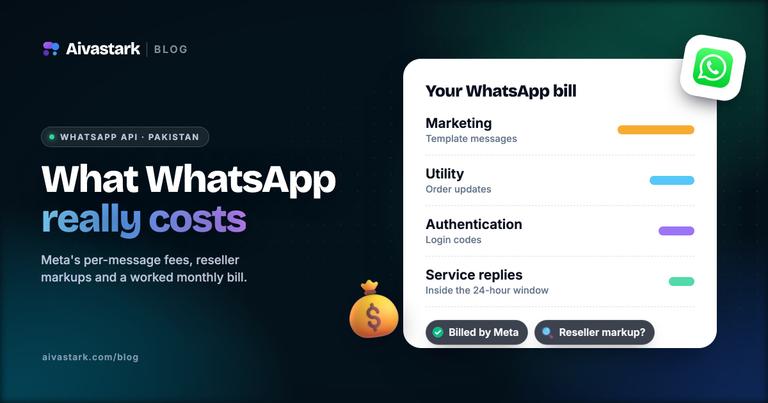
This is Meta's fee only. The platform that runs your agent charges its own plan on top, and some providers resell Meta's fees with a markup. Ask which one you're paying.
Does every AI reply count as a separate message?
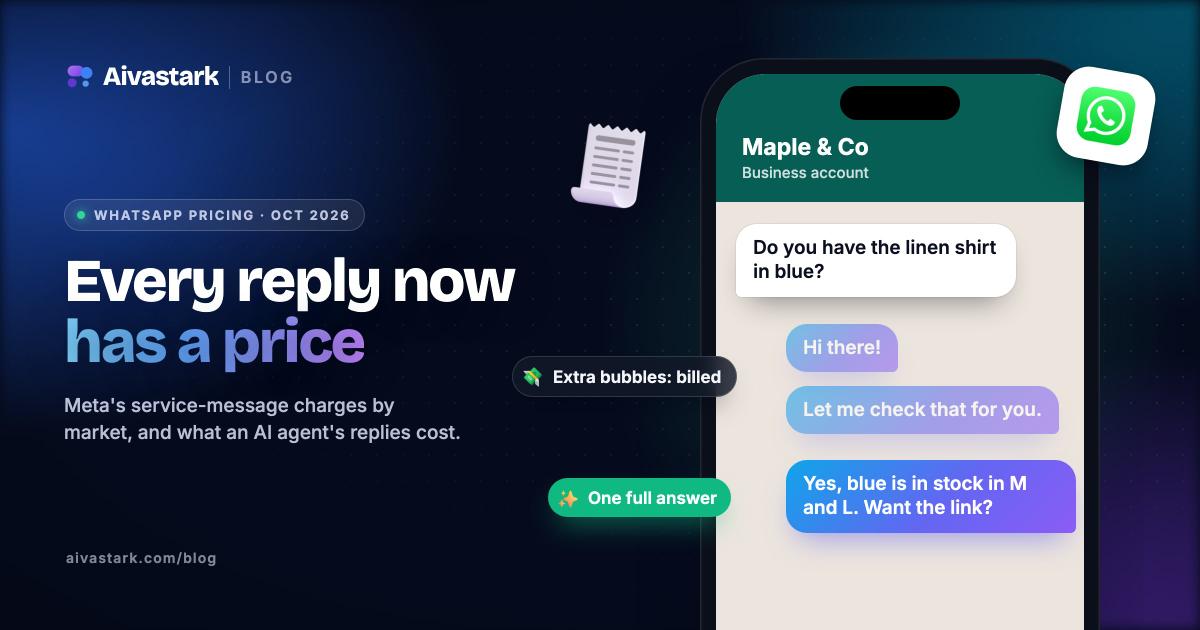
Yes. Meta charges per delivered message, and each message has one charge. An answer split into three bubbles is three charges. A reply with three product photos is four, because each image is its own message. The 1,000 free messages cover every service message from the number, AI and human replies together.
What adds messages without adding value:
- Answers split into several bubbles. Some bots send a greeting, the answer and a question as three separate messages. One message that does all three costs a third as much.
- Answering each fragment. Customers often type one thought as three quick messages. An agent that answers each one sends three replies where one would do.
- Photos nobody asked for. Product photos help when someone is choosing. Attached to every answer, they multiply the count.
- Automatic follow-ups. "Anything else I can help with?" sent ten minutes later is a charged message.
- Teammate replies. When a person takes over a chat, their replies count against the same free 1,000 and the same rate.
How can a store lower its WhatsApp service message bill?
Send fewer, fuller replies. Answer the whole question in one message, wait a few seconds so a customer's burst of messages gets a single answer, send photos only when they help, and keep automatic follow-ups off unless they earn their cost. Chats that start from a click-to-WhatsApp ad are free for up to 7 days.
The levers, roughly in order of effect:
- One answer per question. Check how your agent formats replies. A single message with a short list beats three bubbles.
- Wait before replying. A short pause catches customers who send one thought in several messages, so they get one answer instead of three.
- Photos on request. Let the agent show products when a customer is browsing, not on every answer.
- Follow-ups off by default. Turn them on only where a nudge recovers sales.
- Click-to-WhatsApp ads. When a customer starts a chat from one of these ads on the WhatsApp phone app (Android or iOS), Meta opens a free entry point window of up to 7 days. Inside it, service, utility, marketing and authentication messages are free.
- Keep a payment method on file. Without one, Meta stops delivering service messages once the free 1,000 are used, which means your agent goes quiet mid-month.
What not to do: cut answers so short that customers have to ask again. Every follow-up question starts another reply.
Which Aivastark settings change how many messages you send?
Aivastark answers customers on WhatsApp from the Starter plan, through Meta's WhatsApp Business Platform (Cloud API). Meta bills its message fees to your own WhatsApp Business account; Aivastark's plan is separate, and Aivastark doesn't resell or mark up Meta's fees.
The settings that decide your message count:
- Wait before replying (Agent Settings › Channels): from 0 to 45 seconds, so a customer who splits a question across several messages gets one answer to all of it.
- Product photos go out as captioned images, up to three, when the agent finds products in a Shopify catalogue. Each photo is a message.
- Follow-up nudges (Starter) are off by default. When on, the agent sends up to three, all inside Meta's 24-hour window.
- No templates or broadcasts. The agent only messages customers inside a chat they started, so everything it sends is a service message, never a marketing template.
Plans and what each includes are on the pricing page. If you're comparing WhatsApp tools on cost, see WATI alternatives and WATI's own pricing.
Are utility templates inside the 24-hour window still free?
No. Since 1 October 2026, a utility template sent while a customer service window is open is charged at the utility rate. From 1 July 2025 until then it was free. These templates don't count toward the 1,000 free service messages, which cover service messages only.
This matters if your store sends order confirmations or shipping updates as templates while a customer is mid-chat. Inside an open window, a plain service message can carry the same information and falls under the free tier first.
Market guides
- WhatsApp pricing in the UAE: rates in dirhams, the 1 October changes, and VAT.
- WhatsApp API pricing in Pakistan: Meta's rates for Pakistani numbers.
Rates in this guide were read from Meta's USD rate card, effective 1 October 2026, on 17 November 2026.
Steps at a glance
Count last month's replies
From your WhatsApp Business account's insights or your provider's reports, take the outgoing messages delivered last month for each business phone number.
Split them by customer market
Group the messages by the country calling code of the customers who received them, since the rate follows the customer's number, not your business.
Subtract the free tier
Take 1,000 off the service messages for each business phone number. Chats opened by click-to-WhatsApp ads are free for up to 7 days, so leave them out too.
Apply the rates
Multiply what is left in each market by that market's service rate on Meta's current rate card.
Add your templates
Add any marketing, utility and authentication templates you send, including utility templates sent inside an open window.
Frequently asked questions
Are WhatsApp service messages free in 2026?
Only the first 1,000 a month per business phone number. Since 1 October 2026 Meta charges each delivered service message after that at the utility rate for the customer's market, for example $0.0034 in North America, $0.0157 in the UAE and $0.022 in the UK.
Are the 1,000 free service messages per number or per account?
Per business phone number. Each number gets 1,000 free service messages a month. They don't roll over: the count resets every month, and message 1,001 on that number is charged.
Do messages from customers count toward the bill?
No. Meta charges only for messages a business sends to a customer, and only when they are delivered. Messages customers send you are free.
Does Meta charge AI replies differently from human replies?
No. A service message costs the same whether a person or a third-party AI agent wrote it, and both count toward the same free 1,000. Meta's own Business Agent is a separate category, billed per token.
Are replies to click-to-WhatsApp ad chats free?
Yes, for a while. When a customer starts a chat from a click-to-WhatsApp ad on the Android or iOS app and you reply in time, Meta opens a free entry point window of up to 7 days in which service, utility, marketing and authentication messages are free.
Who pays Meta's fees when I use an AI chatbot platform?
It depends on the platform. With Aivastark, Meta bills its message fees to your own WhatsApp Business account and Aivastark's plan is separate, with no markup on Meta's fees. Some providers resell Meta's fees, so ask before you compare prices.
Sources