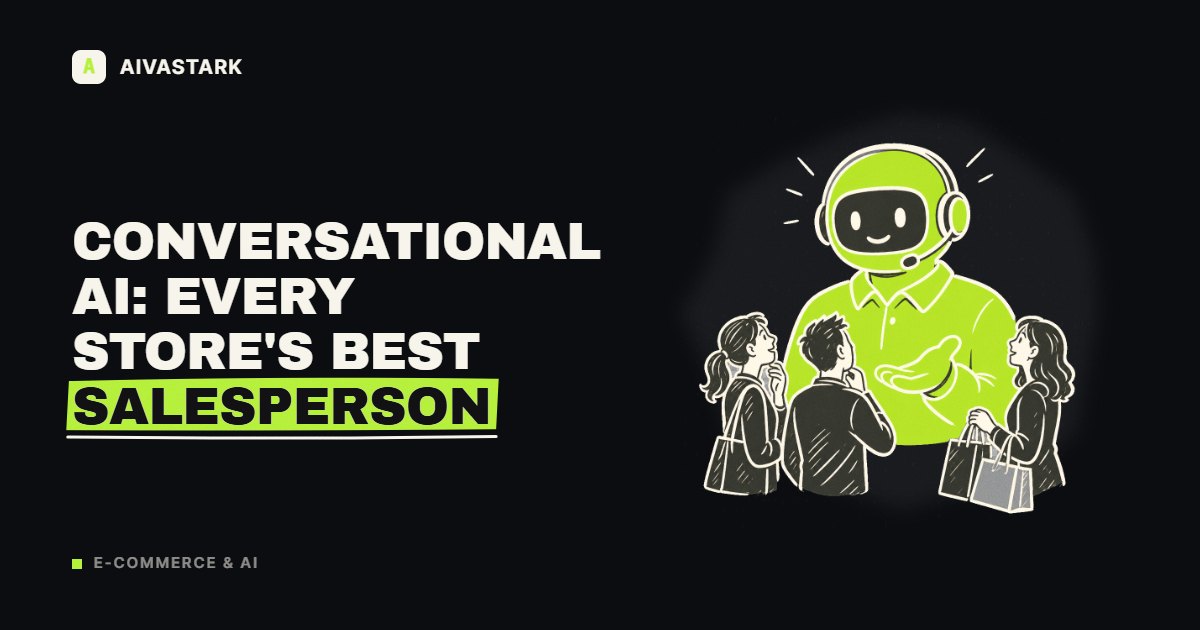
Conversational AI has quietly become the most productive salesperson on your team—one that never sleeps, never gets impatient, and never fumbles a product question at the exact moment a shopper is ready to buy. For e-commerce brands, the shift is happening faster than most merchandising strategies can keep up with. Customers no longer want to hunt through filter menus and category trees; they want to ask a question in plain language and get a precise, helpful answer. That change in behavior is reshaping how online stores discover, guide, and convert their customers.
This article breaks down why conversational AI is outperforming traditional store navigation, how it sells like your best floor associate, and where it delivers the most measurable revenue impact across the buying journey.
Why Shoppers Now Ask Instead of Search
The way people shop online has fundamentally changed. Instead of navigating filters, sorting menus, and static category pages, consumers increasingly expect to type or speak a natural question and receive a relevant answer. As Frontnow notes, the move from clicks to conversations is "more than a design trend. It represents a foundational change in how ecommerce operates."
Consider a query like "red dress for a summer wedding under $150." To a traditional search engine, that sentence is noise. To conversational AI, it's a rich set of instructions. According to Algolia, that single line embeds four distinct constraints—color, occasion, product category, and price—that a shopper would otherwise have to apply as separate filters. Conversational AI extracts them automatically and narrows to relevant results in a single step.
This is not a niche preference. Research cited by Master of Code shows that 71% of consumers now prioritize real-time communication. Shoppers expect to be met with instant, natural dialogue—the same way they'd interact with a knowledgeable associate in a physical store.
The takeaway for e-commerce leaders is clear: rigid search tools and static filters are increasingly at odds with how people actually want to shop. The stores that adapt to conversation-first discovery win the moments that matter most.
How Conversational AI Sells Like Your Best Employee
The best in-store sales associates don't hand you a catalog and walk away. They ask a question or two, listen, and narrow the field to a short list of options you'll actually consider. Conversational AI does exactly this at scale.
As Manago describes it:
Conversational AI does what a good shop assistant does. It asks a question or two, narrows down the options, and gets the customer to something relevant before they lose patience.
That behavior maps directly onto the buying journey. When a customer says something conversational, the AI interprets the intent, the occasion, the style, and the budget, then returns a valuable shortlist—no manual filtering required. It replaces friction with guidance.
Answering questions at the moment of intent
The other half of great salesmanship is answering questions instantly. When a shopper asks "Does this run true to size?" or "What's your return window?", any delay risks losing the sale. Conversational AI removes that delay entirely. As Bland AI puts it, AI "reduces friction at the exact moment a prospect is ready to move forward."
Getting smarter over time
Unlike a static FAQ page, conversational AI improves with use. According to Salsita, it "constantly improves by learning from previous interactions... this leads to more personalized, accurate, and human-like interactions." In other words, your AI salesperson gets better at their job every single day—something you can't say for a printed product guide.
If you're weighing how this differs from a basic bot, our breakdown of AI Agent vs AI Chatbot: What's the Difference? explains why intent-driven agents outperform scripted flows.
The Conversion and Revenue Impact of Conversational AI
Improved experience is nice. Measurable revenue is better—and conversational AI delivers both.
The headline figure is striking: AI chatbots increase conversion rates by an average of 23%, according to Glassix research cited by Bland AI. That lift isn't magic. It comes from removing hesitation at the precise moment purchase intent is highest. When a lead asks a question at midnight, they get an immediate answer instead of waiting until business hours—and that responsiveness keeps momentum alive instead of letting interest fade.
Speed is the underlying mechanism. As GetMyAI explains, conversational AI "speeds up decision-making by delivering immediate, relevant answers during the buying journey... Speed is no longer a feature. It determines whether a user converts or leaves."
The business results follow. Master of Code reports that 79% of companies say conversational tools boosted user loyalty and revenue. And the revenue impact extends beyond a single transaction. According to Insider One, conversational AI drives average order value through:
- Guided selling — recommending complementary or upgraded products in-conversation
- Cart recovery — re-engaging shoppers who abandoned before checkout
- Cross-channel conversations — continuing a dialogue seamlessly across web, chat, and messaging apps
Put together, these mechanisms turn a support tool into a genuine profit center. For a deeper look at how conversations translate into completed orders, see AI Chat Commerce: From Add to Cart to Checkout.
Real Brands Winning With Conversational Commerce
This isn't theoretical. Leading retailers and platforms have already deployed conversational AI for both guided selling and support, treating it as a core commerce capability rather than a bolt-on widget.
The consumer willingness to transact inside chat is now undeniable. Per Bland AI, citing Valtech's global study published in January 2026:
Over 70% of consumers are willing to complete purchases inside AI chat apps.
That statistic reframes the entire conversation. Chat is no longer just where customers ask pre-sale questions—it's increasingly where they buy.
A big part of the appeal is availability. Chatbots are, as Lift AI notes, "cheap, instant, and work 24/7." A customer researching a purchase at midnight gets a knowledgeable answer immediately instead of waiting for business hours—and that's often the difference between a completed order and an abandoned tab.
Bland AI's conclusion captures the strategic shift bluntly: most businesses "treat conversational AI as a novelty feature rather than as essential infrastructure." The brands winning today have crossed that line—they treat it as infrastructure. If you're comparing where AI outperforms staffed support, our guide on AI Chatbots vs Human Support: Which Is Better? puts the tradeoffs in context.
Where Conversational AI Delivers the Most Value in the Buying Journey
Not every stage of the funnel benefits equally. Understanding where to focus first accelerates ROI.
Pre-purchase product discovery
This is where the money is. Algolia states plainly that product discovery is where conversational AI has the most direct revenue impact. When AI can interpret a complex, natural-language request and surface relevant products in one step, it compresses a journey that used to take a dozen clicks into a single exchange.
Reducing time-to-purchase
Every additional step is a chance to lose the customer. As Manago points out, conversational AI "reduces time to purchase" by getting shoppers "to something relevant before they lose patience." Speed here is directly protective of revenue.
Meeting modern expectations
Today's buyers expect instant availability, convenience, and knowledgeable help. Cognigy frames it well: conversational AI improves customer experience "in the areas that matter most: speed, convenience, knowledgeable help, and friendly service." Falling short on any of these erodes trust.
Keeping the journey continuous across channels
Modern customers don't stay in one place. They start on a product page, ask a question in chat, and follow up later through a messaging app. Insider One emphasizes that conversational AI enables "seamless conversations across channels," keeping the experience continuous rather than fragmented. If omnichannel continuity is a priority, our explainer on What Is Omnichannel Customer Support? covers the fundamentals.
Getting Started With a White-Label AI Support Chatbot
Adopting conversational AI doesn't require building a machine-learning team from scratch. A white-label platform lets you deploy a branded, intelligent assistant quickly—and scale it alongside your catalog. Here's how to approach it strategically.
1. Treat conversational AI as core infrastructure
The single biggest mindset shift is to stop viewing conversational AI as an optional add-on. Position it as infrastructure that scales with your product range, traffic, and customer base. This framing changes how you resource, measure, and prioritize it—and it's the approach the leading brands cited above have already adopted.
2. Train the AI on your product data
The intelligence in "conversational AI" comes from context. To interpret a query like "red dress for a summer wedding under $150," the AI needs to understand your catalog—attributes, variants, availability, pricing, and policies. Feeding it accurate, structured product data is what allows it to extract intent and return relevant shortlists. Because it also learns from every interaction, its accuracy compounds over time. Our overview of What is a white-label AI chatbot? explains how the underlying model connects to your data.
3. Craft effective, on-brand responses
Conversational AI is only as good as the answers it gives. As Lift AI advises, "it pays off to take the time to craft effective ones. A productive chatbot is able to answer frequently asked questions, direct visitors to appropriate resources," and guide shoppers toward the right products. Invest in clear, on-brand response quality for your most common FAQs and product questions—these carry the most conversion weight. If you're planning deployment, How to add an AI chatbot to your website walks through the practical steps.
4. Measure conversion lift, AOV, and loyalty
To prove ROI, track the metrics that matter: conversion rate before and after deployment, average order value on AI-assisted sessions, cart recovery rates, and repeat-purchase or loyalty indicators. With benchmarks like a 23% average conversion lift and 79% of companies reporting revenue gains, you have clear targets to measure against. Attribution should tie AI conversations to downstream revenue so the business case is unambiguous.
For e-commerce teams specifically, our AI chatbot for ecommerce page details how these capabilities map to product discovery, support, and guided selling in a retail context.
The Bottom Line
Conversational AI has moved from novelty to necessity. Shoppers now expect to ask rather than search, they reward the stores that answer instantly, and a growing majority are willing to buy directly inside chat. The revenue evidence—a 23% average conversion lift and loyalty and revenue gains reported by 79% of companies—confirms that this is a commercial strategy, not just a UX upgrade.
The stores that win won't be the ones with the most filters. They'll be the ones whose AI listens like a great salesperson, understands intent, and guides shoppers to the right product before impatience sets in. Treated as core infrastructure, trained on your product data, and measured against clear conversion goals, conversational AI becomes exactly what the best floor associate always was: your most reliable path from browsing to buying.
Sources