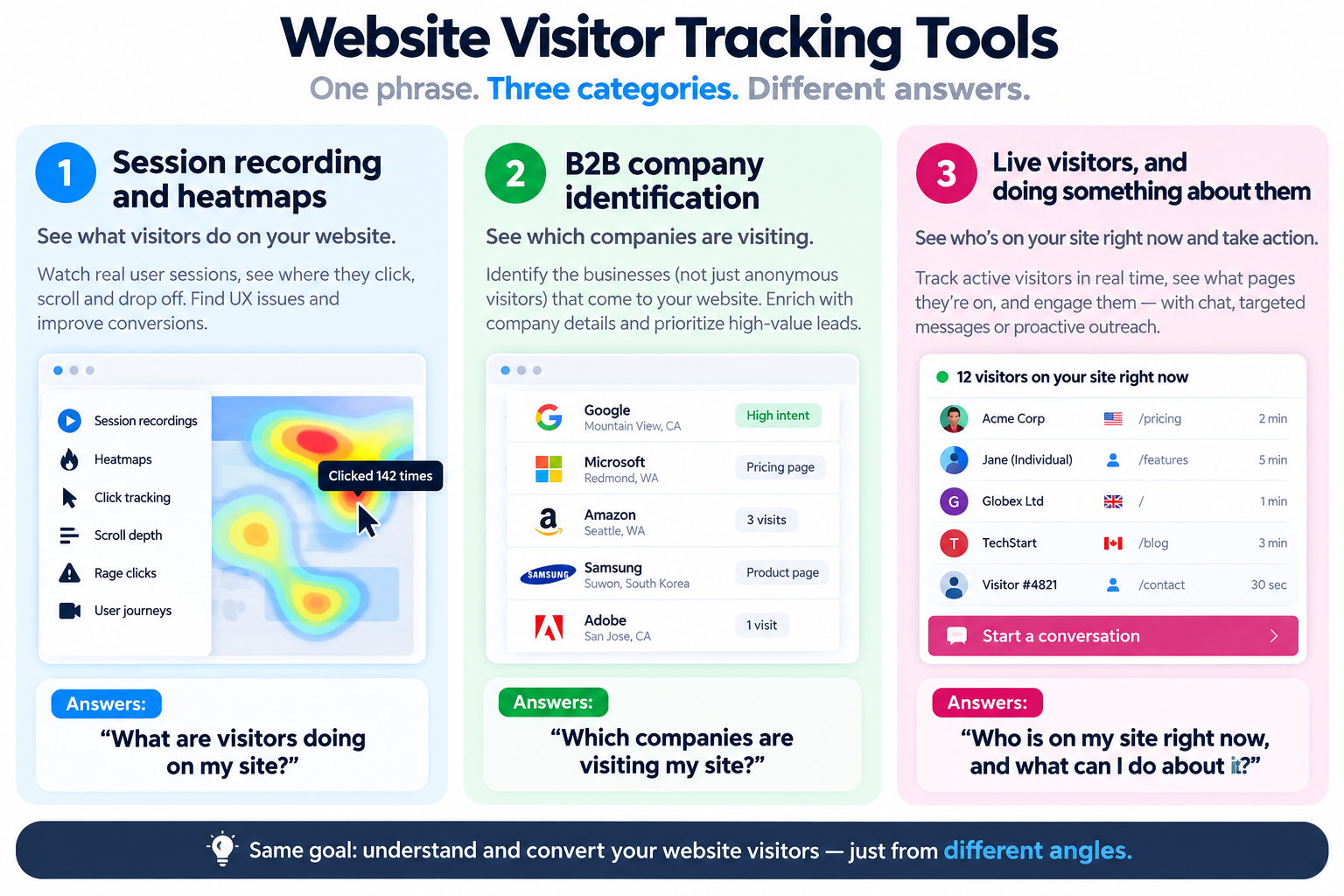
"Website visitor tracking" is not one product category. It is three, and most comparison posts blend them into a single ranked list, which is why buyers end up paying for a heatmap tool when what they wanted was a phone number.
TL;DR: Session recording tells you what happened on the page (Microsoft Clarity, free; Lucky Orange from $32/mo; Contentsquare from $39/mo). Company identification tells you which business was browsing (Leadfeeder, free tier then from €79/mo; Albacross from €59/mo). Live visitor tools tell you who is here now and let something happen about it (Tidio from $24.17/mo plus a separate AI meter; Aivastark Visitor Lens from $39/mo). Hotjar no longer accepts new signups. Every price below was read off the vendor's own pricing page on 17 September 2026.
Key takeaways
- Pick the category first, the tool second. The three categories do not substitute for each other, and no tool on this list is good at all three.
- Hotjar is closed to new customers. Contentsquare's own page says so plainly. (Contentsquare)
- Microsoft Clarity's price is zero and its cost is retention — playback is deleted after 30 days. (Microsoft Learn)
- Dealfront rebranded back to Leadfeeder, not the other way round.
dealfront.com/pricingnow 301-redirects toleadfeeder.com/pricing. - Tidio is the better buy for human live chat; its AI is a separate line item on top of the plan.
- Seeing a visitor is worth nothing on its own. The whole question is what happens in the next thirty seconds.
The three categories, in one table
| What it answers | Tools | Entry price | |
|---|---|---|---|
| Session recording & heatmaps | "What did they do on the page?" | Microsoft Clarity, Lucky Orange, Hotjar → Contentsquare | Free |
| Company identification | "Which company was that?" | Leadfeeder, Albacross | Free (capped), then €59–€79 per month |
| Live visitor & engage | "Who is here now — and what happens next?" | Tidio, Aivastark Visitor Lens | $24.17 / $39 per month |
Read the category you are actually in. If you are a B2B team chasing named accounts, a heatmap tool will never give you a company name no matter how much you pay for it. If you are an ecommerce store trying to work out why the checkout leaks, a company-identification tool is irrelevant — your buyers are consumers, not businesses.
 ---
---
Category 1 — Session recording and heatmaps
These tools answer what happened on the page. They replay anonymous sessions, aggregate clicks and scrolls into heatmaps, and show where people give up. They will not tell you who the visitor was, and they are not meant to.
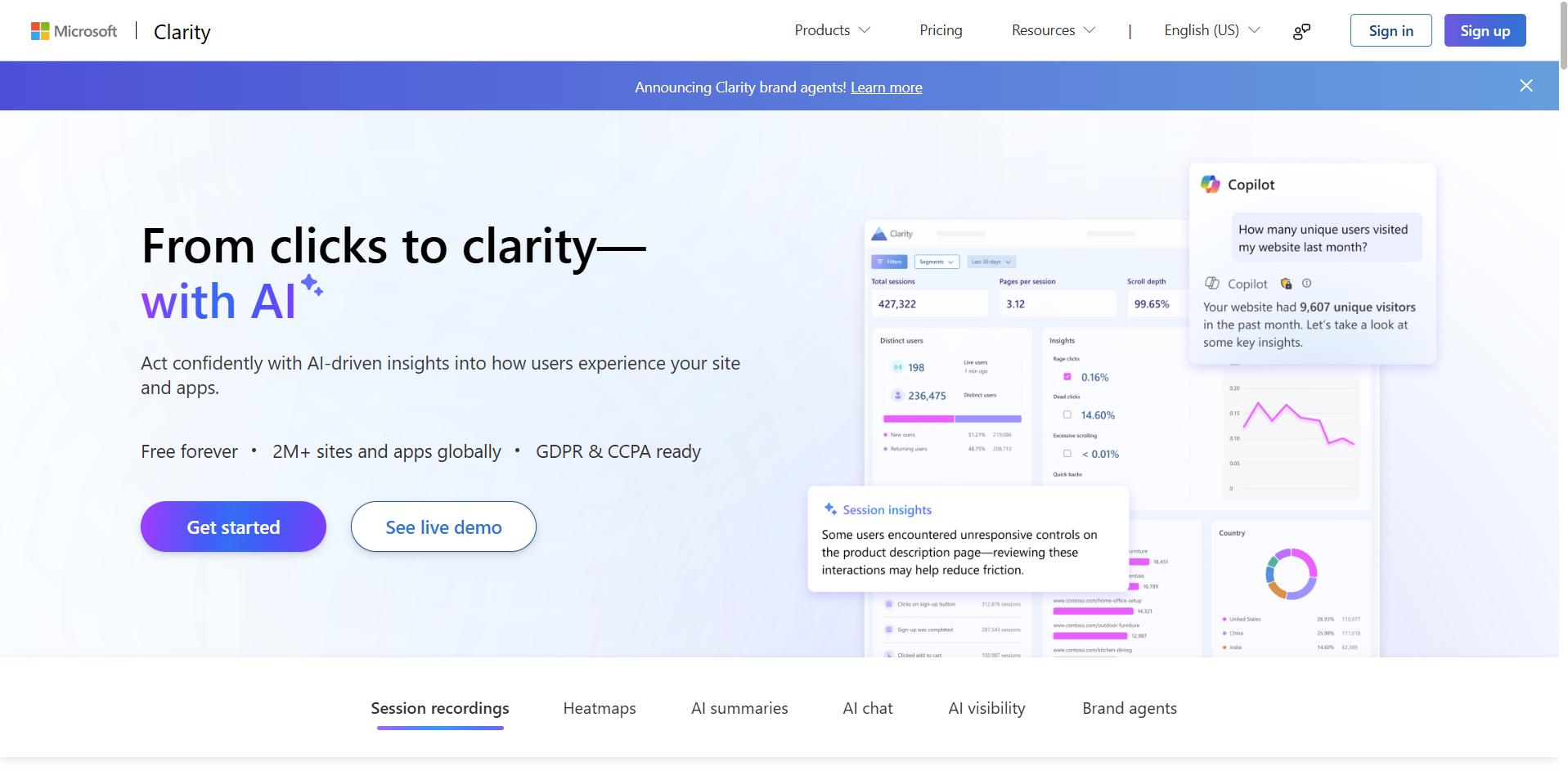
1. Microsoft Clarity — the free default
Pricing (checked 17 September 2026): Free. There is no paid tier, no traffic limit and no session cap. Microsoft's site states "Free forever" and "No limits on traffic," and reports 2M+ sites and apps using it.
Clarity is the rare case where the free tool is the category leader. You get session recordings, heatmaps, AI summaries, an AI chat over your own data, and mobile app analytics for Android, iOS, Flutter and React Native. Nothing is gated behind a plan, because there are no plans.
The catch is retention, not money. Microsoft's documentation is explicit: playback data is kept for 30 days, click and heatmap data for 9 months, and labelled or favourited sessions for 9 months. After that it is deleted from servers and backups and cannot be recovered. If you want to review what happened during a launch last quarter, you needed to have favourited it at the time.
- ✅ Genuinely free, genuinely unlimited traffic
- ✅ GDPR and CCPA compliant, mature mobile SDKs
- ⚠️ 30-day playback retention — favourite anything you might need later
- ⚠️ Your behavioural data sits inside Microsoft's advertising ecosystem; some regulated buyers will not accept that
 ### 2. Hotjar (now Contentsquare) — you can no longer sign up
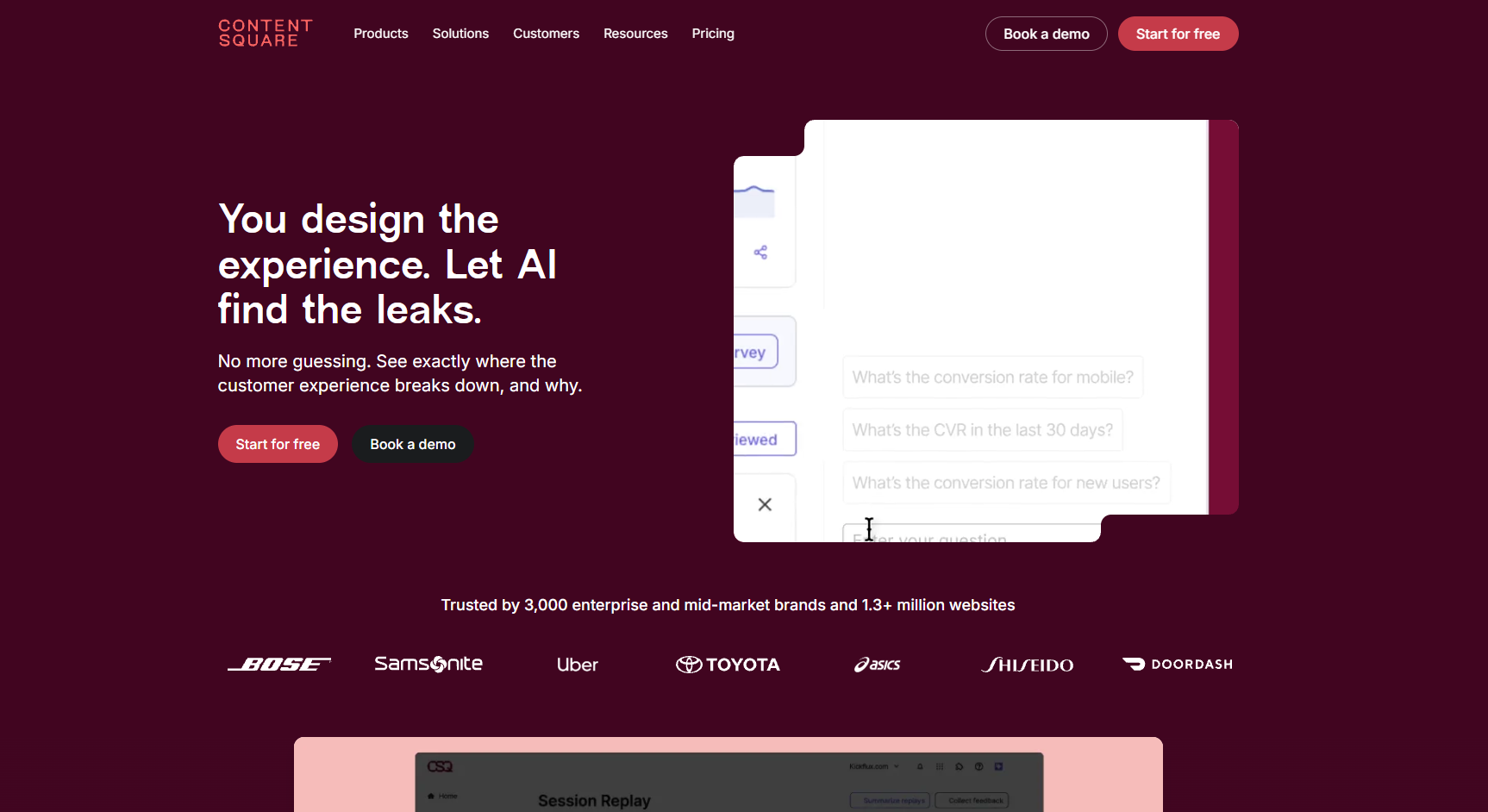
Pricing (checked 17 September 2026): You cannot buy Hotjar any more. Contentsquare's page states: "It's no longer possible to create a new account on Hotjar. New users can sign up for free on Contentsquare." Existing Hotjar accounts still work and can still sign in.
This is the fact most 2026 listicles have not caught up with — many still rank Hotjar first and link to a pricing page that now redirects to Contentsquare.
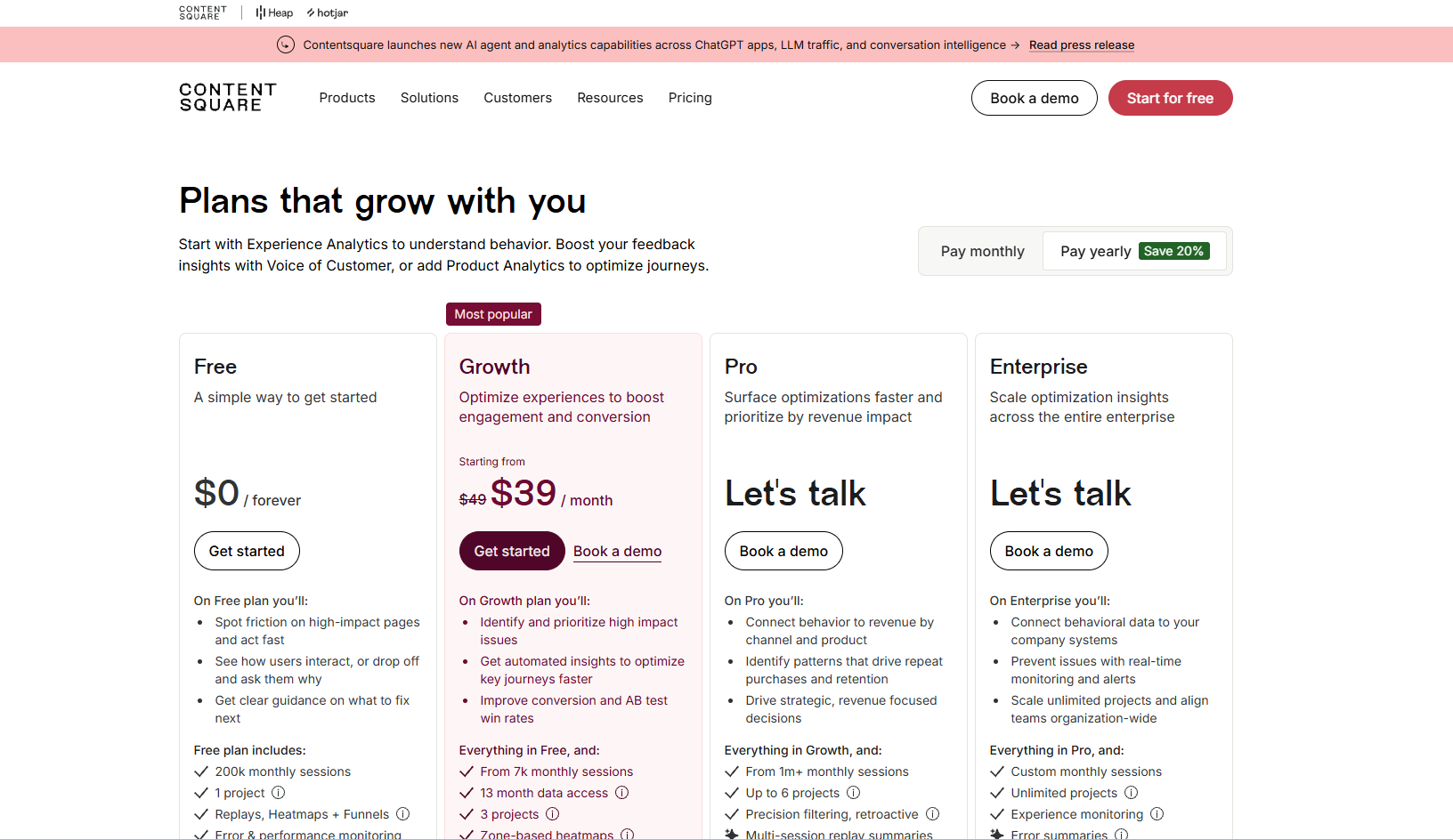
What replaced it is sold as separate product lines, each with its own meter. For the heatmaps-and-recordings job Hotjar used to do, you want Experience Analytics:
| Experience Analytics | Free | Growth | Pro |
|---|---|---|---|
| Price | $0 | $39/mo billed annually ($49 billed monthly) | "Let's talk" |
| Monthly sessions | Up to 200k | 7k – 10m | 1m – unlimited |
| Data access | 1 month | 13 months | 13 months |
| Projects | 1 | 3 | Up to 6 |
Surveys are a second bill. Voice of Customer is Free for 100 monthly responses, then $79/mo billed annually ($99 monthly) for 500–100k responses. Product Analytics is quote-only.
Read that table twice, because it is the whole story. The free plan's 200,000 sessions is by far the most generous headline number in this comparison — Contentsquare's own comparison puts it at roughly 190× Hotjar's old free plan of 35 sessions a day. But free gives you one month of data access, and the $39 Growth plan starts at a smaller session band (7k). You are not paying Contentsquare for volume. You are paying for history and depth: 13 months of data, three projects, journey analysis, zoning. If all you need is "what broke on this page last week," the free plan genuinely covers it and you should not upgrade.
- ✅ The most generous free session allowance here, by a wide margin
- ✅ Surveys and voice-of-customer tooling in the same platform
- ⚠️ One month of data access on Free — no quarter-over-quarter comparison
- ⚠️ Two meters to budget: Experience Analytics and Voice of Customer are priced separately
- ⚠️ Legacy Hotjar customers face an eventual migration off a grandfathered plan
 ### 3. Lucky Orange — every feature on every plan
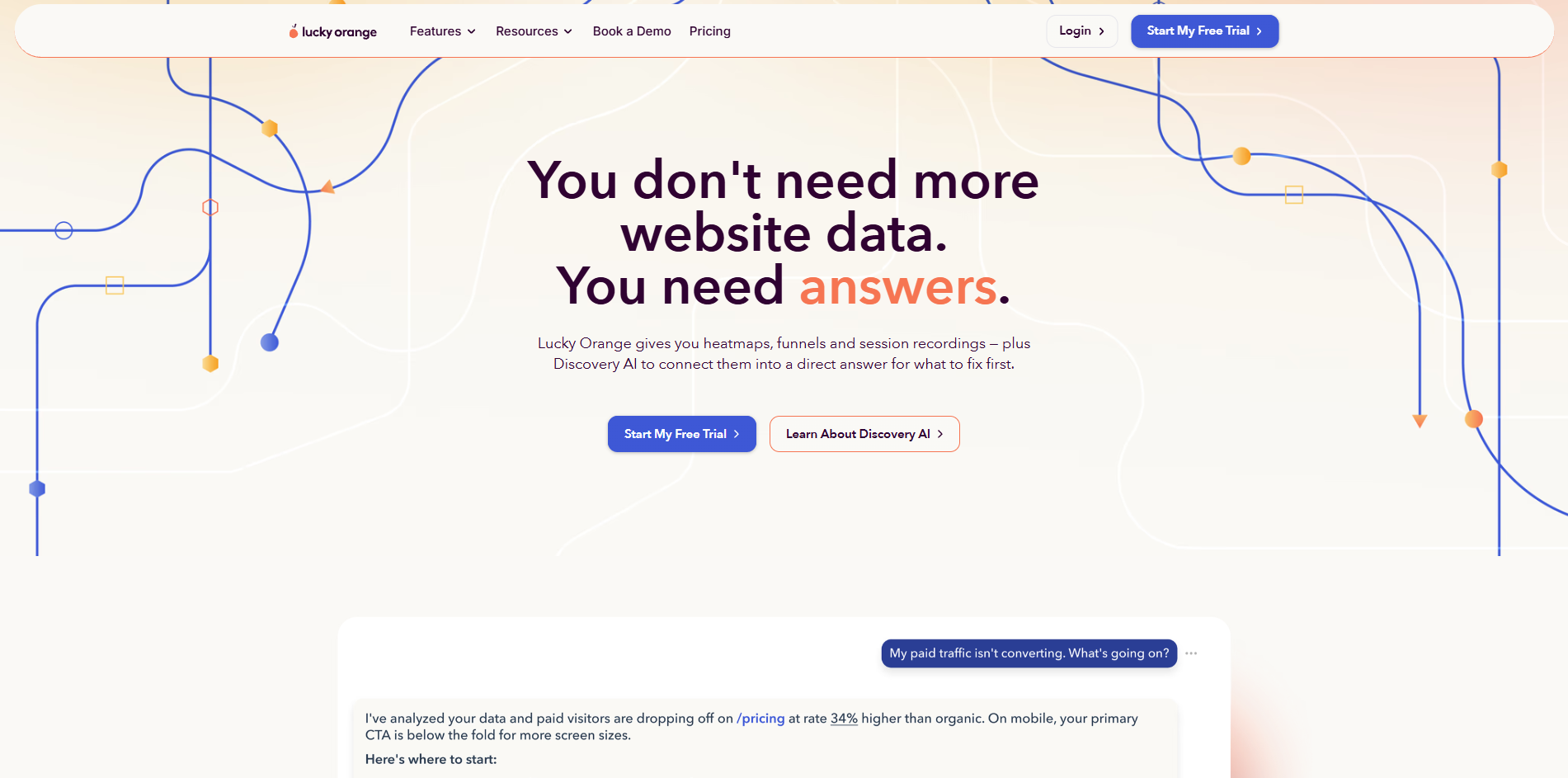
Pricing (checked 17 September 2026), paid annually: Build $32/mo (3,500 sessions), Grow $72/mo (10,000 sessions), Expand $199/mo (from 50,000 sessions), Scale $839/mo (from 300,000 sessions), Enterprise custom (700,000+). Monthly billing costs 20% more — their comparison table lists Build at $39, Expand at $249 and Scale at $1,049. Extra websites are $5 each. There is a 7-day free trial with full access and no free tier after it.
Lucky Orange's genuinely good decision is printed at the top of its own pricing page: "Every feature. Every plan." Recordings, dynamic heatmaps, conversion funnels, form analytics, unlimited surveys, live chat, a live visitor view and unlimited team members are on the $32 plan and the $839 plan alike. You buy sessions, not capabilities. That is unusual in this category and it makes the pricing honest.
- ✅ No feature gating — the cheapest plan is the full product
- ✅ Unlimited team members on every tier
- ✅ Ships a live visitor view and live chat, so it straddles categories 1 and 3
- ⚠️ 3,500 sessions on the entry plan is small; a modest store will outgrow it within a quarter
- ⚠️ The jump from Grow ($72) to Expand ($199) is steep if you land just over 10,000 sessions
 ---
---
Category 2 — B2B company identification
These tools match a visitor's IP address against business databases and tell you which company browsed, even though the individual stays anonymous. This only works for B2B: consumer traffic on home broadband and mobile resolves to an ISP, not an employer. Both tools below price by companies identified per month, so the bill grows with your traffic.
4. Leadfeeder — the free tier that makes it worth testing
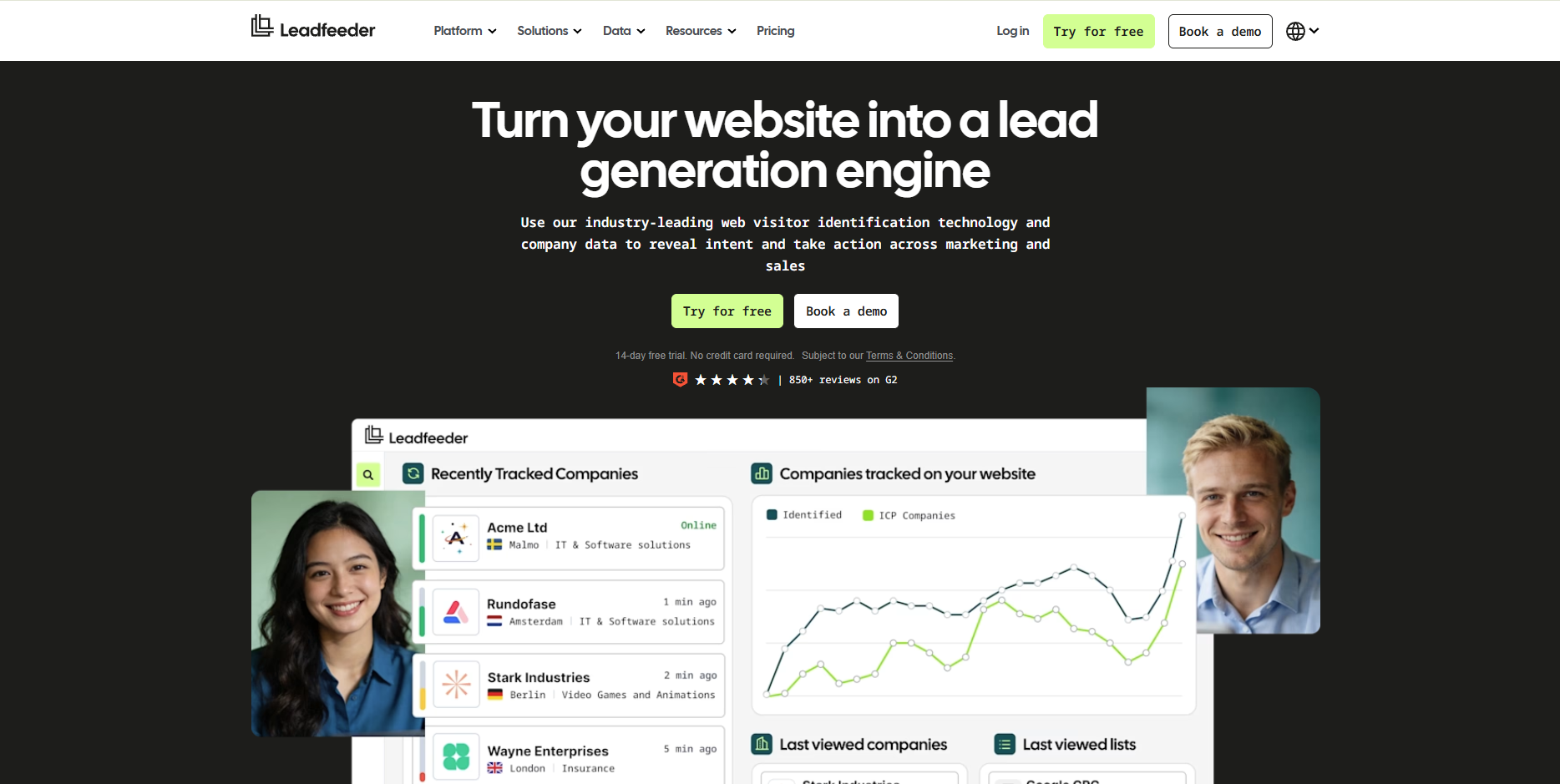
Pricing (checked 17 September 2026): Lite is €0/month, always free — up to 100 identified companies a month, the last 7 days of visitor history, unlimited users. Paid plans are quoted per month billed annually, with annual billing saving 30%: Discover €79/mo, Activate €369/mo (verified emails and phone numbers, B2B display campaigns, CRM automations), Scale €599/mo (annual billing only). Enterprise is "Talk to us." Every paid plan opens with a 14-day full-feature trial.
One correction worth making, because nearly every other listicle has it backwards: Leadfeeder was folded into Dealfront in 2022, and the received wisdom since has been "Leadfeeder is now Dealfront." As of this check, dealfront.com/pricing 301-redirects to leadfeeder.com/pricing, and the site itself says "Dealfront is now Leadfeeder." The legal entity remains Dealfront Group GmbH. The brand went back.
The free Lite tier is the reason to start here rather than with Albacross: you can find out whether reverse-IP identification works on your traffic before paying anything. For a lot of sites the honest answer is that it does not — if your visitors are consumers, or arrive mostly on mobile, you will see ISP names and very little you can sell to.
- ✅ A permanent free tier lets you validate the whole category before spending
- ✅ Unlimited users and unlimited tracked domains
- ⚠️ 7 days of history on Lite is too short to run a real sales cadence
- ⚠️ The €79 → €369 jump is where the actual contact data lives
5. Albacross — European focus, no free tier
Pricing (checked 17 September 2026), billed yearly: Starter €59/mo — 0–50 identified companies a month, 10 verified email credits, 5 verified phone credits. Professional €149/mo — 0–250 identified companies a month, 25 email and 10 phone credits. Organisation is "Talk to Us," billed yearly, banded from 501 up to 5,000+ companies. Monthly billing is available at a higher rate. There is a 14-day free trial, no card needed, and no ongoing free tier. Add-on credits run roughly €0.11–€0.80 per verified email and €0.37–€0.57 per verified phone number.
Albacross is the cheaper entry point than Leadfeeder on paper (€59 against €79), but read the caps before you compare headline prices: 50 identified companies a month on Starter is a pilot allowance, and 10 verified emails will not sustain outbound on their own. Its real strength is European company data, historically denser than US-centric rivals.
- ✅ Lowest paid entry price in the category
- ✅ Strong European coverage
- ⚠️ No free tier — you cannot validate fit without a trial clock running
- ⚠️ 50 companies a month on Starter is a trial-sized allowance, not a working one
 ---
---
Category 3 — Live visitors, and doing something about them
This is where the category stops being analytics. These tools show who is on the site right now and put a conversation in front of them. The difference between the two entries below is what does the talking.
6. Tidio — the strongest human live-chat product here
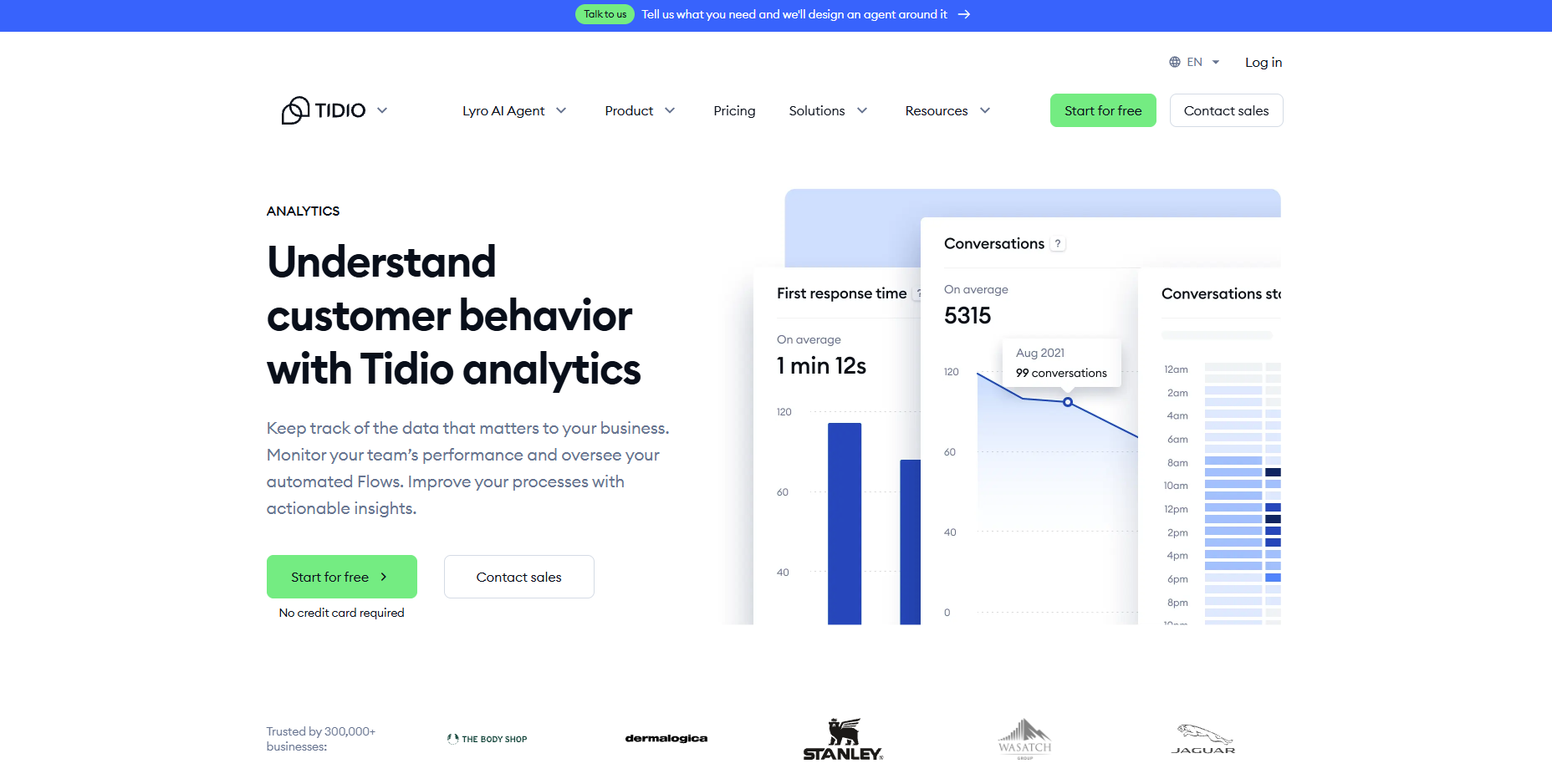
Pricing (checked 17 September 2026), billed annually: Free $0 — 50 billable conversations, 50 one-off Lyro AI conversations, 100 Flows visitors. Starter $24.17/mo — 100 billable conversations, and the tier where the live visitors list appears. Growth from $49.17/mo — from 250 billable conversations, plus advanced analytics and viewed pages history. Plus from $300/mo plus usage. Premium is contact-only, from 3,000 Lyro conversations, with a guaranteed 50% Lyro AI resolution rate and pay-per-resolution billing. Annual billing gives 2 months free, so monthly billing runs higher. Add-ons: Lyro AI Agent from $32.50/mo (from 50 Lyro conversations), Flows from $24.17/mo (from 2,000 visitors reached).
Where Tidio is genuinely better than us, and you should buy it instead:
- Live chat is the product, not a feature. Tidio has spent years on the operator experience — canned responses, transfers, chat assignment, the mobile apps, the Shopify app ecosystem. If your workflow is humans-first with AI as backup, that maturity is worth paying for and we do not match it.
- Flows is a real visual builder. If you want to draw a branching automation node by node rather than describe a goal to an agent, Flows is the better tool.
- A contractual resolution rate. The guaranteed 50% Lyro resolution rate on Premium, with pay-per-resolution billing, is a commitment most vendors — including us — do not put in writing.
- It bolts onto a help desk you already own. Lyro is sold as a standalone agent for Zendesk, Salesforce and others. If you are not replacing your help desk, that is the cleaner path.
Two things to hold in mind when budgeting. First, a billable conversation is one a human agent answered or started — unanswered visitor messages do not count, which is genuinely fair and rarer than it should be. Second, the AI is a separate meter: Lyro is an add-on from $32.50/mo on top of the plan, so a Starter plan doing real AI work is not $24.17, it is nearer $57 before volume.
The visitor tracking itself is a live-visitor list attached to a chat product, with page history held back for Growth. It is useful. It is not why anyone buys Tidio.
 ### 7. Aivastark Visitor Lens — analytics wired to an agent
Pricing (checked 17 September 2026): Free $0 (300 credits/month, 1 website — no Visitor Lens). Solo $12/mo ($108/year, 1,000 credits). Starter $39/mo ($348/year, 5,000 credits, 2 websites, 3 seats) — Visitor Lens starts here. Growth $129/mo ($1,188/year, 25,000 credits, 5 websites, 5 seats). Scale $319/mo ($2,988/year, 75,000 credits, 15 websites, 10 seats). Enterprise is sales-led. Overage runs $4.00, $3.00, $2.00 and $1.20 per 1,000 credits as you move up, and a paid plan never stops answering when it hits its allowance — the excess is billed rather than blocked.
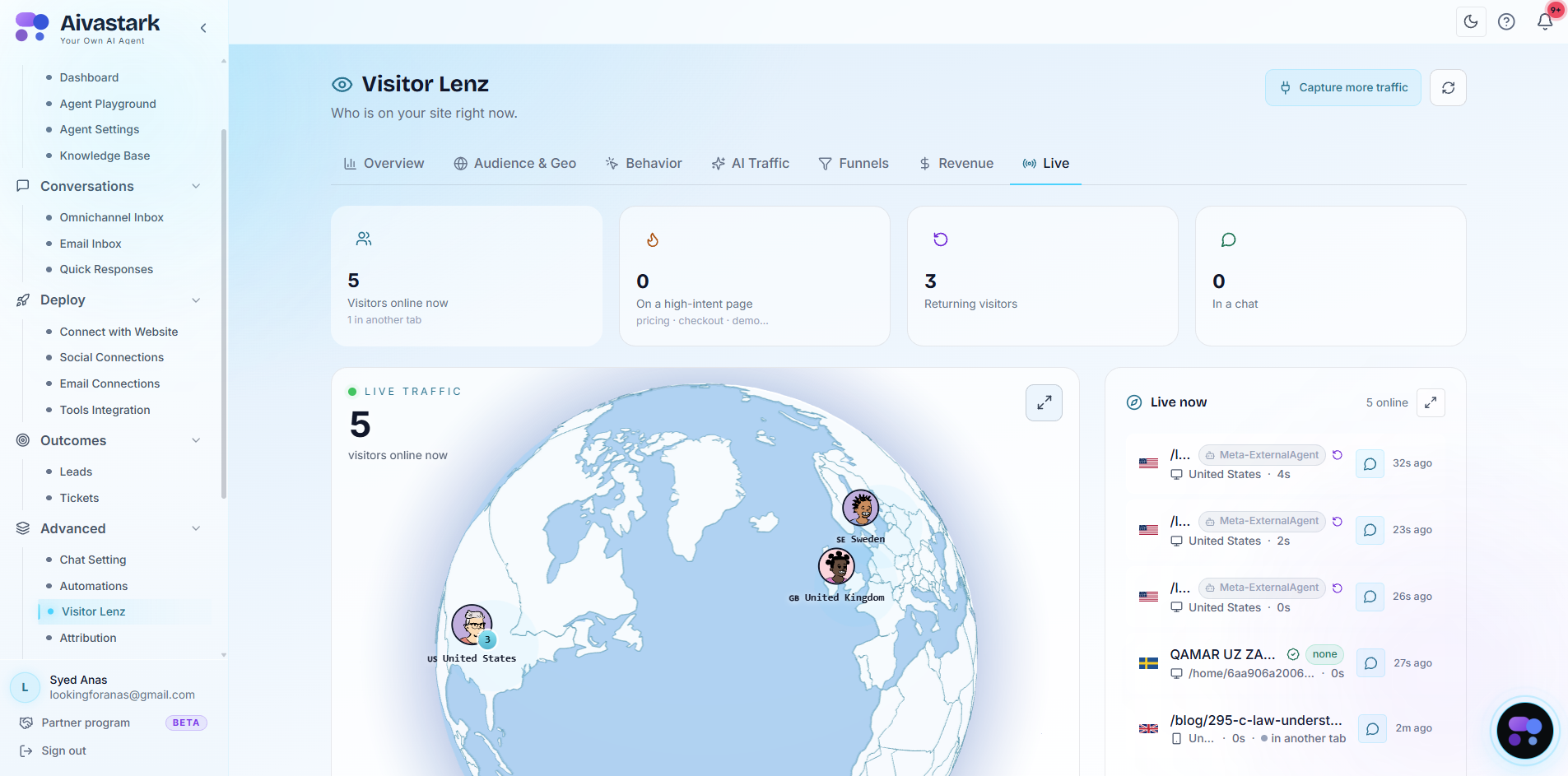
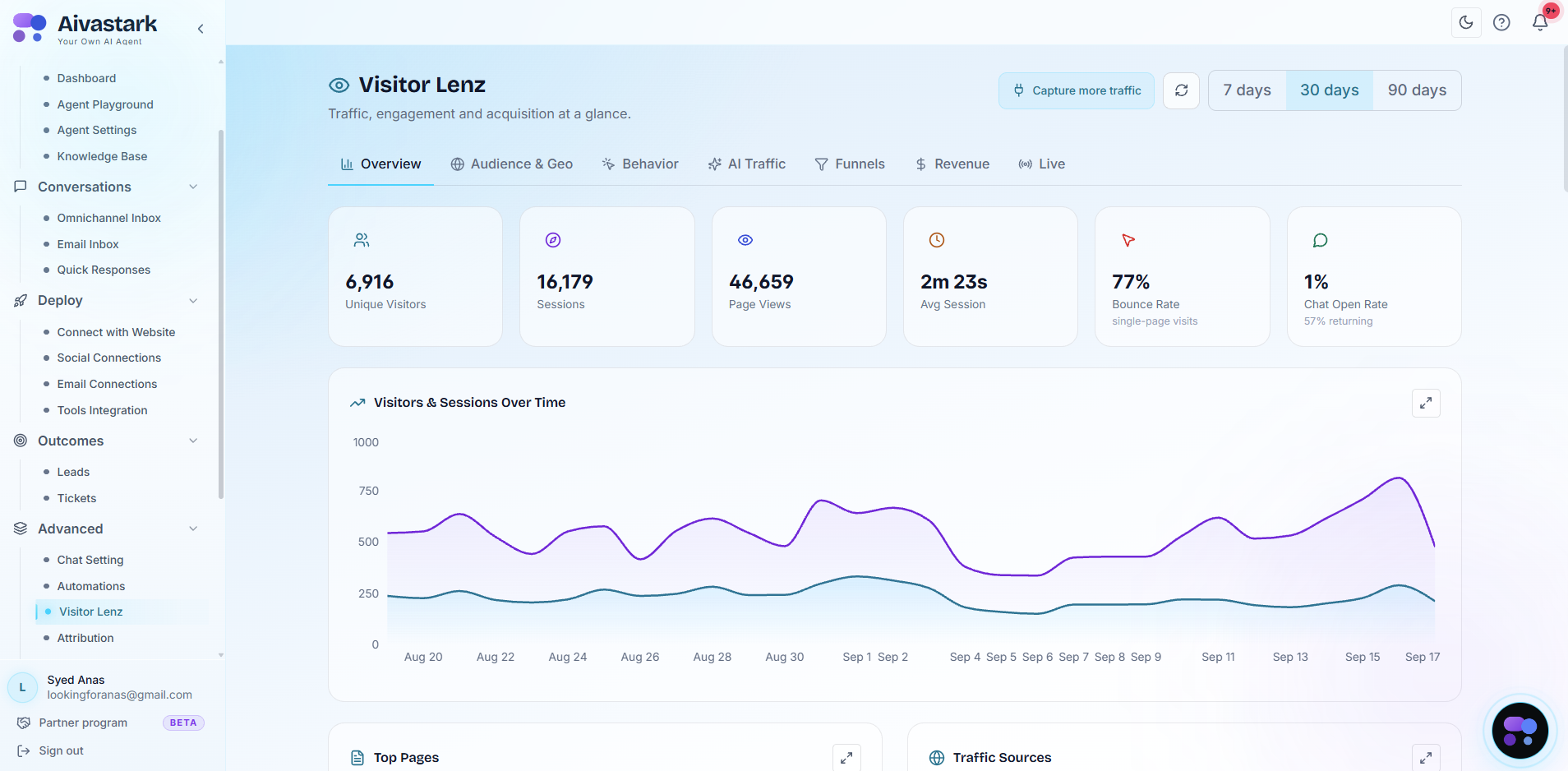
Visitor Lens is cookieless, server-side visitor analytics: an Overview of traffic and acquisition, Audience & Geo, Behavior, Funnels, a Live view of who is on the site at this second, and AI Traffic — which AI assistants and answer engines are sending you people and reading your site. Revenue and marketing attribution sit on the Scale tier.
Be clear about what it is not. Visitor Lens does not record sessions and does not draw heatmaps — if you need to watch someone rage-click a broken button, run Microsoft Clarity next to it, free. It does not do reverse-IP company identification either — if you need firmographics on anonymous B2B traffic, that is Leadfeeder's job, not ours. This is a deliberately narrower analytics product than Contentsquare and it does not pretend otherwise.
What it has that nothing else on this list has is the second half of the sentence.
 ---
---
The thing every tool on this list stops short of
Every product above ends in the same place: a dashboard, and a human who has to read it.
Clarity will show you, tomorrow, that eleven people abandoned your pricing page after ninety seconds. Leadfeeder will email you that a logistics company in Rotterdam visited twice. Lucky Orange will let you watch the recording. All of that is true, useful, and retrospective. The visitor has already gone. Whatever they were about to ask, they asked a competitor instead.
A visitor signal only pays for itself if something happens while the visitor is still on the page. That is the difference between analytics and an agent, and it is why Visitor Lens is not sold as a standalone analytics product.
The signals Visitor Lens reads — time on site, time on page, pages viewed, scroll depth, exit intent — are wired to engagement rules that decide when the agent speaks, and to an audience layer that decides who it speaks to: returning visitors, a particular UTM campaign, a specific referrer, a page pattern. When a rule fires, an AI sales agent opens with something relevant to the page the visitor is actually on.
From there it does the work a dashboard cannot:
- Answers the question that decides the sale — pricing, availability, what is included, whether you serve their region — from your own content, citing what it drew on.
- Asks for the contact when the conversation earns it, on buying-intent keywords or demo intent, not on a timer that fires the second someone lands.
- Qualifies before it hands over, asking the questions you define and routing only the leads worth a human — with the whole thread attached.
- Follows the visitor across channels, because the same agent and the same knowledge base answer on Instagram, Messenger and WhatsApp into one inbox.
That is a different product from a heatmap, and the comparison that matters is not feature-for-feature. It is this: when your best-fit visitor is four minutes into your pricing page, does your software watch them leave, or talk to them?
So which one should you buy?
- You want to see what breaks on your pages: Microsoft Clarity. Free, unlimited, and nothing here beats it at that job. Favourite anything you will want in more than 30 days.
- You want recordings without feature gates: Lucky Orange, from $32/mo paid annually. Check the session allowance against your real traffic first — 3,500 goes quickly.
- You were about to buy Hotjar: you cannot. Take Contentsquare's free plan; 200,000 sessions a month is more than most sites will use. Only pay the $39 for Experience Analytics Growth if you need more than one month of data access.
- You sell B2B and need company names: start on Leadfeeder Lite, free, and find out whether reverse-IP works on your traffic before anyone signs anything. If it does, compare Discover (€79/mo) against Albacross Starter (€59/mo) on identification caps rather than headline price.
- You want humans on live chat: Tidio, from $24.17/mo. Budget the Lyro add-on separately, and check whether a standalone Lyro on your existing help desk is the cheaper shape.
- You want the visitor signal to produce a conversation rather than a report: Visitor Lens on Starter, $39/mo, with the AI sales agent attached. Pair it with Clarity if you also want recordings — together they cost $39.
Most teams end up with two tools, not one, and that is the correct answer. The mistake is buying two tools from the same category and then wondering why neither of them told you who the visitor was.
Every price in this article was read off the vendor's own public pricing page on 17 September 2026 and is quoted in the currency that vendor publishes. Vendors change prices without notice; the linked sources are the authority.